On this page
On the evening of 6 May 1937, the German airship Hindenburg burst into flames as it came in to land at Lakehurst, New Jersey. According to Airships.net's detailed history of the disaster, the first visible flames appeared at 7:25 pm and the ship was destroyed in 32 seconds. Of the 97 people on board, 62 survived. The dead were 35 people on the airship and one man from the ground crew, the same 36 deaths that History.com lists. Three things came together that night: a gas that burns easily, a leak and a spark.
Why did the Hindenburg catch fire?
The Hindenburg floated on hydrogen, about 7 million cubic feet of it, according to History.com. It is the lightest gas, and it burns easily.
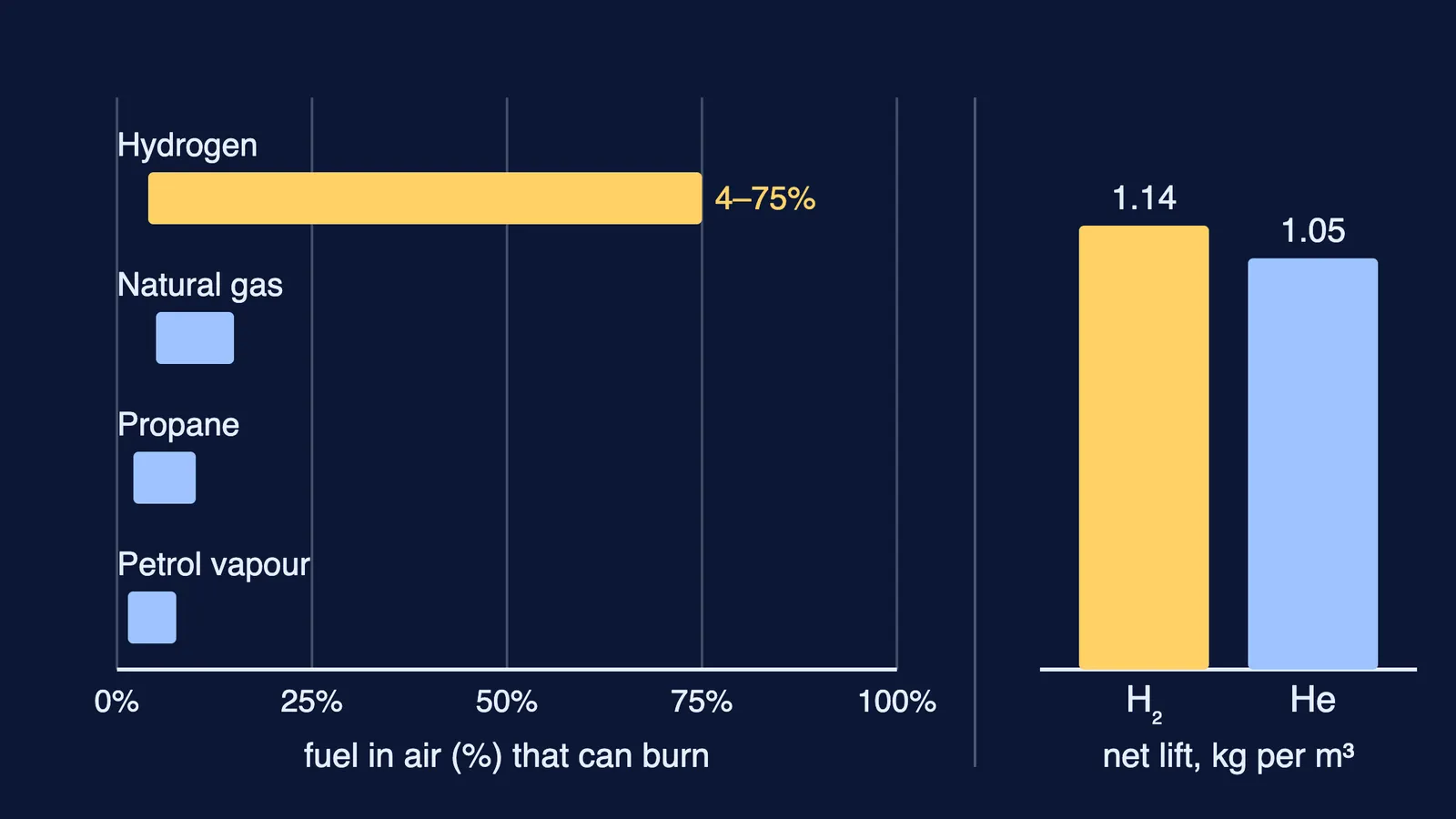
Hydrogen can burn in air at any concentration between 4% and 75%, according to the AIChE Center for Hydrogen Safety. Natural gas, by comparison, burns only between 5% and 15%.
The same AIChE sheet puts hydrogen's ignition energy at about 0.02 millijoules at the best mixture, against 0.24 mJ for petrol vapour and 0.29 mJ for natural gas. In its words, "a small spark will ignite it".
What is the static spark theory?
Airships.net's verdict is direct: "It seems clear that the Hindenburg disaster was caused by an electrostatic discharge (i.e., a spark) that ignited leaking hydrogen." Its account builds the case in steps:
It had been a rainy day, and the ship was landing in an electrically charged atmosphere.
At 7:21 pm, with the ship about 180 feet above the ground, the forward landing ropes were dropped, and the landing line grounded the ship's metal framework.
That left a difference in electric potential between the airship and the air, and a spark most likely jumped from the fabric covering to the framework.
The ship had suffered a significant leak of hydrogen before the disaster, so fuel was waiting.
The same history says no evidence of sabotage was ever found, and that suggestions about the flammability of the outer covering have been "repeatedly debunked".
Firefighters use the same triangle, as our class-by-class guide to fire extinguishers and the fire triangle explains.
Why didn't the Hindenburg use helium?
Helium is also much lighter than air, and it does not burn at all. History.com reports that the Hindenburg's designer, Hugo Eckener, sought to use helium, and that the ship was re-engineered after the US banned helium exports. The US, it says, "had a monopoly on the world's supply of helium and feared that other countries might use the gas for military purposes".
JSTOR Daily dates the export ban to 1925. After the disaster, it adds, Secretary of the Interior Harold Ickes, worried about German military aggression, obstructed helium exports.
Helium also costs lift. According to Airships.net's comparison of the two gases, pure helium gives about 93% of hydrogen's lift, and about 88% in real operation. Helium is also scarce and expensive, and in actual use it can reduce an airship's payload "by almost half".
How much lift does hydrogen give? A worked example
You can check that 93% figure with Class 9 buoyancy: lift = (density of air minus density of gas) times volume times g. At the same temperature and pressure, a gas's density is proportional to its molar mass. Take air as about 29 g/mol, hydrogen (H2) as 2 and helium as 4.
Hydrogen's lift per cubic metre is proportional to 29 minus 2, which is 27.
Helium's is proportional to 29 minus 4, which is 25.
25 divided by 27 is about 0.93, so helium gives about 93% of hydrogen's lift. That matches Airships.net.
Now scale it up. Airships.net says designers conservatively estimated lift at 68 lb per 1,000 cubic feet for hydrogen and 60 lb for helium. For the Hindenburg's 7 million cubic feet (History.com), that is 476,000 lb against 420,000 lb.
The gap is 56,000 lb, about 25 tonnes. The structure weighs the same whichever gas fills it, so all of that comes out of passengers, cargo and fuel.
The same displaced-air reasoning explains how a hot air balloon rises with PV = nRT. If buoyancy problems trip you up, the Fermi Problem Library has worked problems with a step-by-step solver that explains the reasoning rather than printing an answer.
Why did the Hindenburg end the airship age?
After the disaster, JSTOR Daily writes, Germany shifted to a war footing and dismantled its airship industry in favour of building warplanes. Hope for passenger airships faded while fast plane travel flourished.
Static charge can be useful too. It places toner on paper, as our explainer on how a photocopier uses static charge shows. If potential difference is hard to picture, the Fermi Simulation Lab has interactive simulations for ideas that are easier to see than to read.
Next time you see a party balloon, ask the Hindenburg question: what is inside, what does it lift, and what would make it burn?