

On this page
That photocopy of your admit card or a friend's notes was printed with static electricity. A charged drum, light and a dusting of powder do the job, and the idea was first tested in a small lab in New York in 1938.
How does a photocopier work, step by step?
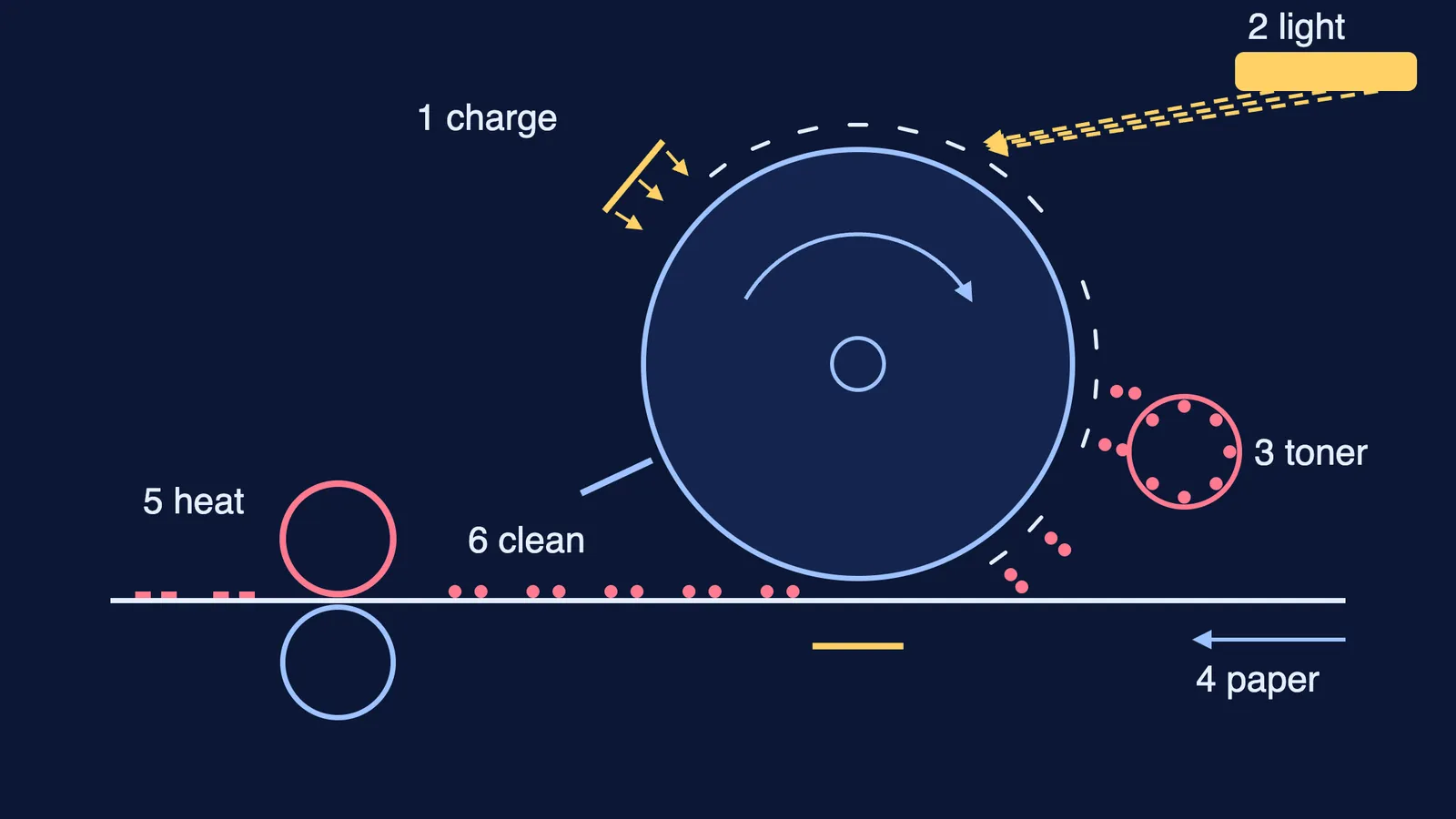
The process is called xerography, from the Greek words for "dry" and "writing", because it uses no liquid chemicals (Wikipedia: Xerography). Inside the machine is a drum coated with a photoconductor. One full cycle has six main steps:
Charge. A thin wire at high voltage ionises the air next to the drum (a corona discharge) and leaves a uniform charge on its surface, about −600 volts in one common design (Wikipedia).
Expose. A lamp lights up your page and the reflected light falls on the drum. The white parts of the page reflect light, so the charge drains away there. The black letters do not, so the charge stays in their shape, an invisible pattern called the latent image.
Develop. Toner, a fine powder that began as carbon and was later melt-mixed with a polymer, carries the opposite charge, so it clings only to the charged areas.
Transfer. Paper rolls past the drum, and electrostatic attraction plus pressure pull the toner across onto it.
Fuse. Heated rollers melt the toner and press it into the paper. That is why a fresh copy feels warm; see why photocopies come out warm.
Clean. A blade or brush removes leftover toner and light wipes the remaining charge, so the drum is ready for the next page.
What did Chester Carlson do in 1938?
Chester Carlson worked for an electronics firm, P. R. Mallory and Co., studied law at night and became manager of the company's patent department, according to the American Physical Society's history of xerography. On 22 October 1938, in a small lab in Astoria, Queens, he and his assistant Otto Kornei made the first xerographic copy. As APS describes it:
Kornei wrote "10-22-38 Astoria" in India ink on a glass microscope slide.
They coated a zinc plate with sulfur, darkened the room and rubbed the plate vigorously with a handkerchief to charge it.
They laid the slide on the plate and put both under a bright incandescent lamp for a few seconds.
They sprinkled lycopodium powder on the plate and blew it off. What stayed was a near-perfect powder copy of the words on the slide.
They pressed wax paper onto the powder image and heated it to melt the wax.
That is nearly every step of a modern copier, done by hand: charge, expose, develop, transfer and fix. Carlson's patent US 2,297,691, titled "Electrophotography", was filed on 4 April 1939 and granted on 6 October 1942 (Google Patents). Selling it was harder: APS says more than 20 companies turned him down. The Xerox 914 office copier stayed in production from 1959 to 1976 (The Henry Ford).
Why does light wipe away the charge?
Carlson's patent describes the materials he needed as "insulators in the dark but which become partial conductors when illuminated", and calls sulfur "one of the best insulators known" (US 2,297,691). In the dark, the charge sits still on the surface. Where light lands, the coating conducts, and the charge leaks away to the metal underneath.
How much energy does each photon bring?
The same patent gives sulfur's maximum sensitivity at about 4700 ångströms, which is 470 nm, in what it calls the blue-violet part of the spectrum (US 2,297,691). Using E = hc/λ:
E = (6.626 × 10⁻³⁴ J s × 3.00 × 10⁸ m/s) ÷ (470 × 10⁻⁹ m) = 4.23 × 10⁻¹⁹ J
Divide by 1.602 × 10⁻¹⁹ J per eV: E ≈ 2.64 eV
For red light at 700 nm, the same sum gives about 1.77 eV, a third less per photon.
Each photon's energy depends on its wavelength, not on how bright the lamp is, the same idea behind why brighter light doesn't give faster photoelectrons. A brighter lamp sends more photons each second, so the charge drains sooner.
If charges and fields are hard to picture, the Fermi Simulation Lab has interactive simulations for ideas that are easier to see than to read.
How can you explain xerography in an exam answer?
Here is a five-line answer you can adapt:
A photoconductive drum is given a uniform charge by a corona discharge.
Light reflected from the document falls on the drum; the lit areas conduct and lose their charge, leaving a latent image of the dark parts.
Oppositely charged toner is attracted only to the charged image.
The toner is transferred to paper by electrostatic attraction and fixed by heat and pressure.
The drum is cleaned and discharged for the next copy.
Then check yourself: for each line, name the idea from your syllabus it uses. Lines 3 and 4 rest on the attraction of unlike charges; for charge moved without contact, see John Canton's 1753 test of charging by induction. Line 2 rests on light delivering energy in photons, as in the worked example above.
To build up from charges to fields to devices like this one, Fermi's AI tutor works out what you already know and builds a plan for the session.


