

On this page
A fresh photocopy feels warm, like a shirt just off the iron. That is not a fault. It is the last step of a process built on two ideas from your textbooks: static electricity puts the powder in place, and heat melts it there for good.
Why do photocopies come out warm?
A photocopier does not use liquid ink. It uses toner, a fine powder made mostly of plastic resin. One Xerox toner patent describes toner particles about 3 to 25 micrometres across, made from polyester and similar resins (US8211607, Xerox).
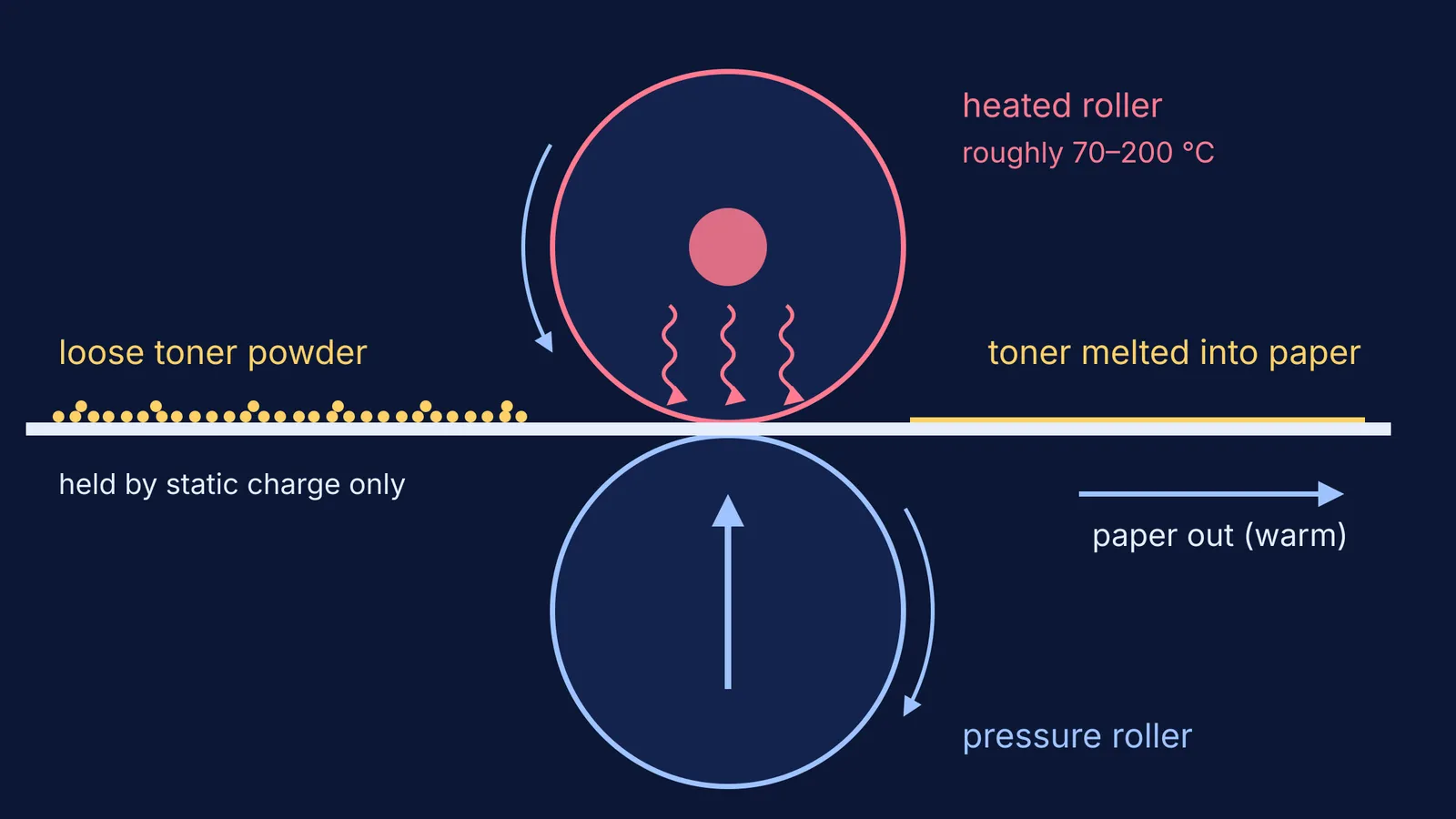
Before the page leaves the machine, it passes between two rollers called the fuser. One roller is heated; the other presses the paper against it. The same Xerox patent says the fuser may be heated to about 70 °C to 160 °C, above the fusing temperature of the toner (US8211607). An older fuser patent puts the roller surface at "typically on the order of 300 to 400 F", which is about 150 °C to 200 °C, and says the roller "softens or melts the toner particles and presses them against the supporting sheet" (US3884623).
The paper is pressed in that gap only briefly, so it comes out warm rather than hot.
How does static electricity put the toner in place?
The Henry Ford museum's history of the Xerox copy sums it up: "Black dry toner is attracted to the statically charged areas, transferred to paper, and fused into place by heat" (The Henry Ford).
A drum coated with a photoconductor is given an even electric charge in the dark.
Light reflected from your original falls on the drum. Where light lands (the white parts of the page), the coating conducts and the charge leaks away. Where the page is dark, the charge stays.
Charged toner powder is brought up to the drum. It clings only to the charged areas, so the drum now carries a powder copy of your page.
The powder image is transferred from the drum onto the paper.
The fuser melts the powder into the paper.
Step 2 needs a material that insulates in the dark and conducts in light. The ASME landmark record for xerography notes that "one form of pure selenium was a particularly good photoconductive insulator", and that the powder "became a pigmented resin that could be fused to the paper" (ETHW, ASME Landmark: Xerography).
The idea came from Chester Carlson. His first xerographic copy, made with his assistant Otto Kornei on 22 October 1938 in a rented room in Astoria, Queens, read "10.-22.-38 Astoria"; the Xerox 914 office copier followed in 1959 (The Henry Ford). The charge is the same kind people have made by rubbing since Otto von Guericke's sulphur globe. If the difference between charging by touch and charging at a distance is fuzzy, read our explainer on charging by conduction vs induction.
Charge you cannot see is hard to picture from a textbook figure. The Fermi Simulation Lab has interactive simulations for ideas that are easier to see than to read.
Why can't the copier skip the heat?
Until the fuser runs, the image is just powder held on by electric attraction, and a finger could wipe it off. Heat turns it into a thin layer of plastic stuck into the paper fibres.
Amorphous plastics, such as the amorphous polyester resins in the Xerox patent, do not melt at one sharp temperature the way ice does. They soften over a range, starting near their glass transition temperature, where a hard, glassy solid turns rubbery. The Xerox patent gives its amorphous toner resins a glass transition temperature of about 30 °C to 80 °C (US8211607). The fuser runs above that, so the resin softens, the pressure roller pushes it into the paper, and it sets again as the page cools.
Compare this with the sharp melting of a crystal in the particle model of melting and boiling. If glass transition is new to you, the Fermi Concept Library gives each concept its own lesson and its place in the map.
Worked example: trace one copy through your syllabus
Match each stage to a topic you study:
Charging the drum: electrostatics, like charges repel and unlike charges attract.
Light clearing the white areas: photoconductivity, where light lets charges move in a material that is otherwise an insulator.
Toner sticking to the dark areas: attraction between opposite charges.
Toner jumping to the paper: a stronger pull from the paper side wins.
Fusing: heat transfer by conduction, plus softening of a polymer above its glass transition.
Warm paper in your hand: conduction from roller to paper, then cooling to the room.
At the copy shop, rub the corner of a fresh copy: the toner does not smudge, because it has already set. Leave the sheet on the counter and it soon cools to room temperature.


