On this page
Around 1663, Otto von Guericke, the mayor of the German city of Magdeburg, built a ball of sulphur, mounted it on an axle and rubbed it with his hand. Light objects were pulled towards it, and some were then pushed away. Today we call that static electricity, and his globe is often listed as the first machine for making it. It is also a neat way to understand what your textbook calls charging by friction.
Who was Otto von Guericke?
Guericke was born on 30 November 1602, died on 21 May 1686, and served as Magdeburg's burgomaster (mayor) from 1646 until 1678, according to his Wikipedia biography. He described both the pump and the sulphur globe in one book, Experimenta Nova (ut vocantur) Magdeburgica de Vacuo Spatio, published in 1672 but essentially finished by March 1663, the same source says.
How did Guericke make the sulphur ball?
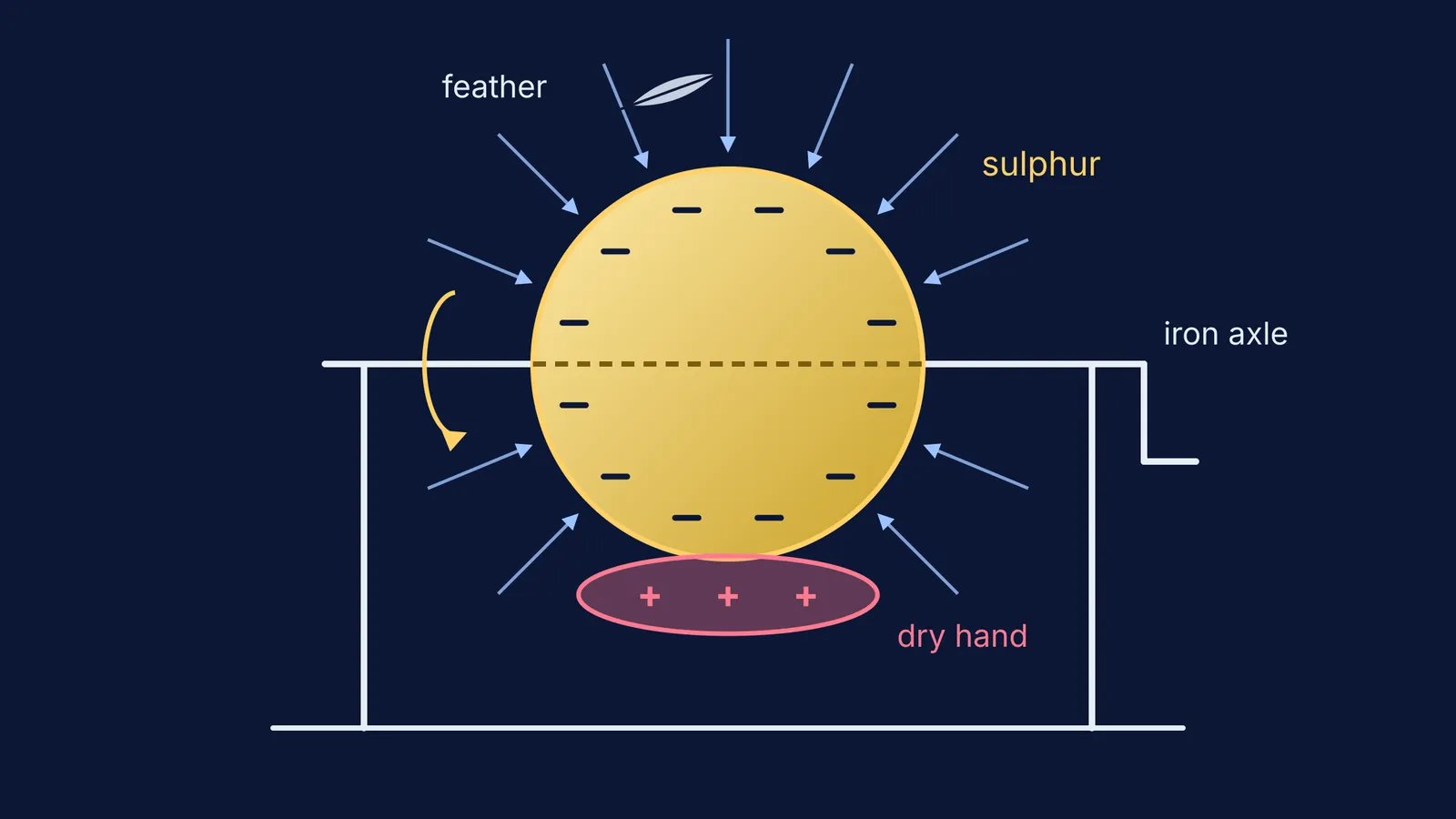
The US National High Magnetic Field Laboratory's history page on the sulfur globe gives the recipe. He ground sulphur to a powder, melted it inside a hollow glass ball, let it cool and then broke the glass away. He bored through the sulphur sphere and fixed it on an iron rod, which served as an axle on a wooden stand with drawers for feathers, paper and other test materials. A handle let the globe be turned quickly.
To charge it, he rubbed its surface with his hand or a pad. The MagLab page lists what he saw: attraction, repulsion, sparks visible in the dark and crackling sounds. It also notes that he sometimes saw the globe glow as it turned, and that no one had reported this effect, now called electroluminescence, before him.
Why does rubbing sulphur make static charge?
Rubbing two different materials together moves electrons from one to the other. The one that gains electrons ends up negative; the one that loses them ends up positive. Lists called triboelectric series rank materials by this tendency. In the lists in the University of Iowa's physics demonstration notes, sulphur sits in the half that gains electrons, while human hands and dry skin sit at or near the top of the half that loses them. So a dry hand on a sulphur ball is a good pairing: the ball picks up negative charge. Our explainer on predicting which material gets negative in the triboelectric series works through more pairs.
The repulsion Guericke saw follows from the same idea. A neutral feather is first pulled towards the charged ball, because charges inside it shift so the near side is attracted more strongly than the far side is pushed. When it touches the ball, some charge moves onto the feather. Now feather and ball carry the same sign, so the feather is pushed away. In the 1730s, as the history of the triboelectric effect records, Charles du Fay sorted effects like these into two kinds of charge; read how du Fay found the two kinds of electric charge.
Was Guericke's globe really the first electrostatic generator?
Wikipedia's history of electrostatic generators calls it a primitive form of frictional machine invented around 1663, but adds that it may not actually have been rotated during use, and that it was not intended to produce electricity at all, but rather "cosmic virtues". His biography notes arguments that he never saw them as electrical. The historian N. H. de V. Heathcote gave the device a whole paper, Guericke's sulphur globe, in Annals of Science in 1950.
Its influence is easier to trace. The same Wikipedia history says that in about 1706 Francis Hauksbee built a machine that spun a glass sphere rapidly against a woollen cloth, and that Guericke's globe inspired many later machines with rotating globes. See how Hauksbee's glowing glass globe worked.
How can you repeat Guericke's experiment at home?
You do not need sulphur, and you should not try melting it at home. A plastic comb or a balloon and your own dry hair do the same job. Try this:
Predict first: write down what will happen when a rubbed comb comes near small bits of tissue paper. Then try it. You should see attraction, like Guericke's light objects.
Watch closely: some bits stick and then jump off. Explain it with the two-step story above.
In a dark room, rub a balloon on a woollen sweater. Listen for crackles and look for tiny sparks when you bring a finger close.
For each test, write one line: which material became negative, and how you know.
If the step where charges shift inside a neutral object is hard to picture, the Fermi Simulation Lab has interactive simulations for ideas that are easier to see than to read. For the theory, the Fermi Concept Library gives every concept in physics its own lesson and its place in the map, so you can see how charging by friction connects to induction and Coulomb's law.
The next time a balloon sticks to a wall, you are repeating something first seen in Magdeburg more than three centuries ago.