

On this page
What happens when you rub a balloon on your head and stick it to a wall? The secret lies in the atoms on the surfaces of the two materials. When they touch, one material inevitably pulls harder on the electrons than the other. This everyday phenomenon of contact electrification is the foundation of static electricity.
What is the triboelectric series?
For decades, the triboelectric series was a qualitative list ranking materials by their tendency to gain or lose electrons. Students and engineers used it to estimate which way charge would flow when two surfaces rubbed together, but the lack of standardized numerical values made it difficult to predict the exact strength of the resulting electric fields.
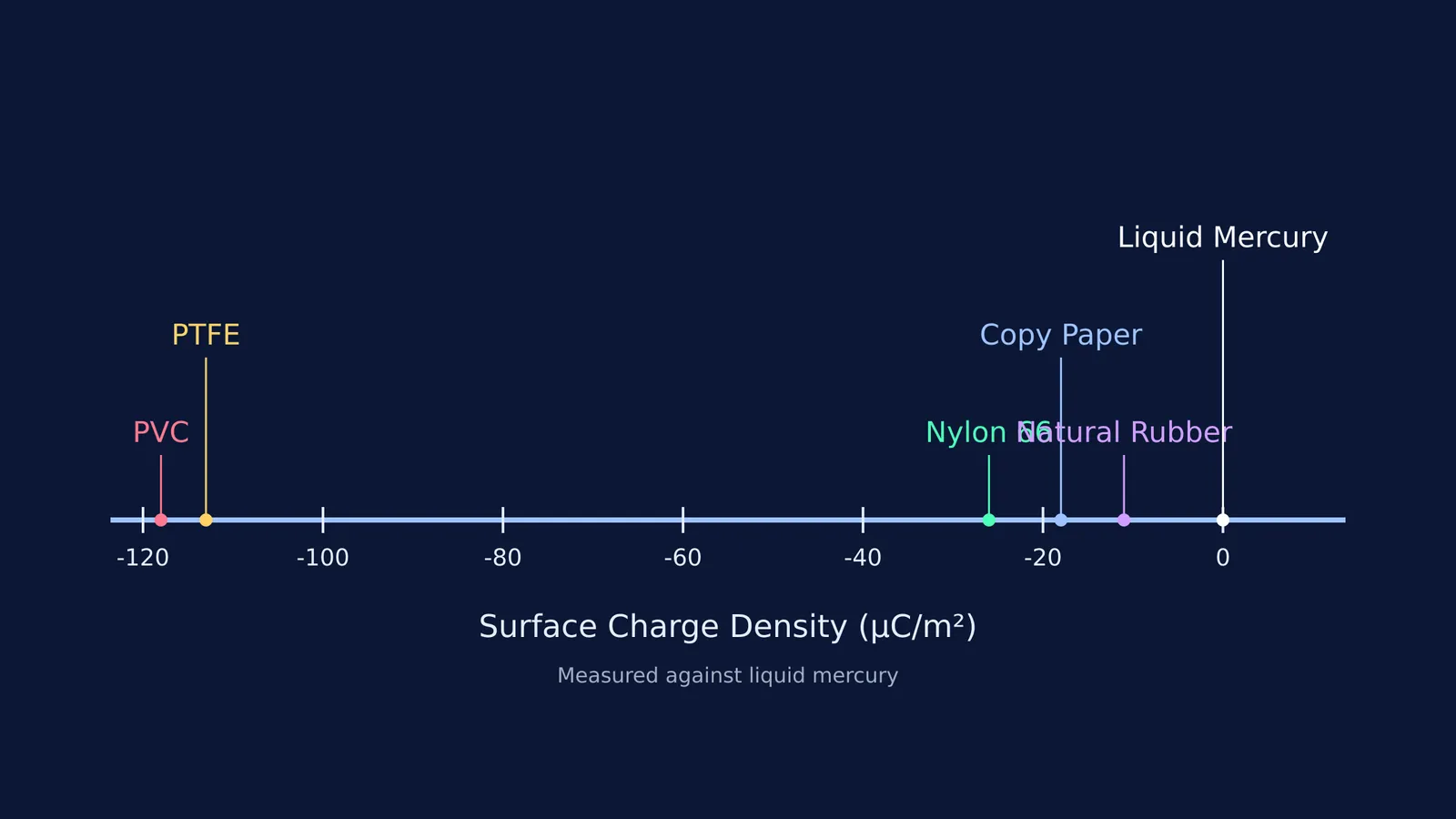
In 2019, researchers quantified the series by measuring the surface charge density generated when materials contact liquid mercury (Nature). Their standardized measurements, recorded in microCoulombs per square meter (μC/m²), reveal where common materials sit relative to mercury:
PVC (Clear polyvinyl chloride): -118 μC/m² (strongly negative)
Teflon (PTFE): -113 μC/m²
Nylon 66: -26 μC/m²
Copy paper: -18 μC/m²
Natural rubber: -11 μC/m²
The rule is simple: when two materials are rubbed together, the one lower on the list (more negative) will tear electrons away from the one higher on the list. Because electrons carry a negative charge, the material that gains them becomes negatively charged.
How did scientists quantify the series?
Historically, measuring triboelectric charge was difficult because of the unpredictable contact between two rough solid surfaces. Microscopic peaks and valleys mean that two flat solids only ever touch at a few points, leading to inconsistent charge transfer that depends heavily on the pressure applied.
To solve this, the researchers used liquid mercury. As a liquid metal, it adapts to the microscopic surface texture of any solid polymer, ensuring maximum contact area without needing extreme pressure. By repeatedly dipping materials into the mercury inside a controlled nitrogen environment, they were able to measure the exact charge density each material developed. This revealed that fluoropolymers like Teflon and PVC are among the most strongly negative materials available.
Which material gets negative in the triboelectric series?
You can use the series to predict the outcome of any static electricity demonstration by comparing the values of the two materials. The material with the more negative value will always pull electrons from the other.
Example 1: A rubber balloon and human hair Human hair sits near the very top of the positive end of traditional qualitative series, while natural rubber was measured at -11 μC/m² (as shown in the Nature study). When you rub a balloon on your hair, the rubber pulls electrons away from the hair strands. The balloon gains a net negative charge. Your hair, having lost electrons, is left with a net positive charge. Because all your hair strands now have the same positive charge, they repel each other and stand on end.
Example 2: A plastic rod and wool If you rub a piece of wool against a PVC plastic rod, the same rule applies. Wool is on the positive side of traditional qualitative series, and PVC is highly negative at -118 μC/m² according to the Nature measurements. The plastic rod strips electrons from the wool, leaving the plastic negatively charged and the wool positively charged.
Why do certain materials become negative?
The position of a material on the triboelectric series depends on its chemical structure. Materials that become highly negative typically contain atoms with a very high electron affinity. For example, Teflon (PTFE) is packed with fluorine atoms, while PVC contains chlorine atoms. Both fluorine and chlorine are highly electronegative halogens that hold tightly to their own electrons and readily pull electrons from other surfaces they contact.
Conversely, materials that easily lose electrons to become positive often have looser molecular structures that readily surrender their outer electrons when exposed to the strong pull of a material like PVC.
How do you predict the charge?
If you are asked to predict the charge of an object in a physics problem, use this three-step framework:
Identify the two materials making contact.
Locate both materials on the triboelectric series.
Assign the charges: the material lower down the list gains electrons to become negative (-), while the material higher up loses electrons to become positive (+).
Once a material is charged, it creates an electric field in the space around it. This is why the negatively charged balloon can stick to a neutral wall: its electric field pushes the wall's electrons away, creating a localized positive patch that attracts the balloon.
Visualising electric fields accurately without making sign errors is a common source of electrostatics mistakes for students. If you struggle to picture how fields interact, the Fermi Simulation Lab provides interactive simulations for the ideas that are easier to see than to read.
Fermi's AI tutor works out what you already know, builds a plan for the session, and teaches through it—drawing the figure and running the simulation to help you build intuition before you memorise formulas.


