On this page
Around 1705 Francis Hauksbee, an instrument maker who ran the experiments at Royal Society meetings, made friction produce light. He spun a glass globe with the air pumped out, pressed his hands against it, and the globe glowed.
What did Francis Hauksbee do with the glass globe?
The Royal Society employed Hauksbee to put on experiments at its weekly meetings, a practice Isaac Newton revived as president in 1703, says the Linda Hall Library. His starting point was a strange effect called “barometric light”: shake a barometer and the mercury sliding over the glass in the empty space at the top glows. The National MagLab's history of his machine says Jean Picard first noticed this, and that Hauksbee reproduced the glow in a bell jar he had pumped out.
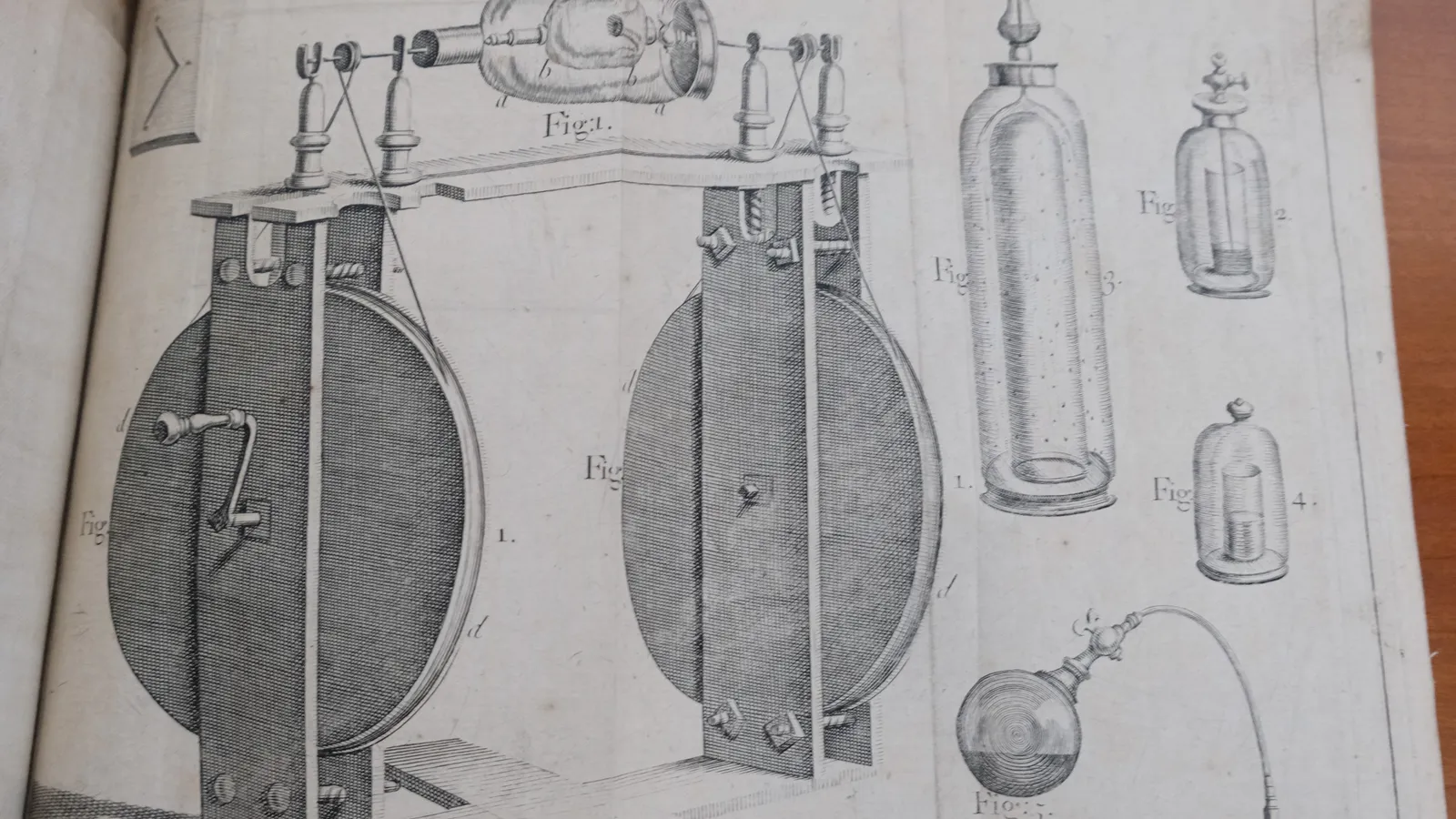
Then he dropped the mercury. His paper in Philosophical Transactions, volume 25, printed in 1706, describes the set-up (we read this transcribed copy):
a glass globe “about 9 inches diameter”, emptied of air by a pump and sealed with a tap so air could not get back in
a “Great Wheel” that turned the globe fast
his “open and naked Hands” pressed on the spinning glass
Why did the evacuated globe glow?
“In a very little time” the globe gave “a considerable Light” of “a curious Purple colour”, Hauksbee wrote. At its brightest, “a Large Print without much difficulty might be read by it”, and a wall at least 10 feet away became visible.
Two things were happening at once. Rubbing the glass built up electric charge on it (Wikipedia: Francis Hauksbee). And the thin air inside let that charge drive an electric discharge through the gas.
A glow discharge is light given off when charged particles, accelerated by an electric field, knock into gas atoms and excite them; the excited atoms release photons as they settle back down (Wikipedia: Glow discharge). Low pressure matters because it lengthens the mean free path, the average distance a particle travels between collisions, so a charged particle picks up more energy before each hit. A UC Santa Barbara lecture demonstration estimates that its 71.5 cm discharge tube would need roughly 1.4 to 2 million volts to break down at atmospheric pressure.
What happened when he let the air back in?
Hauksbee kept rubbing while air leaked back in, and recorded how the light changed. In his first trial, once the globe had refilled, only faint “Specks of Light” showed on the fingers touching it. In a repeat he let the air in a little at a time. Colour and brightness hardly changed until more than a quarter of the globe's air had returned. Then the light “began to break in Branches” from where his hands touched the glass. As “more and more Air was let in”, the light and figures faded until the globe looked as it had at the end of the first trial.
Pump a tube much further, below about a thousandth of a torr, and the UCSB demonstration notes the glow goes out; with a high enough voltage, cathode rays then make the glass itself fluoresce. That is the territory William Crookes explored with his cathode-ray tubes.
How can you work out the pressure effect yourself?
Here is a worked example you can do with Class 11 kinetic theory. The mean free path of a gas molecule is ℓ = k_B T / (√2 π d² p), where d is the molecule's diameter and p the pressure (Wikipedia: Mean free path). For air at normal pressure (1013 hPa), the same source gives ℓ of about 64 to 68 nm. Our guide to the mean free path formula shows where it comes from.
Keep T and d fixed. Then ℓ is proportional to 1/p.
Suppose a pump brings the pressure down to 1 hPa, roughly a thousandth of an atmosphere.
The new mean free path is about 68 nm × 1013 ≈ 69,000 nm, or about 0.07 mm.
A charged particle in the same field now runs about a thousand times further between collisions, so it can gain enough energy to excite or ionise the next atom it hits.
We do not know the pressure inside Hauksbee's globe, so treat this as the reasoning, not a reconstruction. It also explains the overall trend he saw: letting air in shortens the path, and the glow eventually shrinks.
If the jump from “longer path” to “brighter glow” is hard to picture, the Fermi Simulation Lab has interactive simulations for ideas that are easier to see than to read. To revise kinetic theory or electrostatics from the start, each concept has its own lesson in the Fermi Concept Library.
Why does a 1705 experiment still matter?
Hauksbee never built a lamp, the MagLab notes, but glow discharges are now the light source in neon lights and cold-cathode fluorescent lamps (Wikipedia: Glow discharge). His machine built on the generator of Otto von Guericke, inventor of the air pump, as Wikipedia notes.
Next time you pass a glowing sign, ask what gas is inside, at what pressure, and what is pushing the charge.