

On this page
Class 12 physics opens with a rule that feels obvious: like charges repel, unlike charges attract. In 1733 Charles du Fay, a chemist in Paris, worked it out using a rubbed glass tube, some resin and scraps of metal.
Who was Charles du Fay?
Charles François de Cisternay du Fay was born in Paris on 14 September 1698 and died there of smallpox on 16 July 1739, aged 40 (Wikipedia). He joined the French Academy of Sciences in 1723 and ran the Jardin du Roi, the royal botanical garden.
The physicist Steven Weinberg, in his book The Discovery of Subatomic Particles, calls him one of the most versatile scientists of the eighteenth century, writing on everything from geometry to artificial gems and dew. In 1733 he learned of Stephen Gray's experiments in England and turned to electricity. Between 1733 and 1737 he published eight papers on it in the memoirs of the Paris Academy (Linda Hall Library).
What did du Fay discover about electric charge in 1733?
Others had seen electric repulsion before him. Weinberg records that in 1706 Francis Hauksbee saw bits of brass leaf attracted to a rubbed glass tube, then pushed away once they touched it (Weinberg).
Du Fay went a step further. Bits of metal that had touched an electrified glass tube repelled each other, yet they were attracted to bits that had touched electrified copal, a tree resin (Weinberg). If there were only one kind of electricity, both sets should have repelled. So he concluded, as Weinberg quotes him, "there are two electricities, very different from each other; one of these I call vitreous electricity; the other resinous electricity."
He wrote up his findings in a letter in December 1733 (Wikipedia). An English translation from the French was printed in 1734 in volume 38 of the Royal Society's Philosophical Transactions, pages 258 to 266 (Philosophical Transactions, DOI 10.1098/rstl.1733.0040).
Why did he call them vitreous and resinous?
The names come from the materials. Vitreous comes from the Latin vitreus, glassy: it is the electricity of glass, crystal or gems rubbed, especially with silk. Resinous electricity comes from resins like amber or copal rubbed, especially with fur (Weinberg). Weinberg adds that the silk picks up resinous electricity and the fur picks up vitreous, so rubbing produces both kinds at once.
How did vitreous and resinous become positive and negative?
The NCERT Class 12 physics textbook, chapter 1 on electric charges and fields, says the two kinds were named positive and negative by Benjamin Franklin. By convention the charge on a glass rod rubbed with silk is called positive, and the charge on the silk is negative. Weinberg notes that Franklin did not know of du Fay's work, but his positive matches du Fay's vitreous and his negative matches resinous (Weinberg).
The same NCERT chapter gives the modern reason: rubbing moves electrons from the glass to the silk, so the glass ends up short of electrons and the silk has extra. Around 1750 Franklin proposed a single electrical fluid in place of the two-fluid picture that grew out of du Fay's work (Linda Hall Library), though Weinberg notes that the one-fluid versus two-fluid argument lasted into the nineteenth century. You can read that story in our post on Benjamin Franklin and the conservation of charge, and see how the force was finally measured in Coulomb and the torsion balance.
How do you use du Fay's test in a physics problem?
Du Fay's method still works as a way of reasoning: start from a body whose sign you know and test everything else against it. One caution, which NCERT's chapter 1 shows when rubbed rods pick up bits of paper: charged bodies attract neutral ones too.
Here is a worked example. Rod A is glass rubbed with silk. A repels rod B. Rod B attracts rod C, and you are told C is charged. What sign is C?
A is positive, by the convention for glass rubbed with silk.
B repels A, so B has the same kind of charge: positive.
C is attracted to B and is known to be charged, so C is negative.
Check the wording: if the problem had not said C is charged, C could also be neutral and you could not decide.
A quick checklist for any "which sign?" question:
Start from one body whose sign is known.
Use only repulsions to copy a sign from one body to another.
Use attraction to flip a sign only when both bodies are known to be charged.
Remember that the cloth gets the opposite charge to the rod it rubbed.
If sign mistakes keep costing you marks, our list of common electrostatics mistakes covers the usual traps. The Fermi Problem Library has worked problems with a step-by-step solver that explains the reasoning rather than printing an answer. And if the pushing and pulling is hard to picture, the Fermi Simulation Lab has interactive simulations for ideas that are easier to see than to read.
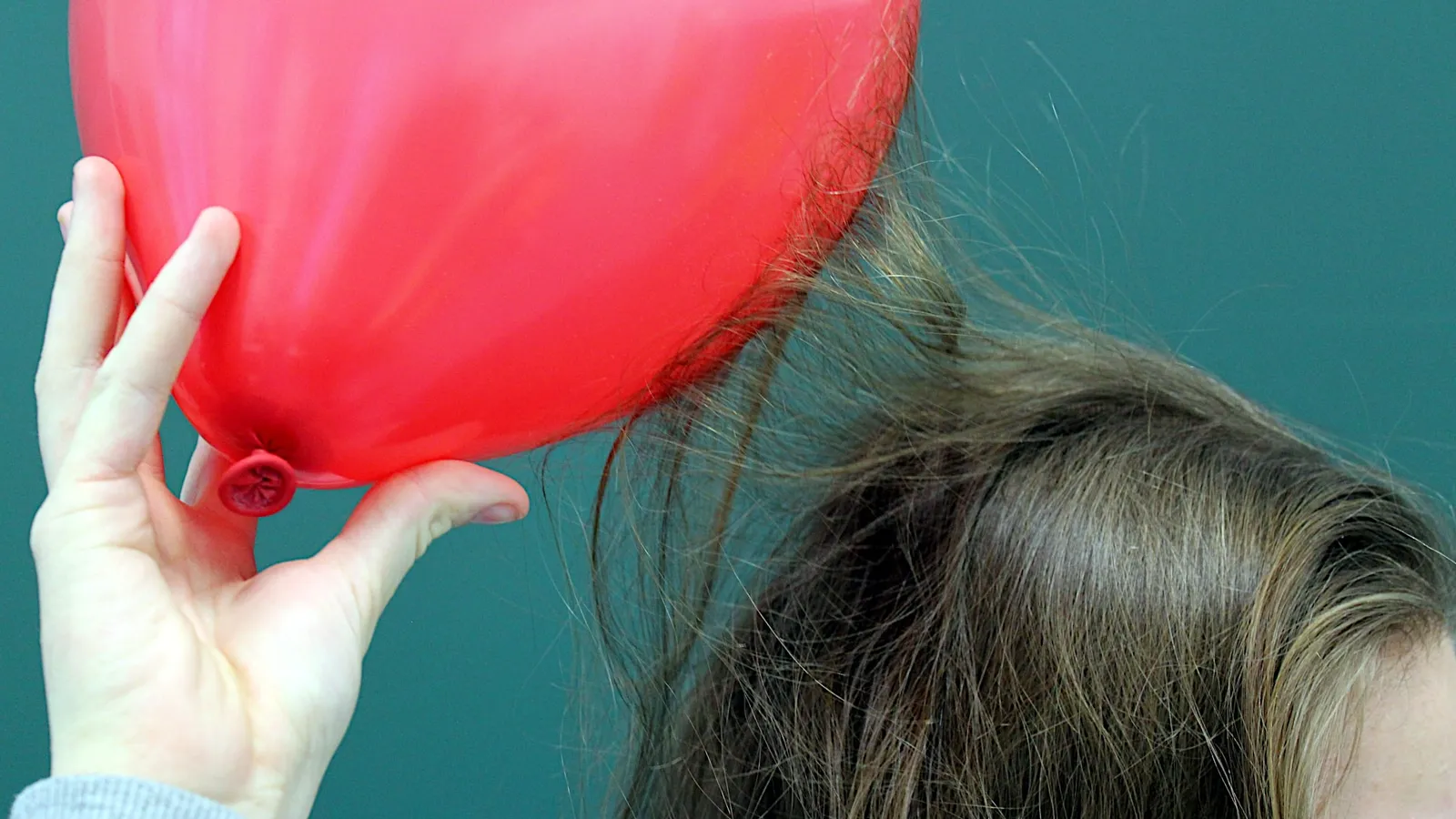
A rubbed balloon lifting your hair is du Fay's rule at work.


