

On this page
Electrostatics problems often look straightforward until an exam asks whether a charged rod loses charge during contact, or what sign an isolated metal sphere acquires when grounded near a charged body. Conduction transfers charge through direct physical contact to produce an identical sign. Induction operates across an air gap without touching, using polarisation and grounding to leave the opposite sign.
How does charging by conduction transfer charge?
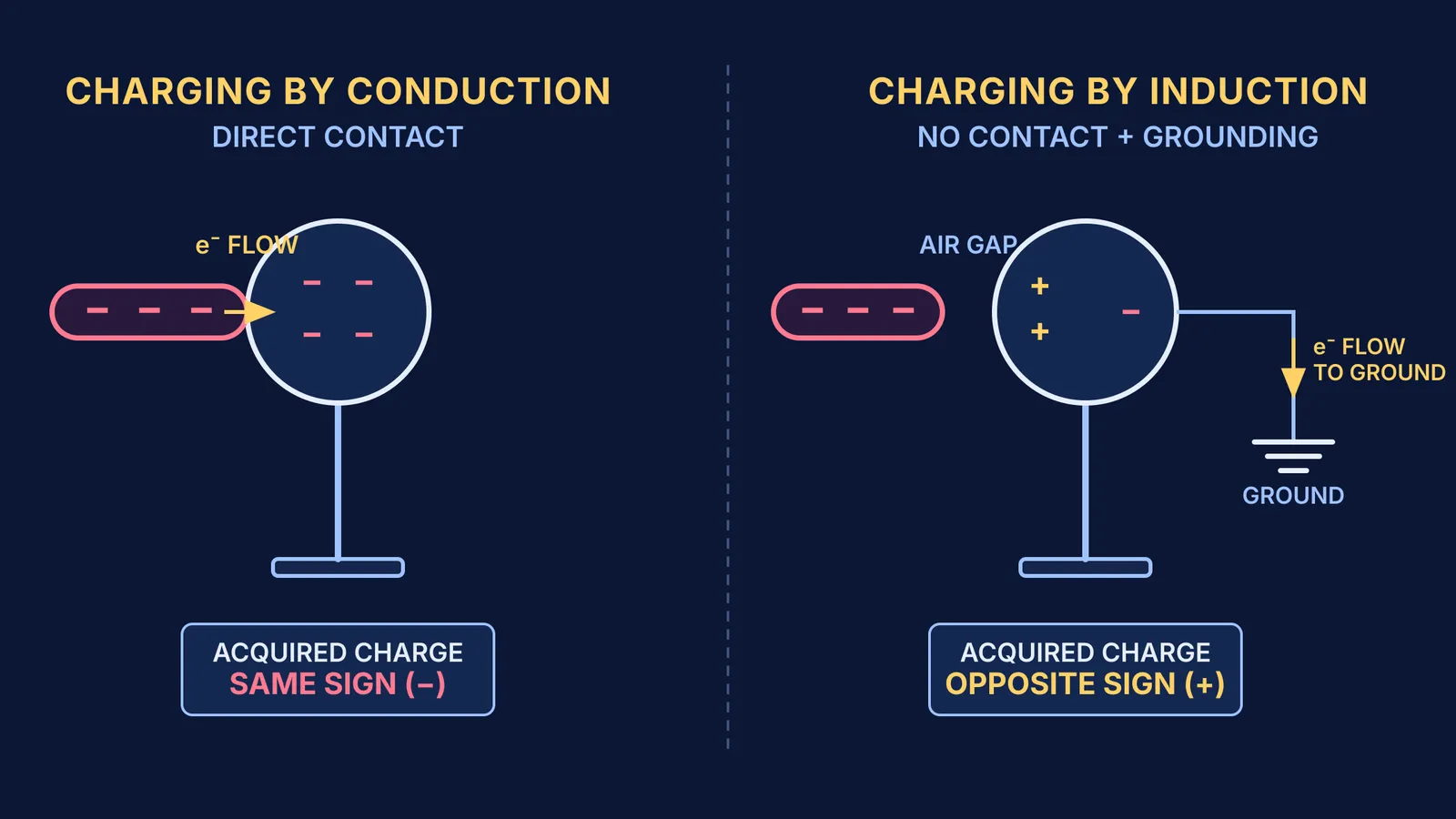
Charging by conduction is the transfer of charge between conductors through direct physical contact. According to the NCERT Class 12 Physics curriculum, when a charged body touches a neutral conductor, mobile electrons flow until both bodies reach the same electric potential. If a negatively charged rod touches a neutral metal sphere, excess electrons repel one another and spread onto the sphere. If the rod is positive, it attracts electrons out of the sphere, leaving the sphere with an electron deficit.
In both cases, the conductor acquires the same sign of charge as the charging object. The charging body gives up part of its charge, reducing its own magnitude. For identical spherical conductors, the total initial charge divides equally upon contact. When mapping field lines around separated bodies, check the rules for drawing electric field lines.
How does charging by induction create an opposite charge?
Charging by induction charges a neutral conductor without physical contact. Bringing a negatively charged rod near a neutral conducting sphere repels mobile electrons to the far side, leaving the near side positively polarised.
To make this charge separation permanent, the conductor must be grounded while the rod stays in place. The repelled electrons flow down the ground wire into the Earth. Disconnecting the ground wire traps the remaining positive charge on the sphere. Once the rod is withdrawn, those trapped positive charges redistribute across the sphere's surface.
Throughout the entire sequence, the inducing rod never touches the conductor and loses zero charge.
What is the core difference between conduction and induction?
Physics exams evaluate five primary distinctions between these two mechanisms:
Contact: Conduction requires direct physical touch; induction operates across an air gap without touching.
Resulting sign: Conduction always produces the same sign as the charging object; induction produces the opposite sign.
Source charge: In conduction, the source object loses charge; in induction, the source object retains all of its initial charge.
Grounding: Conduction requires no earth connection; induction on a single conductor requires grounding to drain or supply electrons.
Carrier motion: In solid conductors, only negative electrons move; positive nuclei remain fixed in the lattice.
These surface distributions directly reflect the boundary conditions explored in Gauss's law in electrostatics.
Why do students get electrostatics questions wrong?
Despite memorising definitions, students frequently stumble on conceptual electrostatics questions. In a nationwide study in the American Journal of Physics evaluating more than 5,000 introductory physics students across 30 institutions, researchers found pretest scores on the Conceptual Survey of Electricity and Magnetism averaged just 31% in calculus-based courses and 25% in algebra-based courses (DOI: 10.1119/1.1371296). Posttest scores only rose to 47% and 44%.
Research by Chitra Guruswamy, Mark D. Somers, and R. G. Hussey demonstrated that students focus on gross charge rather than electric potential differences, wrongly predicting that conductors of the same polarity cannot exchange charge (DOI: 10.1088/0031-9120/32/2/015). Furthermore, Carlos Furió, Jenaro Guisasola, and José M. Almudí showed that students often default to fluid models and believe protons migrate (DOI: 10.1080/14926150409556616).
When multi-step charge distributions create confusion, the Fermi Concept Library maps every concept in physics with dedicated lessons that place charge redistribution in context. To diagnose personal reasoning gaps, see how to use an AI tutor for electrostatics doubts.
How to solve electrostatics charging questions step by step?
Standard textbook curricula, including NCERT Class 12 Physics, recommend following this four-step checklist on board and entrance exam questions:
Identify contact: Touch indicates conduction; a gap indicates induction.
Track electrons only: Sketch mobile electrons moving into or out of the metal. Never move positive nuclei.
Check the disconnection order: Grounding must be severed before removing the external rod to trap charge.
Check conservation: In conduction, total charge is shared (Q_initial = Q_final); in induction, the source retains its full charge.
For example, touching a +6 μC sphere to an identical neutral sphere leaves each with +3 μC by conduction. In contrast, holding the +6 μC sphere near a temporarily grounded neutral sphere draws electrons from Earth, trapping a negative charge while the original sphere keeps all +6 μC.
For numerical problems on conductor potentials, the Fermi Problem Library provides worked problems with a step-by-step solver that explains the reasoning rather than printing an answer. When physical mechanisms are easier to see than to read, the Fermi Simulation Lab provides interactive simulations to test these predictions before class.


