

On this page
Electrostatics marks a sharp turn in the JEE and NEET physics syllabus. You move from the visible, intuitive world of blocks, pulleys and springs into a world of invisible fields, abstract potentials, and imaginary Gaussian surfaces.
Because the concepts are abstract, small misunderstandings early in the chapter can quickly snowball into major roadblocks. If you are struggling to picture what is happening, an AI tutor can help you untangle the rules.
Here are four of the most common confusions in electrostatics and how you can use an AI tutor to fix them.
What is the difference between electric field and electric potential?
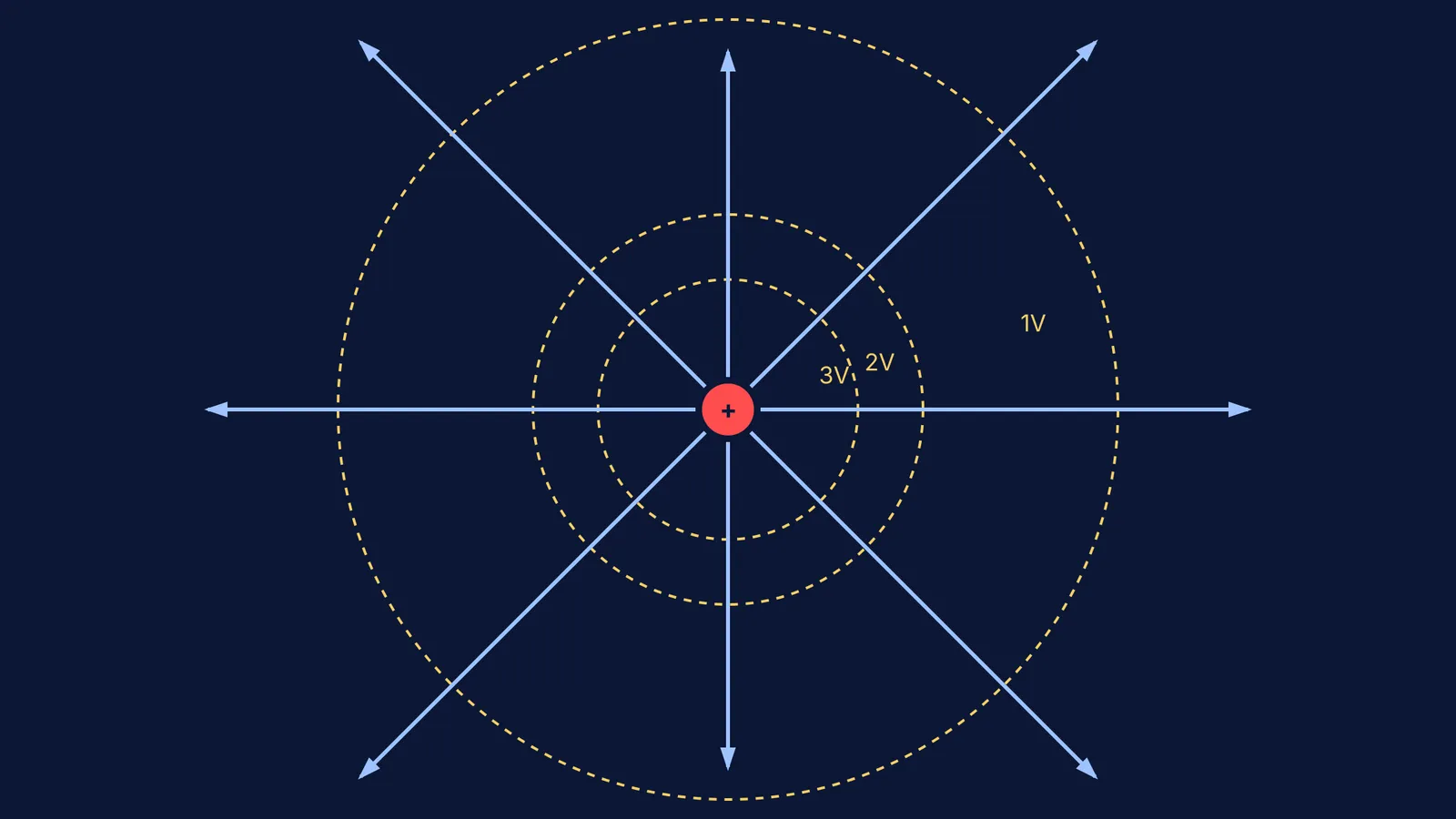
The most common trap is assuming that if the electric field (E) is zero at a point, the electric potential (V) must also be zero.
They are related, but they are not the same thing. The electric field is a vector that tells you the force a charge would feel. The electric potential is a scalar that tells you the potential energy a charge would have. The field is the gradient (the rate of change) of the potential (E = −dV/dr), a principle you use when finding the electric field from a potential gradient.
Think of a flat plateau on a mountain. The slope (the electric field) is zero, so a ball placed there will not roll. However, the height (the electric potential) is still high above sea level. Inside a hollow charged conducting sphere, the electric field is zero everywhere, but the potential is constant and equals the potential on the surface.
Prompt to try: "I am confusing electric field and electric potential. Can you give me three scenarios where one is zero but the other is not, and ask me to explain why?"
Why is the electric field inside a conductor zero?
Another frequent confusion is the behaviour of conductors. Many students memorize the rule that "the electric field inside a conductor is zero," but they do not understand why it happens.
In an ideal conductor, charges are free to move. If there were an electric field inside the conductor, it would exert a force on those free charges, causing them to move. They will continue to move and rearrange themselves on the surface until they create their own internal field that perfectly cancels out the external field. Once the net field is zero, the charges stop moving. This state is called electrostatic equilibrium.
If you struggle to picture this dynamic process, Fermi's AI tutor teaches rather than answers: it holds a line of reasoning across a session, notices where you are stuck, and decides whether to explain, ask or show. It can run a simulation of the charges moving to the surface so you can watch equilibrium happen.
How does induced charge actually work?
A classic JEE trap involves earthing one of two concentric spherical shells. Students often assume that if a shell is connected to the earth, its charge becomes zero.
In reality, the earth acts as an infinite reservoir of charge. When a conductor is earthed, charge flows to or from the earth until the net potential of that conductor becomes zero. If there is a charged object nearby, the earthed conductor will pull charge from the ground to cancel out the nearby object's potential.
For example, if you place a +Q charge at the centre of an earthed spherical shell, the shell will pull −Q from the earth to its inner surface to make its own potential zero. This is a standard step when solving problems with concentric spherical shells and earthing.
Prompt to try: "I have two concentric conducting shells. The inner one has charge +Q and the outer one is earthed. Walk me step-by-step through how to find the final charge on the outer shell. Do not just give me the answer."
Where do students go wrong with Gauss's law and symmetry?
Gauss's law (Φ = Q/ε₀) is a powerful tool, but it is often misapplied in exams. A common misconception is that if the net flux through a closed surface is zero, the electric field must be zero everywhere on that surface.
This is false. A zero net flux simply means the net enclosed charge is zero. For example, if you place an electric dipole inside a sphere, the net charge is zero and the net flux is zero. However, the electric field is non-zero at almost every point on the sphere's surface.
Another trap is trying to use Gauss's law to calculate the electric field for non-symmetric objects, like a cube or a finite rod. While the law is always true, it is only useful for calculating the field in cases of high symmetry, such as infinite planes or spheres.
Prompt to try: "I am studying Gauss's law. Give me a tricky conceptual question where the flux is zero but the electric field is not."
How can you get the most out of an AI tutor?
A 2025 Harvard University study of 194 undergraduate physics students found that a custom AI tutor produced median learning gains more than double those of a traditional active-learning classroom. The students using the AI tutor also completed the material in a median time of 49 minutes, compared to 60 minutes for the classroom group.
To see these kinds of gains, you have to use the AI as a tutor, not an answer key. If you are stuck on a problem from the Fermi Problem Library, do not ask for the full solution. Ask the tutor to check your free-body diagram, or ask it to point out the flaw in your logic. When you make the AI do the work, you learn nothing; when the AI makes you do the work, you master the concept.


