

On this page
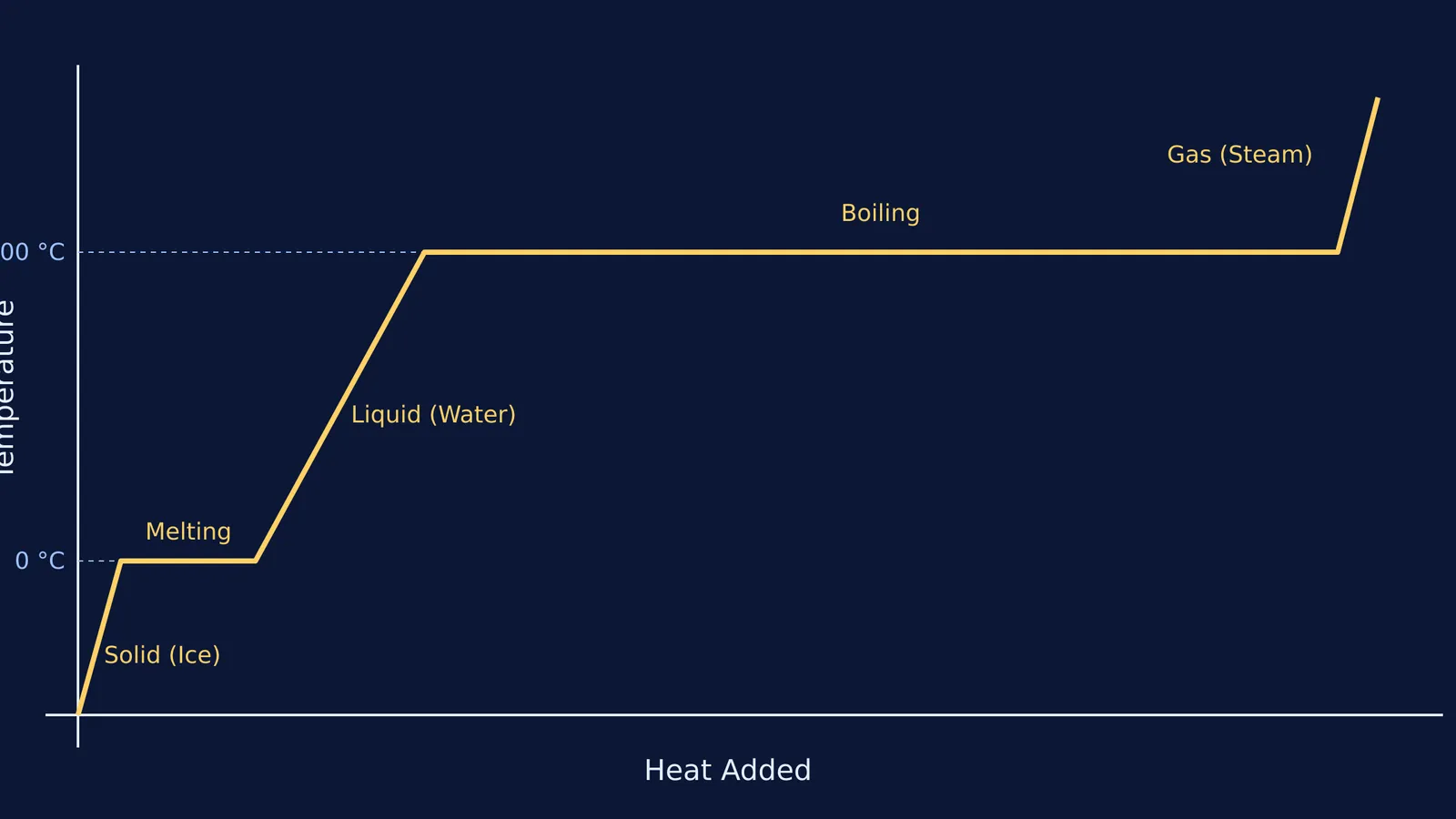
When you heat ice, its temperature rises until it hits 0 °C. Then, strangely, the temperature stops rising even as you keep adding heat. It stays at exactly 0 °C until every last piece of ice has melted.
A states of matter particle model simulation is the clearest way to see why this happens. By making the invisible atoms and molecules visible on screen, these interactive tools reveal what particles do as a solid is heated through melting and boiling.
What Are the Three States of Matter?
Before tracking a substance through a heating curve, it helps to establish the baseline for each state. The particle model defines them by how their component particles (atoms or molecules) are arranged and how they move:
Solid: Particles are held tightly in a fixed, orderly lattice by strong attractive forces. They possess low kinetic energy and can only vibrate in place. This gives solids a fixed shape and volume.
Liquid: Particles are still close together but are randomly arranged. They have moderate kinetic energy and can flow or slide past each other. Liquids maintain a fixed volume but take the shape of their container.
Gas: Particles are spaced far apart with no regular arrangement, as the attractive forces between them are negligible. They possess high kinetic energy and move rapidly in random directions. Gases expand to fill both the shape and the volume of their container.
How Does the Particle Model Explain Melting?
When you add heat to a solid, the particles gain kinetic energy and vibrate more vigorously. At the melting point (0 °C for water), the particles gather enough energy to partially overcome the strong attractive intermolecular forces holding them in their fixed lattice.
During the actual melting process, the temperature remains constant. This is because all the added heat energy is used exclusively to break the bonds between the particles, rather than increasing their kinetic energy or speed. Once the particles break free, they can slide past one another, forming a liquid.
How Does the Particle Model Explain Boiling?
In a liquid, the particles flow randomly but remain close together. As you continue to heat the liquid, the particles move faster and their kinetic energy rises. When the liquid reaches its boiling point (100 °C for water), the particles gain enough energy to completely overcome the remaining forces of attraction between them.
Just like during melting, the temperature remains constant while the liquid is boiling. The energy is used entirely to pull the particles apart. The particles escape the liquid and expand rapidly into a gas, moving at high speeds in all directions. Because phase changes from ordered to less ordered states require an input of energy to overcome forces, they are endothermic processes. On a heating curve, the boiling plateau is typically much longer than the melting plateau because it takes significantly more energy to completely separate the molecules than to just let them slide past one another.
Why Use a States of Matter Particle Model Simulation?
Simulations, such as the widely used PhET States of Matter: Basics, allow you to manipulate these variables directly. You can select different atoms (like neon or argon) or molecules (like oxygen or water) and add or remove heat to observe phase changes. Because the simulation visualises the submicroscopic level, it bridges the gap between what you see in a real laboratory and the abstract theories in your textbook.
One of the most valuable lessons in these digital labs is seeing the structural differences between substances. For example, neon atoms are simple spheres that pack tightly. Water molecules, however, are bent (with two hydrogen atoms bonded to one oxygen atom). When water freezes, these molecules lock into a hexagonal lattice that actually pushes them further apart than they are in liquid water. This expansion is why ice floats on top of liquid water in a pond. The Fermi Simulation Lab has interactive simulations for the ideas that are easier to see than to read.
What Should You Predict Before Using a Simulation?
The best way to use a simulation is not just to watch it, but to use it to test your own hypotheses. Before you adjust the heat slider, write down what you expect to see.
Predict the temperature plateau: Guess the exact temperature where the thermometer will stop rising as the solid turns to liquid.
Predict the particle spacing: Draw how the water molecules will look as a solid versus a gas.
Compare two substances: Predict whether argon or water will require more heat to boil. Water has stronger intermolecular forces, so it requires more energy.
Testing your predictions forces you to actively engage with the physics. If you want to understand what happens when a process absorbs heat without a phase change, read about why cold packs get cold. Or, to understand when digital models fall short of reality, explore the limits of physics simulations.


