

On this page
When you twist and squeeze a chemical cold pack, you break an inner bag of water, mixing it with dry crystals. The pack instantly drops in temperature, providing a portable chill for a sprained ankle.
But where does the heat go? The answer lies in the thermodynamics of breaking ionic bonds.
Why do cold packs get cold endothermic dissolving?
A chemical cold pack relies on an endothermic reaction — a process that absorbs heat from its environment.
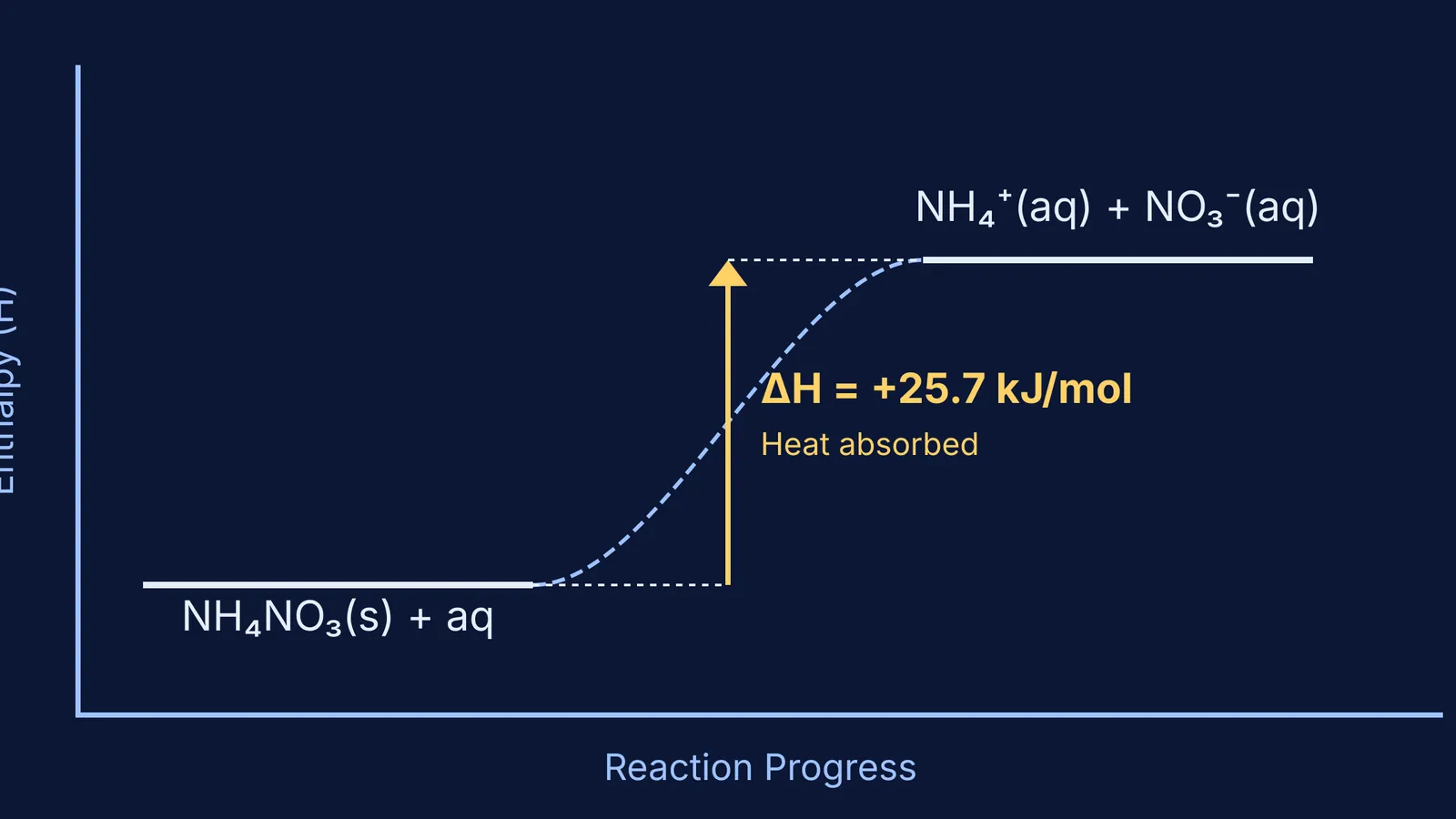
The solid inside most instant cold packs is ammonium nitrate (NH₄NO₃). When it dissolves in water, the enthalpy of solution is +25.7 kJ/mol, according to standard chemical data on Wikipedia. The positive sign means the reaction requires energy to proceed. Because it pulls that thermal energy from the water and the surrounding air (or your skin), the pack feels freezing to the touch.
To understand the energy transfer, we break the dissolution into two steps. First, energy is required to pull the NH₄⁺ and NO₃⁻ ions apart from their solid crystal lattice. This is an endothermic step. Second, energy is released when water molecules surround the free ions, known as hydration. This is an exothermic step.
For ammonium nitrate, breaking the lattice takes much more energy than the hydration releases. The net result is a deficit of heat, causing the rapid temperature drop. If you want to see this energy transfer and measure the temperature without wasting real chemicals, you can run the reaction in the Fermi Simulation Lab.
How does the ammonium nitrate reaction work in practice?
When you activate the pack, the solid salt dissociates into its constituent ions:
NH₄NO₃(s) + H₂O(l) → NH₄⁺(aq) + NO₃⁻(aq)
Even though the process is endothermic and requires energy, it still happens spontaneously at room temperature. This is because moving from a highly ordered solid crystal to freely moving aqueous ions creates a massive increase in entropy (disorder). This entropy boost drives the reaction forward, making it a classic example of an entropically driven process.
You can explore similar energy measurements in the chemistry lab by checking out the enthalpy of neutralisation and solution practical, or by relating ΔH and ΔU in thermodynamic equations.
Ice packs vs chemical cold packs: which is better?
While chemical cold packs are convenient because they require no freezer, their cooling power has strict limits.
A 2013 study in *Wilderness & Environmental Medicine* tested their effectiveness in a controlled benchtop model. Researchers placed cold packs in 2 litres of water in a 41°C environment to simulate a hyperthermic patient. They found that the chemical packs produced a temperature drop of only 5.25°C, while standard ice packs of the same size dropped the temperature by 19.8°C (DOI: 10.1016/j.wem.2012.10.004).
The researchers concluded that chemical packs lose their effectiveness quickly, hitting their limit with a time constant of 1.72 minutes, compared to 26.8 minutes for ice. Modeling on a standard 86.6 kg male showed that applying six chemical packs would change body temperature by less than 0.5°C. For treating severe heat illness, standard ice is significantly better because of the massive heat absorbed when solid ice melts.
A framework for calculating the temperature drop
If you are a student preparing for a chemistry exam, calculating the exact temperature drop of a dissolving salt is a common question. You can follow this three-step framework using the specific heat equation: q = mcΔT.
Imagine a pack containing 40 grams of ammonium nitrate and 100 grams of water.
Calculate the moles: Divide the mass of ammonium nitrate by its molar mass (80.04 g/mol).
40 ÷ 80.04 = 0.50 moles.
Find the total heat absorbed (q): Multiply the number of moles by the enthalpy of solution (+25.7 kJ/mol).
0.50 × 25.7 = 12.85 kJ, or 12,850 Joules.
Determine the temperature change (ΔT): The total mass (m) is 140 grams. Assuming the specific heat capacity (c) is similar to water (4.18 J/g°C), rearrange the equation to solve for the temperature change: ΔT = q / (mc).
ΔT = 12,850 / (140 × 4.18) = 12,850 / 585.2 = 22.0°C.
If the water started at 20°C, the pack theoretically drops to -2.0°C in a perfectly insulated environment. If you forget a step or get stuck on the algebra while working through a thermodynamics problem like this, Fermi's AI tutor can check your working and point out where the equation went off track.


