

On this page
The calorimetry practical asks for one number, the enthalpy change per mole, and students lose marks in three places: forgetting the calorimeter, dividing by the wrong number of moles and getting the sign backwards. This post works through the full calculation with sample readings, compares the result with a reference value and explains why the solution, not the reaction, is what warms up.
Where does this experiment appear?
The CBSE Chemistry curriculum for 2026-27 asks Class 12 students to do any one of three thermochemistry experiments: enthalpy of dissolution of copper sulphate or potassium nitrate, enthalpy of neutralisation of HCl and NaOH, or the enthalpy change when acetone and chloroform form hydrogen bonds. The JEE (Main) 2026 syllabus and the NEET (UG)-2026 syllabus list the chemical principles of the enthalpy of solution of CuSO4 and the enthalpy of neutralisation of a strong acid and a strong base. The theory is in the NCERT Class 11 chapter Thermodynamics. Check the documents for your own year.
Why does the solution warm up?
When H⁺ and OH⁻ combine, energy is released. It goes into the water and the cup, so the temperature rises. The reaction is the system and the solution is the surroundings, so a rise in temperature means ΔH is negative. NCERT puts it the same way: in an exothermic reaction, heat is evolved, qp is negative and ΔrH is negative.
Students often find this confusing. Greenbowe and Meltzer (2003) studied solution calorimetry problems answered by 207 university chemistry students. Many difficulties came from not understanding that the energy change from bonds forming and breaking in the reaction is transferred into, or out of, the whole mass of the resulting solution.
Step 1: find the calorimeter constant
The cup, stirrer and thermometer also absorb heat. Measure how much by mixing hot and cold water. Sample readings: 50 g of water at 20.0 °C is placed in the calorimeter, 50 g of water at 40.0 °C is added, and the final temperature is 29.6 °C. Use c = 4.18 J g⁻¹ K⁻¹.
Heat lost by hot water: 50 × 4.18 × (40.0 − 29.6) = 2173.6 J.
Heat gained by cold water: 50 × 4.18 × (29.6 − 20.0) = 2006.4 J.
The difference, 167.2 J, went into the calorimeter, which warmed by 9.6 K.
Calorimeter constant: 167.2 / 9.6 = 17.4 J/K.
Step 2: the enthalpy of neutralisation
Sample readings: 50 mL of 1.0 M HCl and 50 mL of 1.0 M NaOH, both at the same starting temperature, are mixed in the calorimeter. The temperature rises by 6.4 K.
Treat the 100 mL of solution as 100 g with c = 4.18 J g⁻¹ K⁻¹.
Heat released: (100 × 4.18 + 17.4) × 6.4 = 435.4 × 6.4 = 2787 J.
Moles of water formed: 0.050 L × 1.0 M = 0.050 mol.
ΔH = −2787 J / 0.050 mol = −55 700 J/mol ≈ −55.7 kJ/mol.
How does that compare with reference data? The CODATA Key Values for Thermodynamics give ΔfH° = −285.830 kJ/mol for liquid water and −230.015 kJ/mol for OH⁻(aq), with H⁺(aq) defined as zero. For H⁺ + OH⁻ → H2O, ΔH° = −285.830 − (−230.015) = −55.8 kJ/mol at 298 K. The sample result is close because the calorimeter constant was included. Leave it out and you get (100 × 4.18 × 6.4) / 0.050 = 53.5 kJ/mol, about 4% too small.
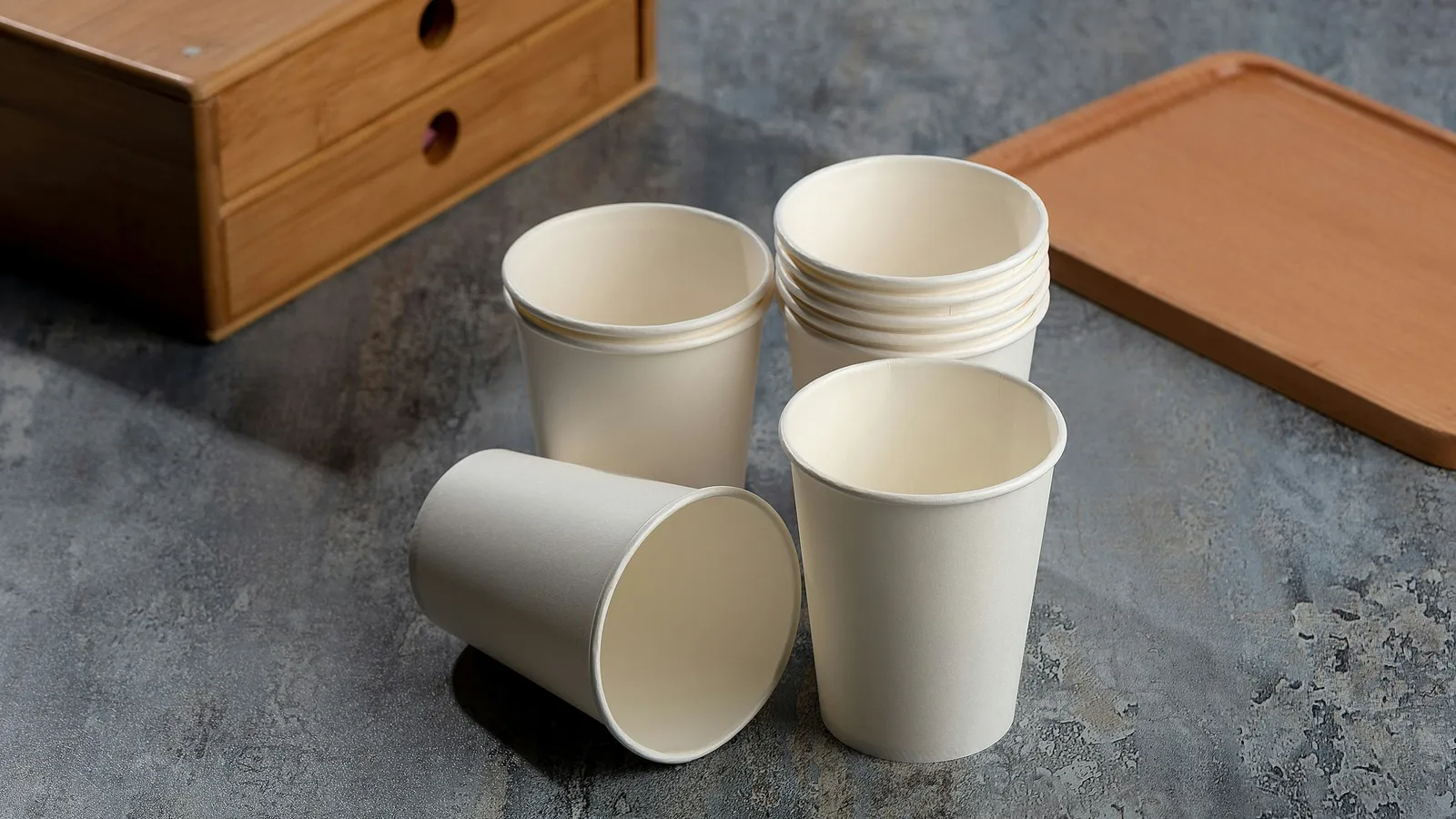
Cheap equipment can still give good results. Bopegedera and Perera (2016) reported that calorimeters made from paper coffee cups gave values for the enthalpy of neutralisation comparable to Styrofoam cups and close to published values.
What about enthalpy of solution?
The method is the same, but you dissolve a weighed solid instead of mixing two solutions. Sample readings: 5.06 g of KNO3 (molar mass 101.1 g/mol, so 0.0500 mol) dissolves in 100 g of water and the temperature falls by 4.0 K.
Heat absorbed from the solution: (100 × 4.18 + 17.4) × 4.0 = 1742 J.
ΔsolH = +1742 J / 0.0500 mol = +34.8 kJ/mol. The temperature fell, so the process is endothermic and ΔH is positive.
This ignores the small mass of the solid, which is acceptable at school level.
Which mistakes cost marks?
Sign errors. Temperature rises: ΔH negative. Temperature falls: ΔH positive.
Using only 50 g. Both solutions end up in the cup, so use the total mass.
Leaving out the calorimeter constant. It makes the result too small.
Reading the temperature too early. Stir and record the highest steady reading, or plot temperature against time.
Starting the two solutions at different temperatures. Bring them to the same temperature first, or average the two.
Our post on calorimetry and heat transfer covers mixing problems, and Hess's law shows how these values combine.
A practice routine before the practical
Explain in one sentence why the temperature rise means ΔH is negative.
Redo the calorimeter constant with your own sample figures.
Calculate ΔH for 100 mL each of 0.5 M HCl and 0.5 M NaOH with a rise of 3.3 K, and check that it comes out near −56 kJ/mol.
List three sources of heat loss and how your set-up reduces each.
If heat, temperature and enthalpy still blur together, revise the ideas before the numbers. The Fermi Concept Library covers every concept in physics, chemistry, biology, mathematics and computing, so you can revise heat capacity before the lab.
Before your practical, set up your results table with columns for mass, starting temperature, highest temperature and ΔT.


