On this page
Rub a balloon on your hair, hold it near a scrap of foil, and the foil moves before anything touches it. In 1753 a London schoolmaster, John Canton, turned that trick into a careful experiment that still sits behind your Class 12 chapter on charges.
Who discovered charging by induction?
The effect was noticed long before it was explained. Isaac Newton reported an example to the Royal Society in 1675, according to Wikipedia's history of electrostatic induction, which credits John Canton in 1753 and Johan Carl Wilcke in 1762 with the first detailed studies.
Canton was born in Stroud on 31 July 1718 and trained under a schoolmaster in Spital Square, London, later becoming his partner, says the Dictionary of National Biography.
What exactly did Canton do in 1753?
His paper, "Electrical experiments, with an attempt to account for their several phaenomena", was read to the Royal Society on 6 December 1753 and printed in Philosophical Transactions, volume 48, pages 350 to 358.
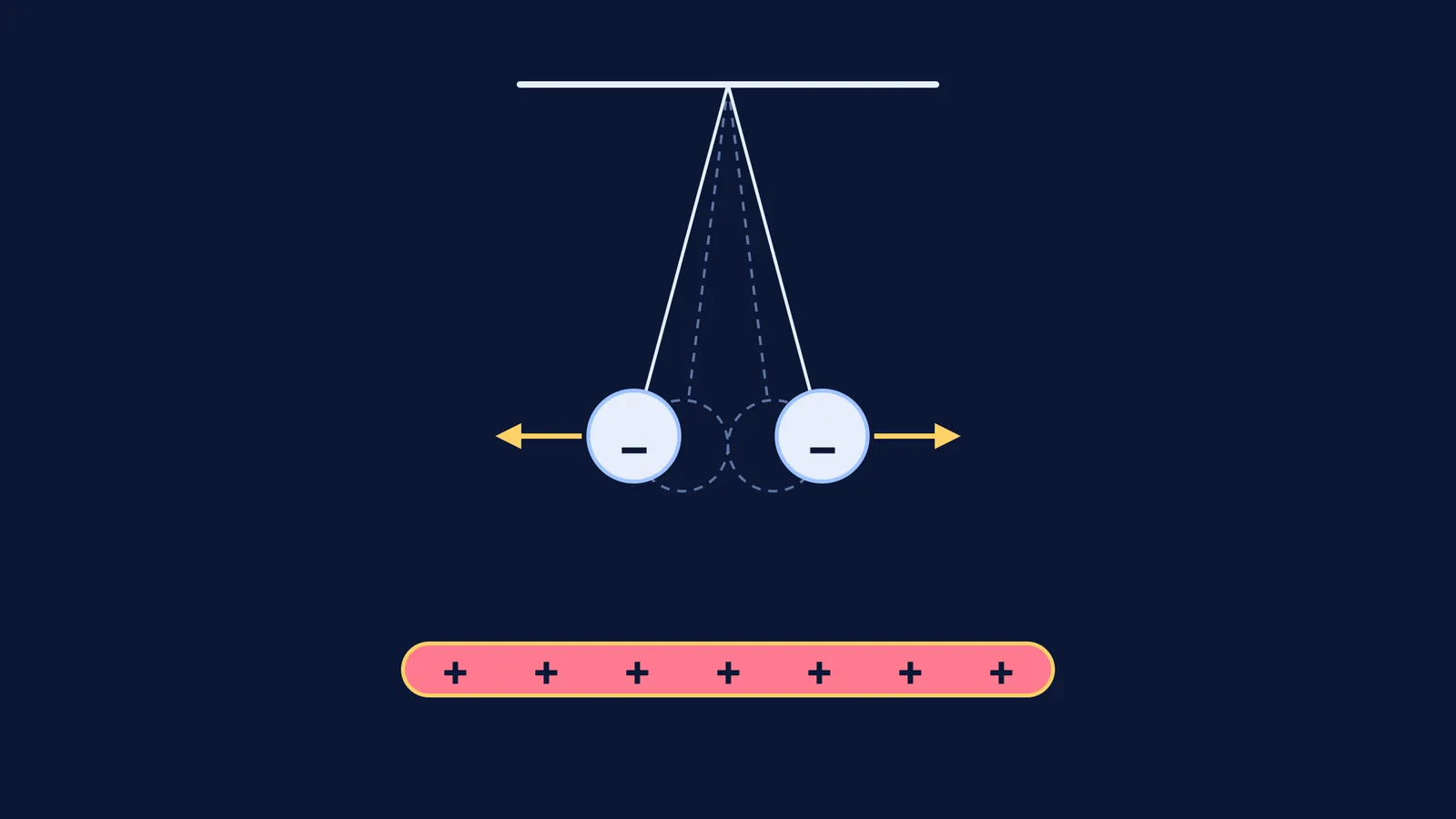
In his first experiment, two cork balls, "each about the bigness of a small pea", hang side by side on linen threads eight or nine inches long, touching. He brought a rubbed ("excited") glass tube underneath, and the balls separated with the tube still three or four feet away, spreading wider as it came closer. When he withdrew it, "they will immediately come together".
His second experiment changed one thing: dry silk threads instead of linen. Now the tube had to come within eighteen inches before the balls separated, and they stayed apart for some time after it was taken away.
Why did the balls move without being touched?
Canton saw the puzzle himself: "As the balls in the first experiment are not insulated, they cannot properly be said to be electrified," he wrote in the 1753 paper. He explained it with the "electrical fluid" ideas of his day.
The modern explanation uses electrons. In conductors such as metals, electrons are comparatively free to move, and the human body and the earth are conductors too, as the NCERT Class 12 chapter Electric Charges and Fields explains. The same chapter notes that rubbed glass is called positive by convention, and a positive charge attracts electrons. The linen thread gives electrons a path down from the ceiling it hangs from, so both balls gain a little extra negative charge. Like charges repel, so they swing apart. Take the tube away, the extra electrons drain back, and the balls hang together again.
That is induction: a charged body rearranges charge in another body from a distance. Cut the path back at the right moment and the change becomes permanent, which is charging by induction. For the earlier history, see how Stephen Gray discovered conductors and insulators.
How can you repeat Canton's experiment at home?
You need a balloon, kitchen foil, cotton sewing thread, nylon thread or fishing line, a pencil and two stacks of books.
Part A, Canton's version:
Squeeze two pea-sized foil balls tightly and tie each to a 20 cm length of cotton thread.
Tape both threads to a pencil laid across the books, so the balls hang touching.
Rub the balloon on dry hair or a wool sweater for about 15 seconds.
Bring it slowly up from below, starting about 50 cm away, and note where the balls first part.
Pull the balloon away and see whether they drop together at once, as Canton's did.
Part B, a charge that stays:
Re-hang the balls on nylon thread, which NCERT lists among insulators, touching side by side.
Bring the charged balloon close to one ball, in line with both, without touching.
Keeping the balloon still, slide the far ball's thread a few centimetres along the pencil.
Take the balloon away. The balls should lean towards each other, because they now carry opposite charges.
Let them touch. They should hang straight again as the charges cancel: conservation of charge.
If nothing happens, recharge the balloon, try another thread and write down what changed, just as Canton did.
How does this connect to Class 12 Electric Charges and Fields?
The NCERT chapter uses the same idea for a comb and paper: the charged comb "polarises" the paper, inducing a dipole moment, and because the comb's field is not uniform the paper feels a net pull. Canton's balls are the conductor version, and Part B tests the chapter's rule that the total charge of an isolated system is conserved.
When you explain induction in an answer, check you have said four things: which charges are free to move, which way they move, what path to earth exists, and what is cut before the charged body leaves. Our guide compares charging by conduction versus induction.
If the charge shuffle is hard to picture, the Fermi Simulation Lab has interactive simulations for ideas that are easier to see than to read. You can also charge an electroscope by induction, step by step.