

On this page
Stephen Gray, an English astronomer and experimental physicist living as a pensioner at the Charterhouse in London, made his biggest discovery in 1729: the electric "virtue" of a rubbed glass tube could travel from one object to another, many feet away, along a thread (Linda Hall Library).
He described it in a letter printed in the Royal Society's Philosophical Transactions in 1731 (Gray, 1731, vol. 37, pp. 18-44; OCR text of the letter).
What did Stephen Gray notice first?
Gray fitted a cork into each end of his glass tube to keep the dust out. When he rubbed the tube, the cork, which nobody had rubbed, attracted and repelled a down feather. He "concluded that there was certainly an attractive Vertue communicated to the Cork" (Gray, 1731). An ivory ball on a stick in the cork attracted too, and so did the ball hung from the tube on about three feet of packthread (strong hemp string).
How far did Gray send electricity along a thread?
At Norton Court in Kent, a friend's house, his first recorded experiment used a rod of about 24 feet on 14 May 1729. By 31 May a pole and a line hanging from a balcony measured 52 feet (Gray, 1731).
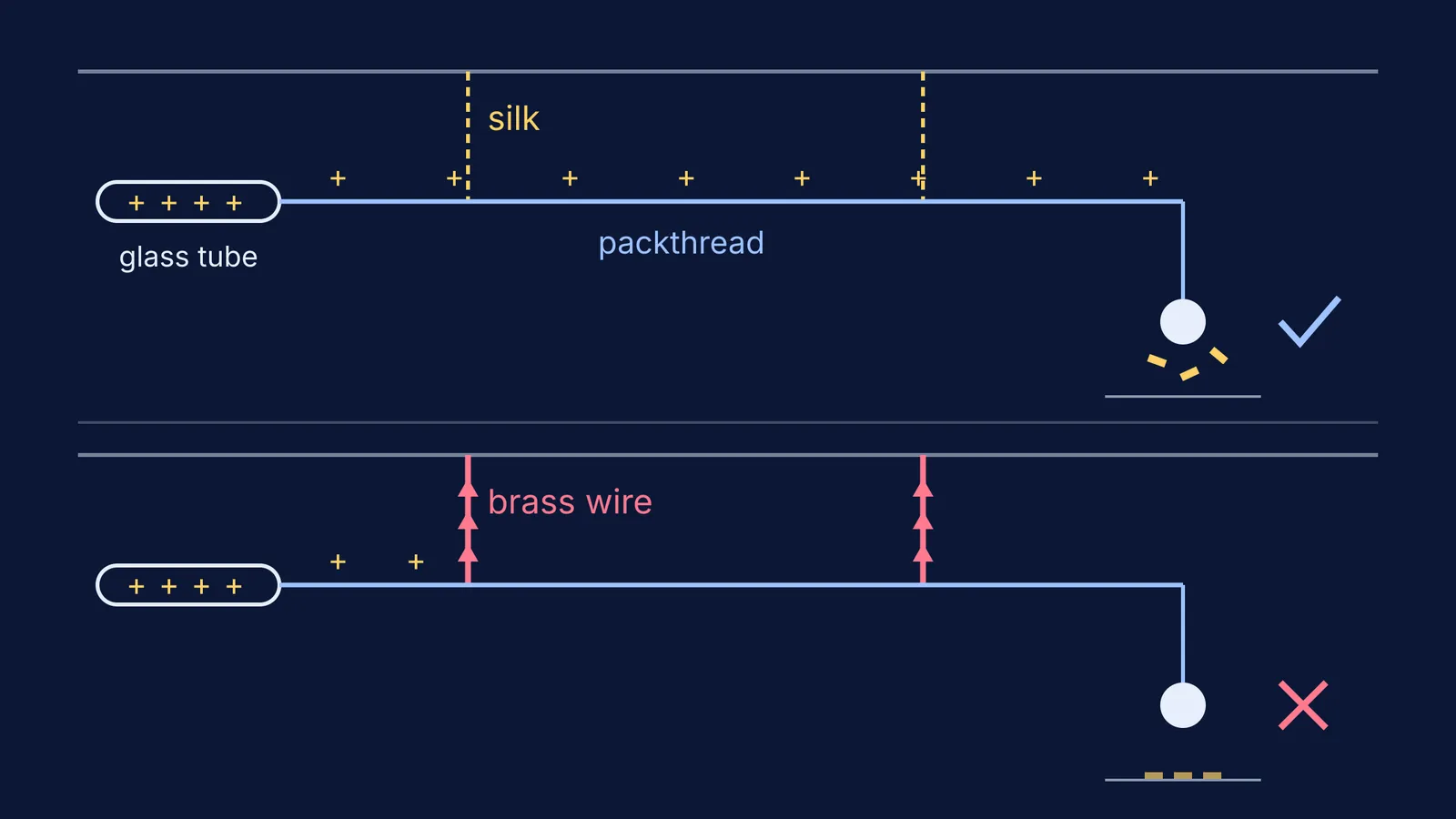
Running a line sideways was harder: hung from a packthread loop on a beam, it carried nothing to the ball. On 30 June 1729 Gray visited Granville Wheler at Otterden Place, and Wheler proposed holding the line up with a silk line. On 2 July, in the house's matted gallery, a line 80½ feet long laid across silk carried the charge to the ivory ball. Of the visit, Gray wrote that they "succeeded far beyond our Expectation" (Gray, 1731).
The letter records lines of 147, 293, 666, 650 and 765 feet that July. On 1 August 1730, at Wheler's, leaf-brass still rose to the ball when the tube touched a line 886 feet long, about 270 metres. The pull was strong at stations "not exceeding two or three hundred Feet" but "grew weaker as we came towards the farther End of the Line" (Gray, 1731).
Why did silk work and brass wire fail?
The key result came from an accident on 3 July 1729, in Wheler's barn. Rubbing the tube shook the line, and the silk supports broke. Thin iron wire was too weak to bear the line, so they used slightly thicker brass wire. This time, Gray wrote, "there was not the least Motion or Attraction given by the Ball". His conclusion: their earlier success "depended upon the Lines that supported the Line of Communication, being Silk, and not upon their being small" (Gray, 1731).
That sentence holds the split between conductors and insulators. The charge passed along the wire to the timber, Gray explained; silk gave it no such path.
What is the difference between conductors and insulators?
A conductor is a material that lets electric charge move through it; an insulator is a material that holds charge in place. Gray tested household objects: a fire shovel, tongs, an iron poker, a copper tea kettle and a silver pint pot were all "strongly Electrical" when hung from the tube by packthread (Gray, 1731). Gray's friend Desaguliers gave the two classes of material the names "conductors" and "insulators" (EBSCO Research Starters).
Gray received the Royal Society's Copley Medal when it was first awarded, in 1731 (Royal Society), and again in 1732 (EBSCO Research Starters). He died in February 1736 (Linda Hall Library).
How can you use Gray's method on conductor problems?
For any textbook setup, ask:
Where does the charge go in?
What touches the charged object?
Do any of those things connect, through conductors only, to the ground, a wall or your hand?
If yes, the charge spreads out and leaks away. If every path passes through an insulator, the charge stays.
Worked example: Gray's "flying boy". On 8 April 1730 he hung a boy of eight or nine horizontally from two hair lines, "such as Cloaths are dried on", and held the rubbed tube near the boy's feet without touching them. Leaf-brass rose to the boy's face "to the Height of eight, and sometimes ten Inches" (Gray, 1731).
Question 1: from the tube, near his feet.
Question 2: only the hair lines.
Question 3: no. The lines behaved as insulators and were his only link to the beam.
Question 4: the charge stays and, since his body conducts, spreads to his face.
Swap the hair lines for iron chains and, like the brass wire, they would drain the charge into the beam.
If the hard part is picturing charge spreading over a conductor, the Fermi Simulation Lab has interactive simulations for ideas that are easier to see than to read. If the gap is the idea itself, each physics concept has its own lesson in the Fermi Concept Library.
Next, see how Charles du Fay found two kinds of electric charge, how Abraham Bennet's gold-leaf electroscope detected charge, or try some balloon static electricity experiments at home.


