On this page
In 1787 Abraham Bennet, a curate in Derbyshire, sent a letter to Joseph Priestley titled “Description of a new electrometer”, printed in the Royal Society's Philosophical Transactions on pages 26 to 31. A short appendix addressed to Charles Blagden, the Society's secretary, followed on pages 32 to 34. The instrument in those pages, two strips of gold leaf hanging inside glass, is the gold-leaf electroscope in your physics book. It is still one of the clearest ways to see charge and induction with your own eyes.
Who was Abraham Bennet?
Bennet was baptised in Taxal, Derbyshire, in 1749, ordained in 1775 and made curate of Wirksworth in 1776, according to his Wikipedia biography. He met Alessandro Volta in London in 1782, was elected a Fellow of the Royal Society in 1789, and that year published New Experiments on Electricity, which described his electroscope and a “doubler” of electricity.
The doubler first appeared in the same 1787 volume as the electroscope, described as “a Machine by which the least conceivable Quantity of positive or negative Electricity may be continually doubled” (Wikisource list of Bennet's papers).
What did the gold-leaf electroscope improve on?
Electroscopes were not new. The Wikipedia history of the electroscope traces them from William Gilbert's pivoted needle, the versorium, around 1600, through Stephen Gray's hanging thread in 1731 to John Canton's pith-ball electroscope in 1754. It describes Bennet's gold-leaf instrument as more sensitive than the pith-ball and straw-blade electroscopes then in use. Housing an electroscope in glass kept breezes, moisture and other outside influences from disturbing the results, notes the National MagLab's history of the instrument.
Erasmus Darwin described “the very sensible electrometer improved by Mr. Bennett” in his 1791 poem The Botanic Garden. Rub a stick of sealing wax on a dry cloth, he wrote, hold it “at the distance of two or three feet from the cap of this instrument”, and “the gold leaves seperate”.
How does a gold-leaf electroscope work?
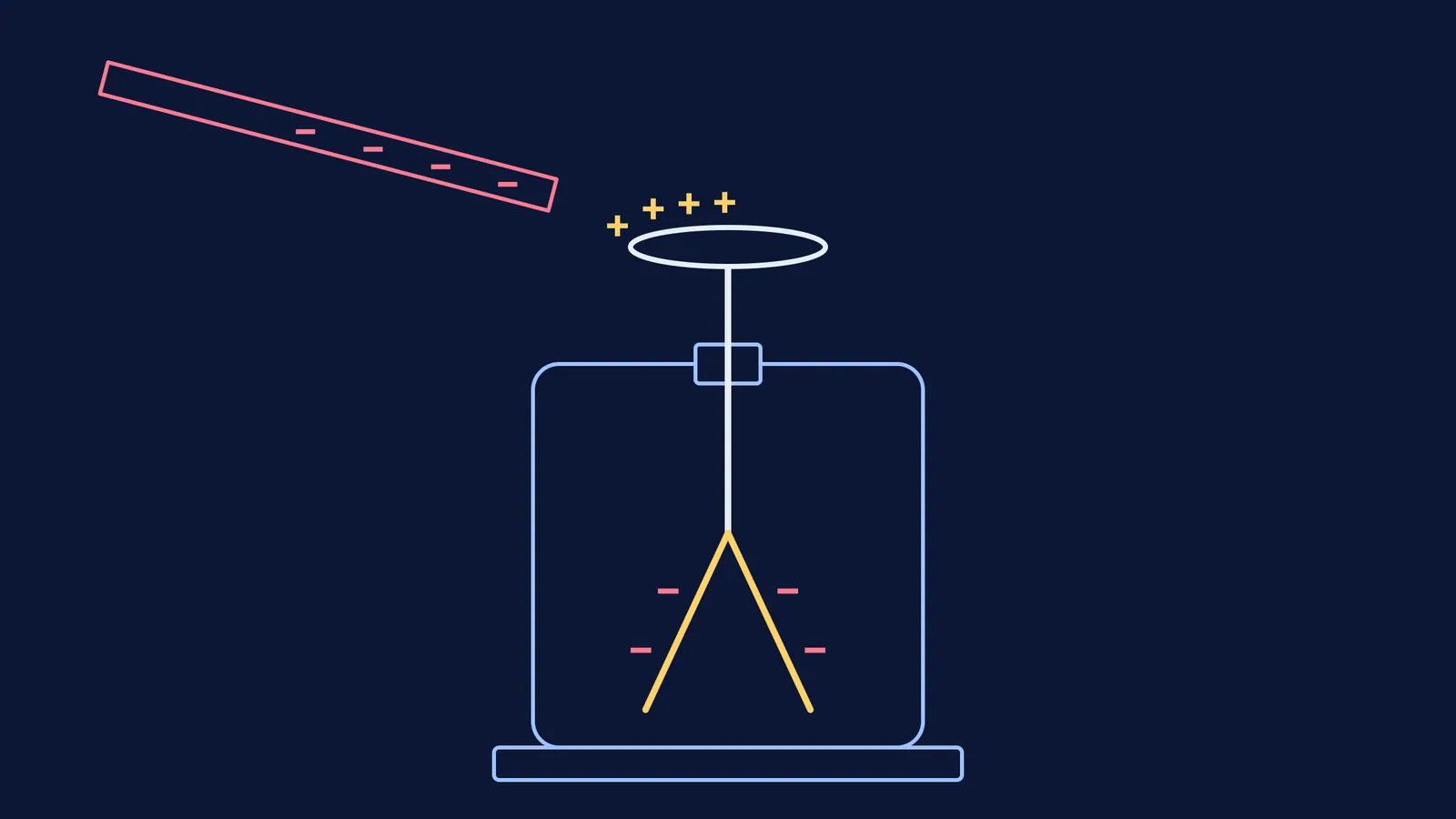
A gold-leaf electroscope is a vertical metal rod, usually brass, with two thin strips of gold leaf hanging from its lower end (Wikipedia). When the rod carries charge, both leaves get charge of the same sign, repel each other and spread apart. Connect the rod to the ground and the charge flows away, so the leaves drop back together.
The wider the leaves open, the greater the charge, but on its own the instrument shows only that charge is present, not whether it is positive or negative (National MagLab). To find the sign you compare against a known charge, as in the callout below. Indian students meet it early: a Class 8 State Board science lesson on YaClass credits the instrument to Bennet in 1787.
How do you charge an electroscope by induction?
Charging by induction leaves an object with a charge opposite in sign to the rod that caused it, without the two ever touching (OpenStax College Physics on LibreTexts). Here it is with a negatively charged rod, the case drawn above. Before each step, say what the leaves will do, then check.
Bring the negative rod near the cap without touching. Electrons in the metal are pushed down to the leaves; the cap is left positive. The leaves open.
Touch the cap with a finger while the rod stays put. The pushed electrons escape through you to the earth. The leaves close.
Take your finger away first. The electroscope is now short of electrons, but the nearby rod still holds that positive charge up at the cap. The leaves stay closed.
Now take the rod away. The positive charge spreads over the whole conductor, including the leaves. The leaves open again, and the electroscope is positive.
Swap steps 3 and 4 and electrons flow back from the earth, leaving the electroscope neutral.
Induction can be hard to picture from a page. The Fermi Simulation Lab has interactive simulations for the ideas that are easier to see than to read, so you can watch an idea like this instead of only picturing it.
What should you remember for exams?
Contact charging gives the same sign as the rod; induction gives the opposite sign (LibreTexts).
Leaves open for any net charge on them; the opening alone never tells you the sign.
In induction, remove the earth connection before the inducing rod.
Charge on a conductor sits on its outer surface, which is why a closed metal case shields what is inside; see our guide to conductors, surface charge and shielding.
Bennet's leaves came out of the same century of electrical experiment as the first capacitor; read about Pieter van Musschenbroek and the Leyden jar next. If the sign rules still feel shaky, the Fermi Concept Library covers every concept in physics, each with its own lesson and its place in the map.