

On this page
A balloon, a head of dry hair and a kitchen tap are enough for three memorable science experiments a child can do at home. The harder part is the explanation, because phrases many of us grew up with, such as "rubbing makes electricity", are the ones science teachers later have to undo.
What do you need, and is it safe?
You need a round balloon, blown up and tied; a woollen sweater or clean, dry hair; a few bits of paper torn to fingernail size; and a tap that can run a thin, steady stream.
The one real hazard is the balloon itself. The US Consumer Product Safety Commission warns that uninflated balloons and pieces of broken balloons can suffocate young children, and recommends that children under eight not play with uninflated balloons without supervision. An adult should blow the balloon up, and if it pops, pick up every piece straight away.
Choose a dry day if you can. In humid air, surfaces carry a thin, invisible film of water that acts as "a conducting path which carries away any static charges", as a University of Kentucky physics explainer puts it. So a sticky monsoon afternoon can make every trick fail, and that failure is worth talking about too.
How do you do the three balloon experiments?
Lift paper bits. Rub the balloon briskly on hair or wool, then hold it a few centimetres above the paper. The bits jump up and cling, and some fly off again.
Stick it to a wall. Rub again, press the rubbed side gently against a painted wall and let go. Ask your child to guess how long it will stay, then check.
Bend water. Open the tap until the stream is thin but unbroken. Bring the rubbed side close without touching. The stream curves towards the balloon.
Before each step, ask for a prediction ("What if we use the side we did not rub?") and then test it. Guessing first and checking second is the real science here.
Why does a rubbed balloon pick up paper that has no charge?
Rubbing moves electrons, the tiny negatively charged particles in the outer part of every atom, from one surface to the other. No charge is created: one object ends up with extra electrons and the other is left short. A 2011 study in Science found that rubbing two objects leaves patches of positive and negative charge on both surfaces, so the real picture is messier than a textbook drawing, but the rule holds: both objects change.
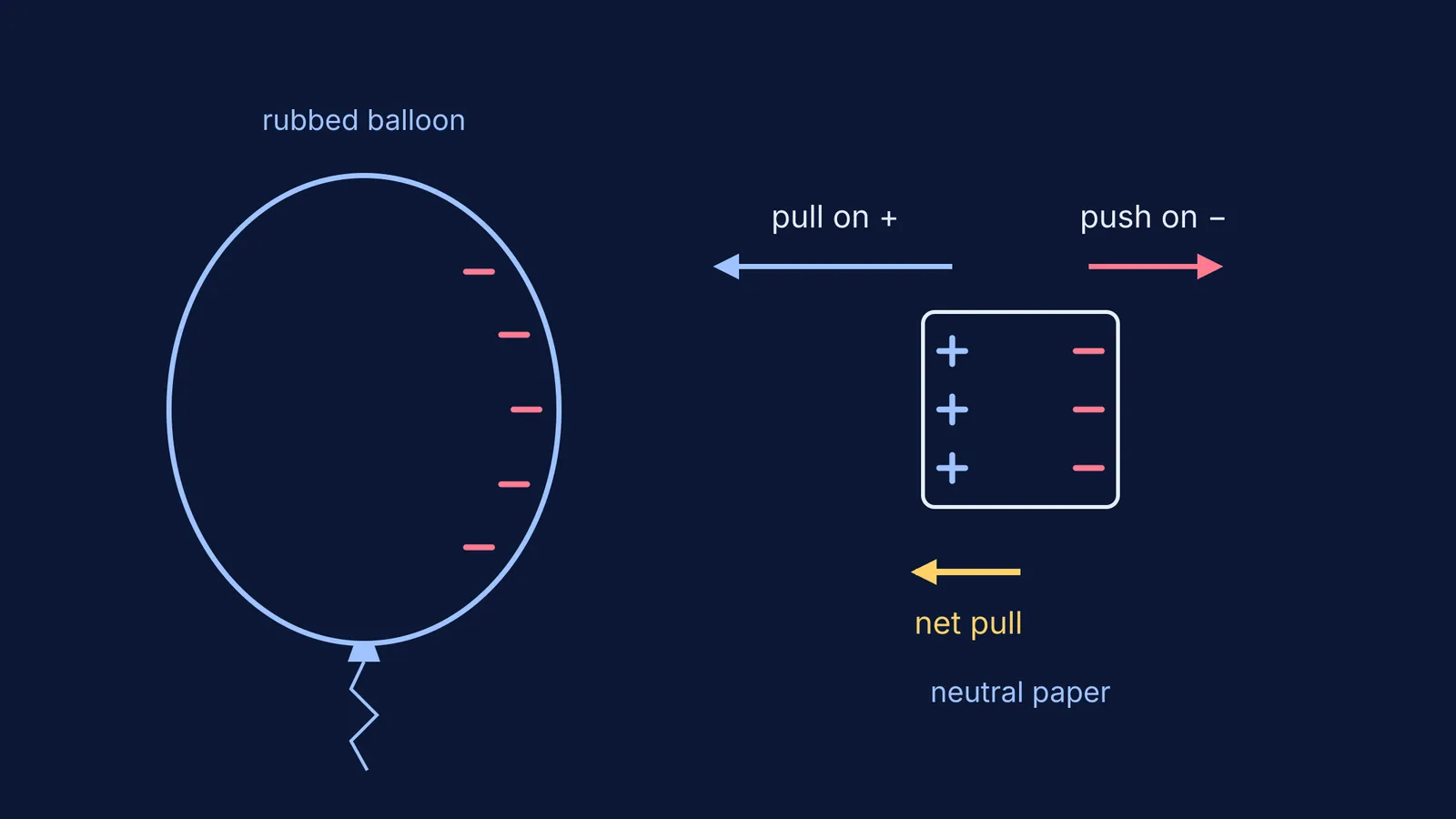
The paper bits start neutral. When the balloon comes close, the charges inside each bit shift slightly, so the side nearest the balloon carries the opposite charge and the far side carries the same charge. Opposites attract and likes repel, but the force weakens quickly with distance, as Charles Coulomb worked out, so the pull on the near side beats the push on the far side. The diagram at the top of this page shows that balance. A wall works the same way.
Why does a balloon bend water?
Chemistry textbooks often show a bending water stream as a sign that water molecules are polar. A 2000 paper in the Journal of Chemical Education by Arizona State University chemists tested that idea and found a different cause. When the drops formed inside a shielded, field-free space, even a vigorously charged balloon could not visibly bend the stream. The bend happens because each drop picks up a small net charge, opposite to the balloon's, at the moment it breaks away, and the balloon then pulls on that charge. The authors recommended that the demonstration stop being used to show that molecules are polar.
What words should you use so later science lessons make sense?
Mix-ups about charge can last into secondary school. In one small study of 22 Class X students at an Indonesian vocational school, published in the ICRIEMS 2020 proceedings, 54.5% held a misconception about charging by rubbing, and the authors note learners who thought an object turns positive by losing protons rather than electrons. Plain, accurate words now leave less to unlearn later.
Use this script:
Say "Rubbing moves electrons from one thing to the other", not "Rubbing makes electricity".
Say "Both things got charged", not "The balloon got charged" on its own.
Say "Positive means it is short of electrons", not "It has extra protons".
Say "The paper's charges shifted", not "The balloon is a magnet".
Say "electric charge", not "static" as if it were a substance.
For a young child, "tiny bits called electrons" is enough. Later, the idea that the force weakens with distance becomes Coulomb's law, and nothing learned at the tap has to be thrown away.
If an older child wants to read more about charge, the Fermi Concept Library covers every concept in physics, chemistry, biology, mathematics and computing, each with its own lesson. For more evenings like this, try our kitchen science experiments for families and our guide to encouraging curiosity at home.


