On this page
A fire extinguisher only works if it suits what is burning. Pick the wrong one and you can spread burning oil across a kitchen, or get a shock from live wiring. India's code for choosing extinguishers, IS 2190 from the Bureau of Indian Standards, sorts fires by their fuel and says which extinguisher suits each.
What is the fire triangle?
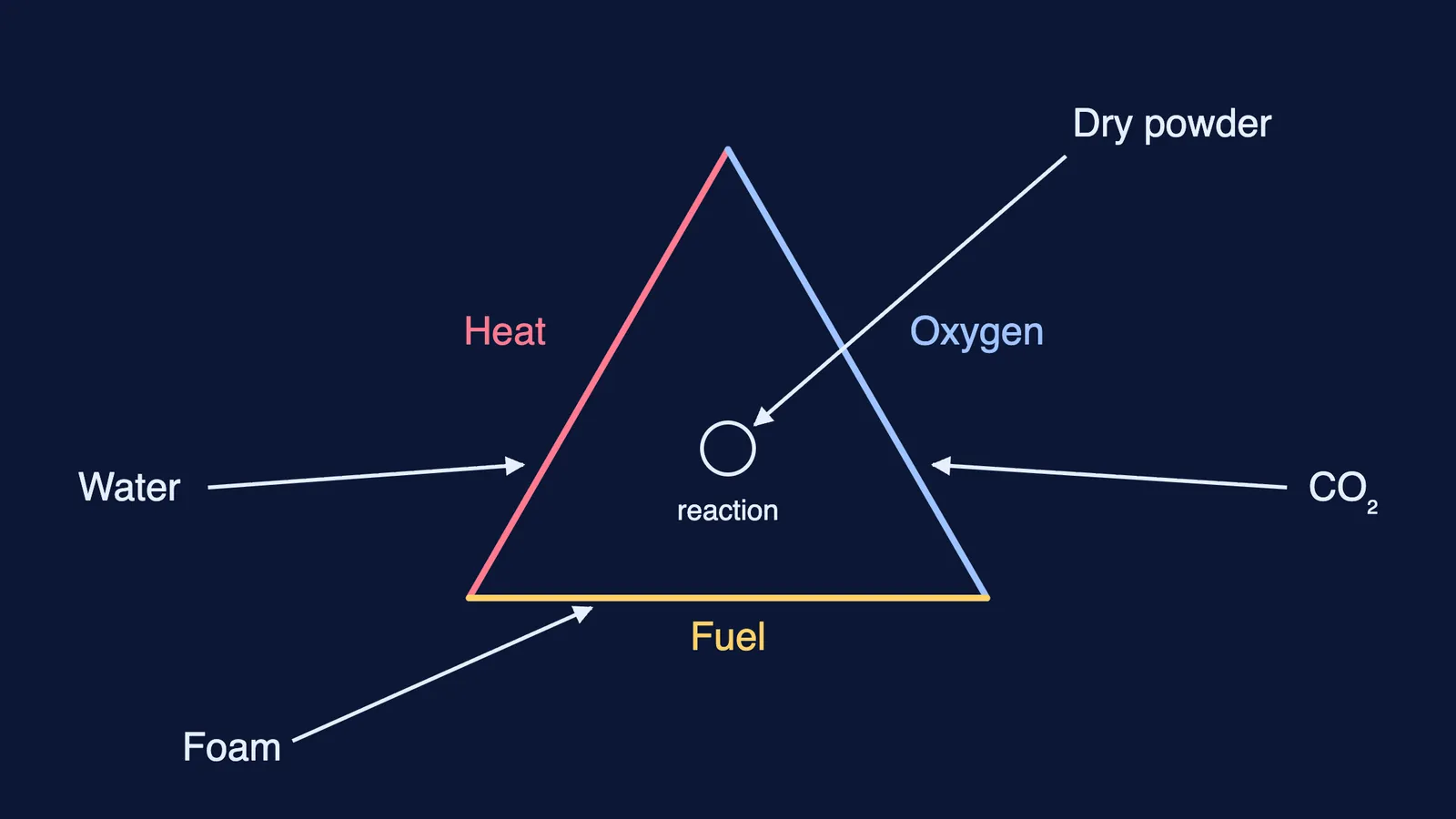
A fire needs three things at once: fuel, oxygen, and enough heat to reach the fuel's ignition temperature. OSHA's guide to portable extinguishers adds a fourth, the chemical reaction itself, which is why the triangle is sometimes drawn as a fire tetrahedron. Take away any one and the fire goes out.
The same OSHA page explains how three agents attack them:
Water cools the surface of the fuel, taking away heat.
Carbon dioxide displaces oxygen.
Dry powder coats the fuel in a thin layer that separates it from oxygen, and it also interrupts the chemical reaction.
Foam lays a blanket over a burning liquid, and IS 2190 says a blanketing effect is what liquid fires need.
What are the classes of fire in India?
Clause 9 of IS 2190 groups fires into four classes by fuel:
Class A: solids such as wood, paper, rubber and plastics, where the cooling effect of water is essential.
Class B: flammable liquids or liquefiable solids, where a blanketing effect is essential.
Class C: flammable gases under pressure, including liquefied gases.
Class D: combustible metals such as magnesium, aluminium, zinc, sodium and potassium.
A 2023 Bureau of Indian Standards explainer adds Class F: cooking oils and fats in cooking appliances. It names petrol and kerosene (Class B) and LPG (Class C) as examples.
Watch out for imported labels. In the US system described by OSHA, Class C means live electrical equipment and Class K means cooking oils and fats. A "C" on a US-made extinguisher means electrical; in IS 2190 it means gas.
Which fire extinguisher for which fire?
This is the suitability table of IS 2190 (Table 3) in plain words:
Water: Class A only. Not for liquids, gases, metals or anything live.
Mechanical foam: Class A and B. Not for gas or metal fires.
Carbon dioxide: Class B and C. Not for Class A, because solids can smoulder and reignite after the gas drifts away, as OSHA notes.
Dry powder (ABC type): Class A, B and C. The standard calls dry powder a quick knockdown agent, but warns that it can cut visibility for a few minutes in a confined space and that a liquid fire can reignite once the discharge stops.
Special dry powder for metals: Class D only.
Clean agent: Class A, B and C.
For live electrical equipment, IS 2190 says only dry powder, carbon dioxide (without a metal horn) or clean agent extinguishers should be used, because the agent must not conduct electricity.
Worked example: one school, four rooms
Library (paper, wooden shelves): Class A. Water, foam or ABC powder.
Chemistry lab (ethanol or acetone on the bench): Class B. Both mix with water, so IS 2190 asks for dry powder or alcohol-resistant foam; carbon dioxide also suits Class B. Our post on the chemistry lab safety rules and the accident each one prevents explains why solvents stay away from flames.
Computer room: live electronics. Where they could be damaged, the standard allows only carbon dioxide or clean agent.
Canteen kitchen (LPG and hot oil): Class C and Class F. Closing the gas valve, if you can reach it safely, removes the fuel. For a gas fire, IS 2190 lists dry powder, carbon dioxide or clean agent. For kitchens with fat fryers, the UK Home Office guide for small premises says to provide a fire blanket and a Class F extinguisher made for burning fats and oils. Here is why you should never pour water on burning oil.
If you want to see what is inside each cylinder, read our explainer on how different fire extinguishers put out fires. For the chemistry of combustion, the Fermi Concept Library covers every chemistry and physics concept, each with its own lesson.
How do you use an extinguisher, and when should you not?
OSHA teaches the PASS steps on its extinguisher use page:
Pull the pin.
Aim low, at the base of the fire.
Squeeze the handle.
Sweep from side to side at the base until the fire appears to be out, then back away in case it flares up again.
Don't touch the plastic horn of a CO2 extinguisher; OSHA warns it gets very cold and may damage skin. If the fire is spreading, the extinguisher runs out, or you have any doubt, leave and call the fire service.
IS 2190 also says nobody should have to walk more than 15 m from a fire to reach an extinguisher, so at home or school, find the nearest one today and read its label.