On this page
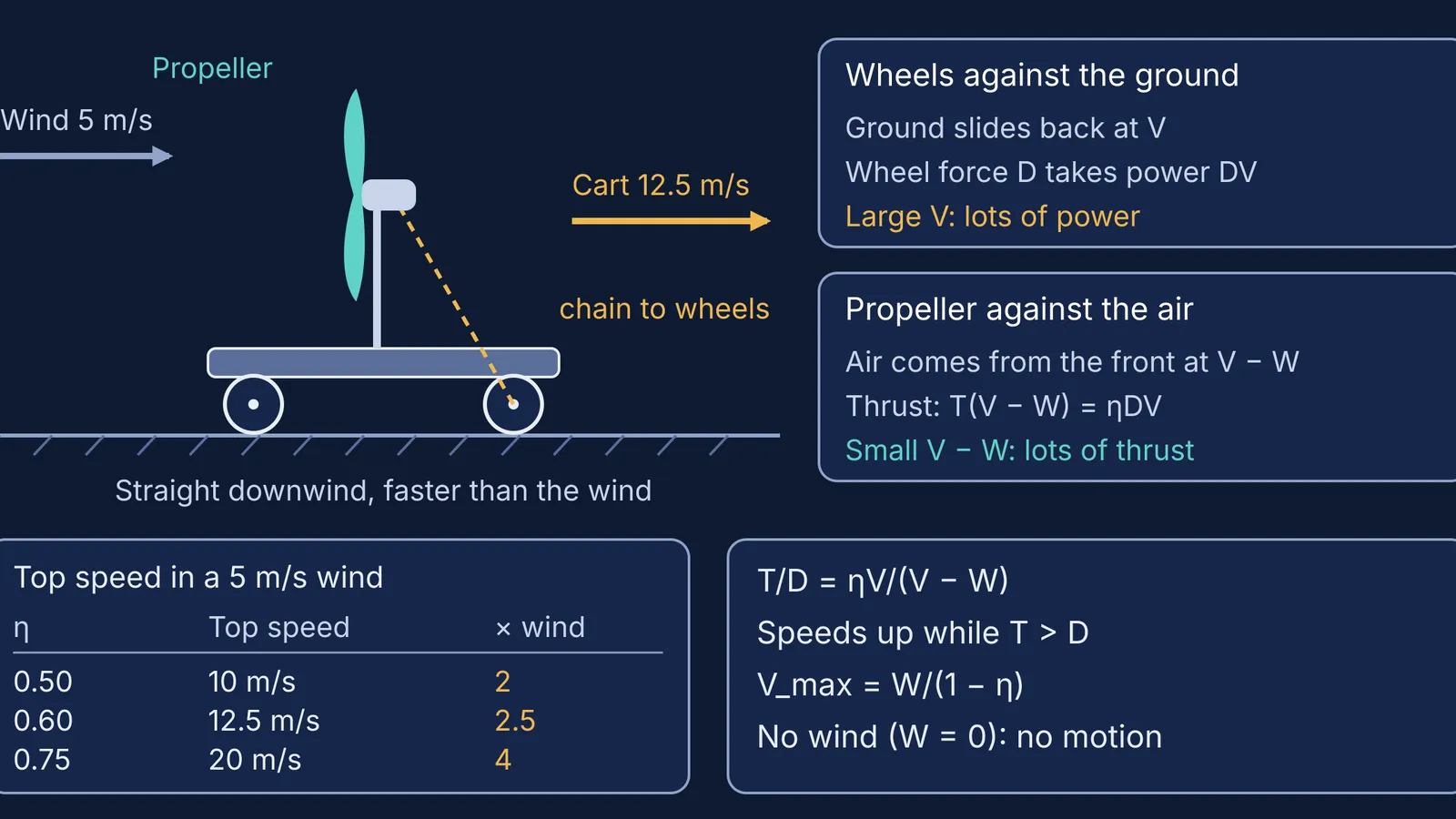
Can a vehicle powered only by the wind go straight downwind faster than the wind itself? Most people say no: once you match the wind, it stops pushing. Yet a light cart with a propeller geared to its wheels can do it, and the reason is a neat piece of relative velocity and power that works well as a JEE or INPhO style puzzle. With a 5 m/s wind and a propeller that turns 60% of the wheel power into useful thrust, the cart can reach 12.5 m/s, 2.5 times the wind.
How is this cart different from a sailing boat?
A sail is pushed by the air moving past it. Going straight downwind, a sail can never go faster than the wind, because at wind speed the air around it is still and there is no push. A boat sailing across or towards the wind uses a different trick, apparent wind and a keel, explained in how a sailing boat moves towards the wind.
The downwind cart has no sail. Its wheels are connected by a chain or gears to a propeller, and the propeller is driven by the wheels. As the cart rolls, the wheels turn the propeller, which pushes air backwards and so pushes the cart forwards. That sounds like a perpetual motion machine until you notice that the wheels and the propeller are working against two different things moving at two different speeds.
Why do the wheels and the propeller see different speeds?
Let the wind blow at W and the cart move in the same direction at V, with V > W. Look at each part in its own frame, the same move you make in the rain and umbrella relative velocity problem.
Wheels. Relative to the cart, the ground slides backwards at speed V. The wheels resist turning because they drive the propeller, so the ground pushes back on the cart with a drag force D. The power taken from the ground is P = DV. Because V is large, a modest force gives a lot of power.
Propeller. Relative to the cart, the air comes from the front at only V − W. A propeller of efficiency η turns shaft power P into thrust T with T(V − W) = ηP. Because V − W is small, that power buys a large force.
Put them together: T(V − W) = ηDV, so T/D = ηV/(V − W). The cart speeds up as long as T > D, that is, as long as ηV > V − W. Rearranging, V < W/(1 − η). That is the top speed.
How fast can the cart go in a 5 m/s wind?
Take W = 5 m/s and ignore rolling resistance and air drag on the body. These efficiencies are illustrative.
η = 0.5: V_max = 5/(1 − 0.5) = 10 m/s, twice the wind.
η = 0.6: V_max = 5/(1 − 0.6) = 12.5 m/s, 2.5 times the wind.
η = 0.75: V_max = 5/(1 − 0.75) = 20 m/s, four times the wind.
Force check at V = 10 m/s with η = 0.6: T/D = 0.6 × 10/(10 − 5) = 1.2. The thrust is 20% bigger than the wheel drag, so the cart is still speeding up.
Put in numbers: suppose D = 100 N at V = 10 m/s. The wheels take 100 × 10 = 1,000 W. The propeller turns 600 W of that into thrust against air arriving at 5 m/s, so T = 600/5 = 120 N. Net forward force 20 N.
At V = 12.5 m/s: T/D = 0.6 × 12.5/7.5 = 1.0. No net force: this is the top speed.
Units check: T(V − W) and DV are both N × m/s = W, so η is a pure number, as it should be.
Notice what happens as η falls. If η = 0, the propeller does nothing and the top speed is W, just like a sail. Every bit of propeller efficiency raises it. Real carts lose some power to rolling and body drag, so their top speed is lower than this simple formula gives, and η here stands for the combined efficiency of the gearing and the propeller. The formula is for V > W; below wind speed the wind pushes on the cart and its propeller anyway.
Does this break conservation of energy?
No. Set W = 0 in the formula: the top speed is 0/(1 − η) = 0. With no wind there is no motion, so the cart is not making energy from nothing.
The energy comes from the difference between the motion of the air and the motion of the ground. Look at it in the frame of the air: the air is still, and the ground slides backwards under it at speed W. The cart is a machine sitting between two things in relative motion, the moving ground and the still air, much as a wind turbine sits between moving air and the fixed ground, as explained in how wind turbines make electricity from moving air. The propeller throws air backwards relative to the ground, so it slows the wind slightly. That lost kinetic energy of the air is what drives the cart.
Has anyone actually built one?
Yes. The North American Land Sailing Association (NALSA) record page states that the cart Blackbird, driven by Rick Cavallaro on 2 July 2010, sailed directly downwind at 27.7 mph in a sustained 10 mph wind, a ratio of cart speed to true wind speed of nearly 2.8.
You can use the simple model to see what that demands. A ratio of 2.8 needs 1/(1 − η) ≥ 2.8, so η ≥ 1 − 1/2.8 = 0.64. Since the real cart also had rolling and body drag, its gearing and propeller together must have done better than 64%. That is the kind of estimate examiners like: a simple model that gives a lower bound.
How would this appear in a JEE problem?
Expect it dressed as a power-and-relative-velocity question: given W, η and a speed, find the net force or the top speed, or show that the speed is limited. The steps are always the same: write the wheel power in the ground frame, the thrust power in the air's frame, set them equal with η, and compare T with D. For more problems of this kind, the Fermi Problem Library has a step-by-step solver that explains the reasoning.
If you are preparing for JEE, Fermi Test Prep offers personalised preparation for JEE Main & Advanced with an AI tutor, live classes, adaptive mocks, mentorship and a study plan that updates based on mastery.
Quick checklist
The propeller is driven by the wheels; it is not a sail being blown.
Wheel power in the ground frame: P = DV.
Propeller thrust in the cart frame: T(V − W) = ηDV, so T/D = ηV/(V − W).
The cart speeds up while V < W/(1 − η); with W = 5 m/s and η = 0.6, that is 12.5 m/s.
With no wind, the top speed is zero. The energy comes from the air moving relative to the ground.
Blackbird's NALSA ratio of nearly 2.8 needs a combined efficiency above 64% in this model.