On this page
NCERT Class 11 Chemistry, Unit 6 (Equilibrium), Problem 6.20 asks for the pH of 0.08 M hypochlorous acid, HOCl, and gives its ionization constant as 2.5 × 10⁻⁵. The worked answer is pH 2.85. Two pages earlier, the same chapter's Table 6.6 lists hypochlorous acid at 3.0 × 10⁻⁸ at 298 K. Both numbers cannot describe the same acid. Measured data agree with the table, so the problem's Ka is about 830 times too large. The method in the solution is fine. The number fed into it is not, and it is worth knowing why that matters.
What does NCERT Problem 6.20 say?
In the Reprint 2026-27 of NCERT Class 11 Chemistry, Unit 6, page 197, the problem reads: "Calculate the pH of 0.08M solution of hypochlorous acid, HOCl. The ionization constant of the acid is 2.5 × 10⁻⁵. Determine the percent dissociation of HOCl."
The solution sets up HOCl(aq) + H₂O(l) ⇌ H₃O⁺(aq) + ClO⁻(aq), uses x²/0.08 = 2.5 × 10⁻⁵, and gets:
[H⁺] = 1.41 × 10⁻³ M
percent dissociation = 1.76%
pH = 2.85
The arithmetic is correct for the Ka given. On page 195 of the same chapter, Table 6.6 ("The Ionization Constants of Some Selected Weak Acids (at 298K)") gives hypochlorous acid as 3.0 × 10⁻⁸. The ratio of the two values is 2.5 × 10⁻⁵ ÷ 3.0 × 10⁻⁸ ≈ 830.
What is the real Ka of hypochlorous acid?
The table value matches what water chemists measure. Health Canada's guideline technical document on chlorine in drinking water (section 4.4) states that at pH 6.5, a chlorine solution contains about 92.4% HOCl and 7.6% OCl⁻ at 20 °C, and 95.5% HOCl and 4.5% OCl⁻ at 0 °C.
You can turn those percentages into a pKa with the Henderson–Hasselbalch equation, pKa = pH + log([HOCl]/[OCl⁻]):
At 20 °C: pKa = 6.5 + log(92.4/7.6) = 6.5 + 1.08 = 7.58
At 0 °C: pKa = 6.5 + log(95.5/4.5) = 6.5 + 1.33 = 7.83
The pKa falls as the temperature rises, so a value near 7.5 at 25 °C fits. NCERT's own 3.0 × 10⁻⁸ gives pKa = −log(3.0 × 10⁻⁸) = 7.52. A widely cited laboratory measurement of this constant over 5 to 35 °C is a 1966 paper by J. Carrell Morris in the Journal of Physical Chemistry.
A Ka of 2.5 × 10⁻⁵ would mean pKa 4.60. No measurement we could find puts HOCl anywhere near that, and NCERT does not say where the number comes from. Treat it as a number chosen for practice, not as data about HOCl.
Worked example: the pH of 0.08 M HOCl with the measured Ka
Use NCERT's own Table 6.6 value, Ka = 3.0 × 10⁻⁸ at 298 K.
Write the equilibrium. HOCl + H₂O ⇌ H₃O⁺ + ClO⁻. Let x = [H₃O⁺] = [ClO⁻] at equilibrium, so [HOCl] = 0.08 − x.
Set up Ka. Ka = x²/(0.08 − x) = 3.0 × 10⁻⁸.
Approximate. Ka is tiny, so x is far smaller than 0.08. Then x² = 3.0 × 10⁻⁸ × 0.08 = 2.4 × 10⁻⁹.
Solve. x = √(2.4 × 10⁻⁹) = 4.90 × 10⁻⁵ M.
Check the approximation. Percent dissociation = (4.90 × 10⁻⁵ ÷ 0.08) × 100 = 0.061%, far below the usual 5% limit.
Check water's contribution. 4.90 × 10⁻⁵ M is about 500 times the 1 × 10⁻⁷ M from water, so you can ignore water.
pH. pH = −log(4.90 × 10⁻⁵) = 4.31.
Compare the two answers:
With Ka = 2.5 × 10⁻⁵: [H⁺] = 1.41 × 10⁻³ M, pH 2.85, 1.76% dissociated.
With Ka = 3.0 × 10⁻⁸: [H⁺] = 4.90 × 10⁻⁵ M, pH 4.31, 0.061% dissociated.
The Ka values differ by a factor of about 830, but [H⁺] goes as √Ka, so [H⁺] differs by √830 ≈ 29 and the pH by about 1.5 units. If you want to reverse the process and get Ka from a measured pH, see how to find Ka from the pH of a weak acid solution.
Why does a wrong Ka matter if the method is right?
For the marks in this one problem, it does not. For your sense of chemistry, it does, because the number changes where HOCl sits among acids you know.
Against acetic acid. Table 6.6 gives acetic acid Ka = 1.74 × 10⁻⁵. With 2.5 × 10⁻⁵, HOCl would be about 1.4 times stronger than acetic acid. With the table value, HOCl is about 580 times weaker. HOCl is a very weak acid, closer to HCN than to vinegar.
Against the oxoacid rule of thumb. Pauling's rule pKa ≈ 8 − 5p predicts about 8 for HOCl, since it has no oxygen without a hydrogen (p = 0). The measured 7.5 fits; 4.6 does not. The rule and the order HOCl < HClO₂ < HClO₃ < HClO₄ are explained in why HClO₄ beats HOCl in acidity.
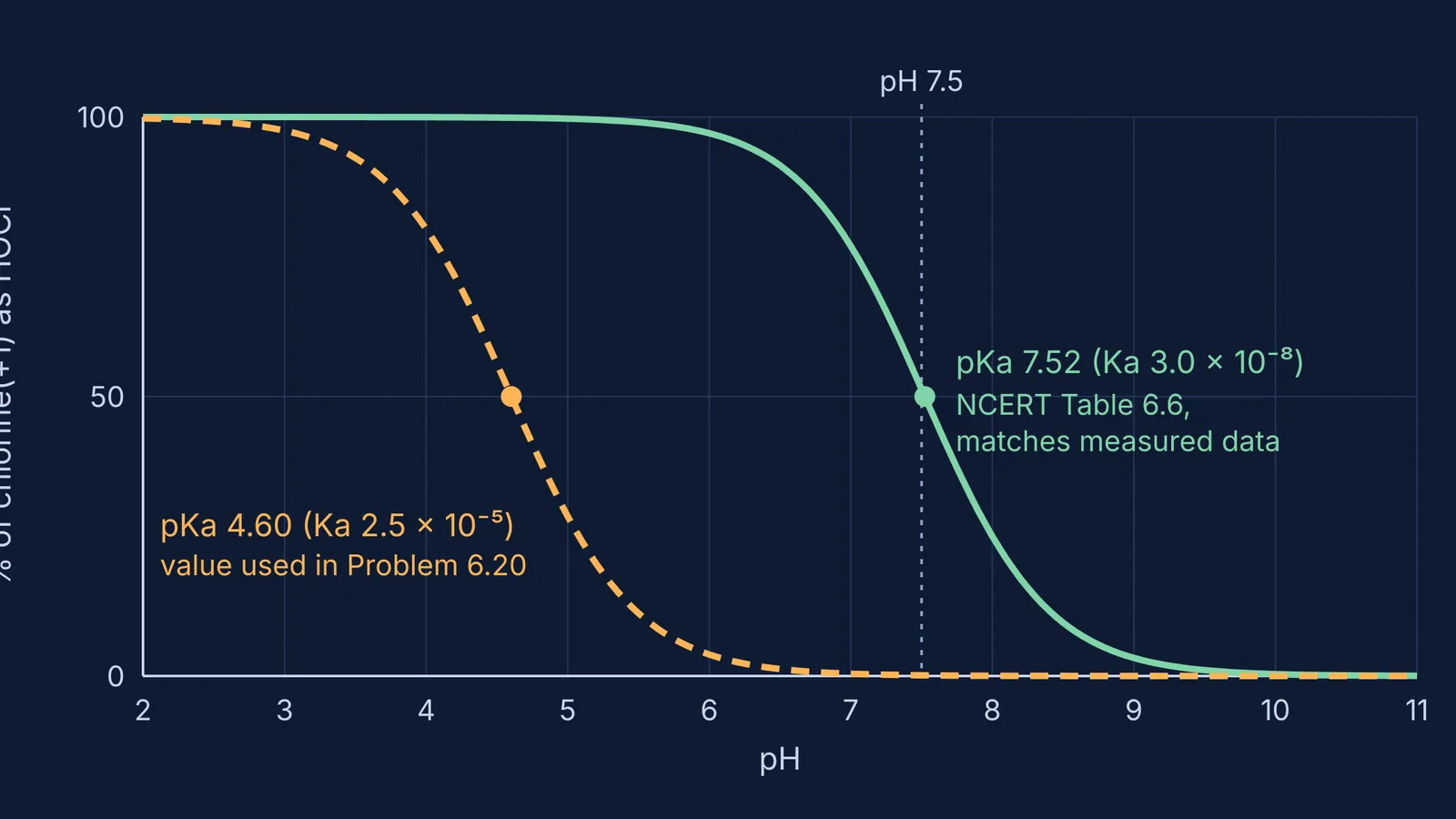
Against water treatment. The fraction of chlorine(+1) present as HOCl is 1/(1 + 10^(pH − pKa)). At pH 7.5, pKa 7.52 gives 51%, about half HOCl and half OCl⁻. That is why pool and tap-water operators watch pH so closely; see why swimming pools make your eyes red. With pKa 4.60, only 0.13% would be HOCl at pH 7.5, and pH control would hardly matter.
The hero graph above shows this. The two curves have the same shape, but the one built on 2.5 × 10⁻⁵ is shifted almost three pH units to the left.
What should you remember about HOCl's acid strength?
Keep two different questions apart in your head.
"Calculate the pH, Ka = ..." This is a method question. Use the number printed in the question. Examiners grade the method and the arithmetic.
"Which is the stronger acid?" or "Why is HOCl a better disinfectant at pH 6.5 than at 8.5?" This is a chemistry question. Use pKa ≈ 7.5.
The same habit helps with other textbook problems. Before you start, glance at the Ka and ask whether it looks right for that acid. If it doesn't, still use it to answer the question, then note the real value for yourself.
If you prepare for JEE and want practice that pairs numericals with the chemistry behind them, Fermi Test Prep covers JEE Main and Advanced preparation. When a textbook number and a table disagree and you are not sure which to trust, Fermi's AI tutor for JEE prep can work through the check with you.
Quick checklist
NCERT Problem 6.20 uses Ka = 2.5 × 10⁻⁵ and gets pH 2.85. Use that in the exam.
NCERT Table 6.6 gives HOCl Ka = 3.0 × 10⁻⁸ (pKa 7.52), which matches measured data.
The two differ by about 830 times in Ka and about 1.5 units in pH.
With the real Ka, 0.08 M HOCl has pH 4.31 and is only 0.061% dissociated.
HOCl is weaker than acetic acid and about half dissociated at pH 7.5.
pKa depends on temperature: about 7.8 at 0 °C and 7.6 at 20 °C.