On this page
Suppose someone offers you a coin that lands heads 60% of the time, and you may bet any amount on heads at even money. Two researchers ran exactly this game as an experiment (Haghani and Dewey, arXiv). You have an edge. The hard question is not whether to bet but how much. Bet too much and you can lose money in the long run even though every bet favours you.
This is a maths lesson, not a tip to gamble; in real life you rarely know your true chance of winning.
What is the Kelly criterion?
The Kelly criterion is a rule for sizing repeated bets, first set out by John L. Kelly Jr. in the Bell System Technical Journal in 1956 (Kelly, A New Interpretation of Information Rate).
The Kelly criterion chooses the bet that maximises the expected value of the logarithm of your wealth (Wikipedia: Kelly criterion; Thorp, The Kelly criterion in blackjack, sports betting and the stock market).
For a simple bet, the answer is a fraction of your bankroll:
The Kelly fraction: f* = p − q/b
p is your chance of winning and q = 1 − p is your chance of losing.
b is the net odds: you win b rupees for every rupee staked, and lose the rupee if you lose.
If f* comes out zero or negative, you have no edge, and Kelly says do not bet at all.
How much should you bet on a 60–40 coin?
At even money, b = 1, so f* = 0.6 − 0.4 = 0.2. The authors of the experiment below note that the Kelly criterion "would tell the subject to bet 20% (2*.6-1) of his account on heads on each flip" (Haghani and Dewey, arXiv).
A worked example we computed: start with ₹1,000. Betting a fraction f, each win multiplies your money by (1 + f) and each loss by (1 − f). Over 100 flips with 60 heads and 40 tails, the order does not matter, only the counts:
Bet 10% (half Kelly): 1.1^60 × 0.9^40 ≈ 4.5, so about ₹4,500.
Bet 20% (Kelly): 1.2^60 × 0.8^40 ≈ 7.5, so about ₹7,500.
Bet 30%: about 4.4, so about ₹4,400.
Bet 40%: about 0.78, so you end with about ₹780.
Bet 50%: about 0.033, so you end with about ₹33.
With the same 60 wins, the 40% bettor loses money while the 20% bettor multiplies it 7.5 times.
Why does betting more than Kelly lose money over time?
The expected gain on each flip is positive at any bet size: 0.6f − 0.4f = 0.2f. But your money multiplies, it does not add, which is why Kelly works with the logarithm of wealth (Wikipedia: Kelly criterion). A 40% win followed by a 40% loss leaves you with 1.4 × 0.6 = 0.84 of what you started with. Losses hurt more than equal-sized wins help.
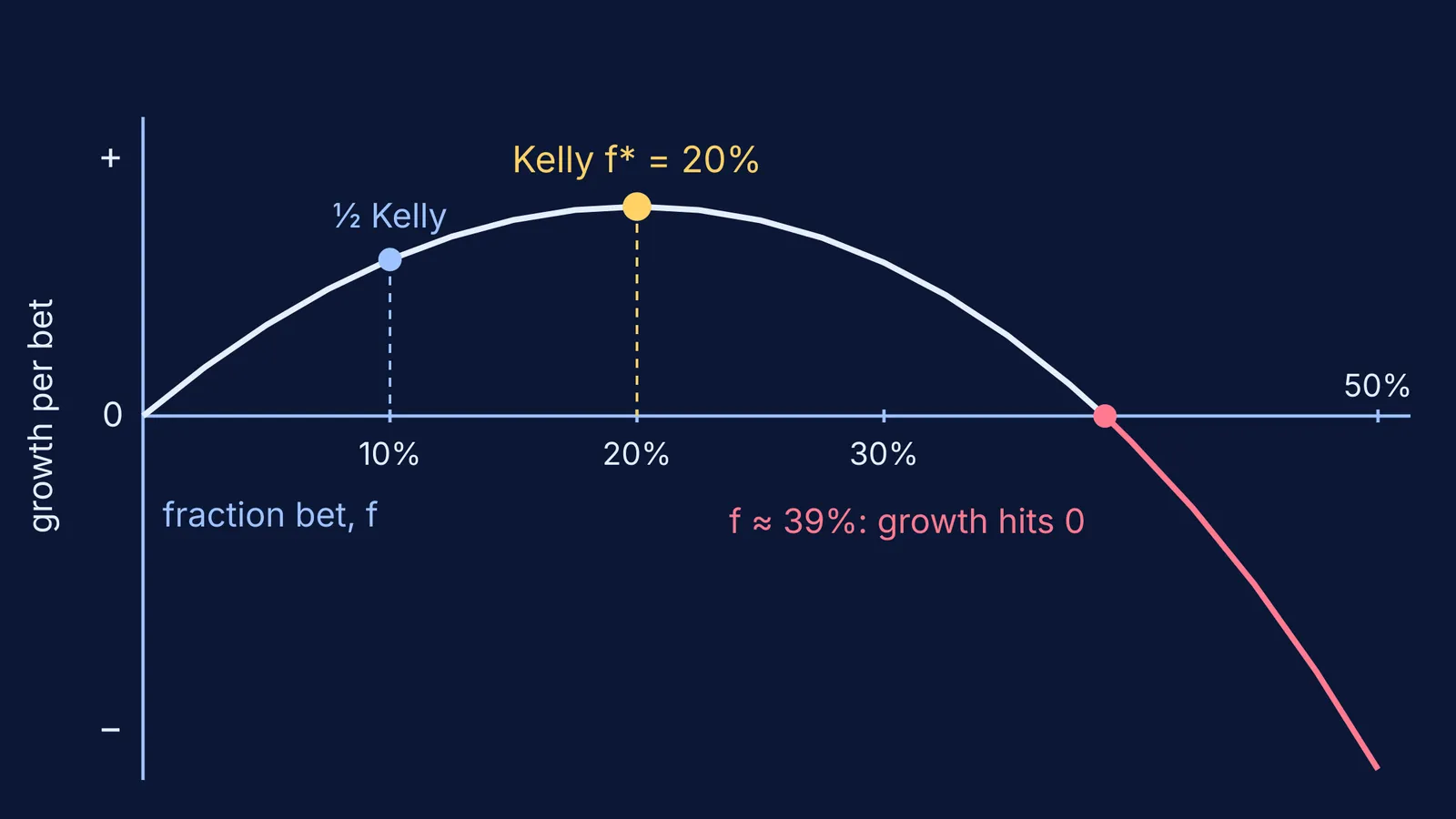
What matters is the average growth of log wealth per bet, which Kelly maximises:
g(f) = p ln(1 + f) + q ln(1 − f)
For the 60–40 coin, g(0.2) ≈ 0.0201 per flip, the peak. The curve then falls and crosses zero at f ≈ 0.39, roughly twice the Kelly fraction. Any bigger, and your wealth shrinks over time despite the edge. For small edges at even money, g(f) ≈ (p − q)f − f²/2, which is zero at f = 2(p − q), twice Kelly.
Averages also mislead in the St Petersburg paradox, a coin game with infinite expected value. To revise the averaging itself, see how to check if a dice game is fair using expected value.
What happened when people played the 60–40 coin?
Victor Haghani and Richard Dewey gave 61 subjects $25 and 30 minutes to bet on a simulated coin with a 60% chance of heads, with winnings capped at $250 (Haghani and Dewey, arXiv). The sample was largely economics and finance students and young professionals at finance firms.
The paper reports that 28% of participants went bust (its abstract rounds this to about 30%) and only 21% reached the $250 maximum, counting anyone who finished with at least $200. Of the 61 subjects, 18 bet their entire bankroll on a single flip.
Why do people use half-Kelly in practice?
Kelly assumes you know p exactly. You do not. If you think your edge is 60–40 but it is really 55–45, full Kelly on your estimate is twice the true Kelly fraction, which sits right at the line where growth stops. Wikipedia's article notes that "Even Kelly supporters usually argue for fractional Kelly", trading some growth for lower volatility (Wikipedia: Kelly criterion).
In our 60–40 example, half Kelly gives g(0.1) ≈ 0.0150 per flip, about 75% of the full-Kelly growth, for half the bet size. The small-edge formula gives three-quarters in general.
A four-step check for any bet in a textbook problem:
Write down p honestly, then shade it down a little.
Find b, the net payout per rupee staked.
Compute f* = p − q/b. If it is zero or negative, do not bet.
Bet half of f*, and never more than f* itself: above it you take more risk for less growth.
If logarithms or expectation feel shaky, the Fermi Concept Library gives every concept in mathematics its own lesson and its place in the map. To practise expected-value questions like these, the Fermi Problem Library has worked problems with a step-by-step solver that explains the reasoning rather than printing an answer. For a related tool, read how to use linearity of expectation with indicator variables.