

On this page
Picture a stall at a college fest. A coin is tossed until it lands heads. If heads comes on the first toss you win ₹2, on the second ₹4, on the third ₹8, and the prize keeps doubling with every tail. How much would you pay to play once?
Most of us would offer a small sum, perhaps ₹10 or ₹20. Yet the textbook tool for pricing a gamble, expected value, says the fair price is infinite. That clash is the St Petersburg paradox.
Where does the St Petersburg paradox come from?
The Stanford Encyclopedia of Philosophy entry by Martin Peterson states the standard game: a fair coin is flipped until it comes up heads, and the player wins 2ⁿ, where n is the number of flips. The same entry records that Nicolaus Bernoulli introduced the problem in 1713, in a letter to Pierre Rémond de Montmort.
His cousin Daniel Bernoulli published the best-known analysis in 1738 in the Commentaries of the Imperial Academy of Science of Saint Petersburg, and the paradox takes its name from that analysis (Wikipedia, St. Petersburg paradox).
Why is the expected payout infinite?
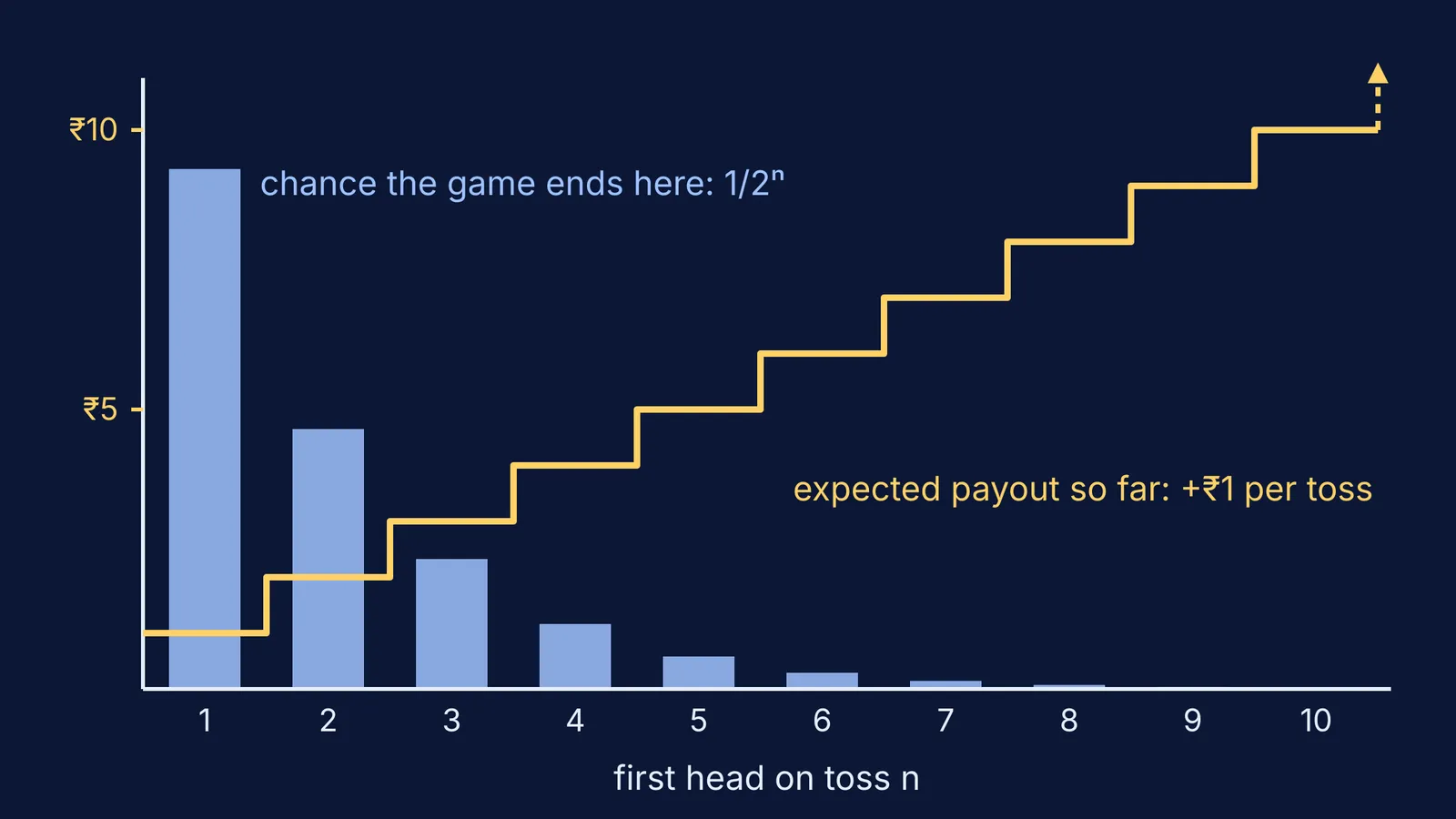
Expected value means: multiply each prize by its probability, then add. Here is the sum, term by term.
Heads on toss 1: probability 1/2, prize ₹2, contribution 1/2 × 2 = ₹1.
Heads on toss 2: probability 1/4, prize ₹4, contribution ₹1.
Heads on toss 3: probability 1/8, prize ₹8, contribution ₹1.
Heads on toss n: probability 1/2ⁿ, prize ₹2ⁿ, contribution ₹1.
So the expected payout is 1 + 1 + 1 + …, which grows without limit. The probability halves exactly as fast as the prize doubles, so every possible outcome adds the same rupee.
Compare this with the expected number of tosses until the first head: the probabilities are the same, but the count grows by 1 each step instead of doubling, so 1·1/2 + 2·1/4 + 3·1/8 + … settles at 2. It helps to split an expectation into simple pieces with linearity and check each one.
Why would no one pay much to play?
The classic answer is about what money is worth to you. In a 1728 letter to Nicolaus Bernoulli, quoted in the Stanford Encyclopedia entry, Gabriel Cramér wrote that "mathematicians value money in proportion to its quantity, and men of good sense in proportion to the usage that they may make of it." Daniel Bernoulli argued that the utility of wealth equals the logarithm of the amount; his paper was translated into English as "Exposition of a New Theory on the Measurement of Risk" in Econometrica in 1954.
The average also hides what a single play looks like. An average describes many plays. In one play the typical prize is tiny, and paying ₹1,000 means you lose money unless the first nine tosses are all tails, a chance of 1 in 512.
A worked example shows how much log utility shrinks the game. If the prize is all you have, the expected value of log₂(prize) is 1·1/2 + 2·1/4 + 3·1/8 + … = 2, the same sum as before. So the game feels like a sure 2² = ₹4. Wealth changes the answer: with natural-log utility, Wikipedia's worked figures say a person with $1,000 should pay up to $10.95, and a millionaire up to $20.88.
What happens when the bank runs out of money?
No stall can pay ₹2⁴⁰, so suppose the bank holds W rupees and pays at most W. Let L be the largest n with 2ⁿ ≤ W. The first L terms still add ₹1 each, and all the capped terms together add W/2ᴸ. The expected value becomes L + W/2ᴸ.
Bank of ₹1 lakh: L = 16, expected value about ₹17.53.
Bank of ₹1 crore: L = 23, expected value about ₹24.19.
Bank of ₹1,000 crore: L = 33, expected value about ₹34.16.
A bank 100,000 times richer adds only about ₹17 to the fair price, because the extra money only pays for outcomes that almost never happen. Wikipedia's table of finite lotteries makes the same point in dollars: a millionaire's game is worth about $20 and a billionaire's about $30.
How do you use this in a probability problem?
When a question asks whether a bet is fair, run four checks.
Write the expectation term by term before trusting a formula.
Ask whether the series converges; if each term stays the same size, it does not.
Ask whether every prize can actually be paid, and cap the terms if not.
Ask whether the question wants the average outcome or the value to a person, which is a utility question.
For a full walk-through of check 1 on ordinary games, see our guide to checking whether a game is fair with expected value. If a series like Σn/2ⁿ is where you get stuck, the Fermi Problem Library has worked problems with a step-by-step solver that explains the reasoning, and the Fermi Concept Library covers every concept in mathematics, each with its own lesson.
Try the capped sum with a bank of ₹10 lakh and check it against the pattern above.


