On this page
Pour ethanol into water and the beaker gets warm. The volume shrinks too. By the summary table most of us learn for Class 12 Solutions, warming and shrinking both point to a negative deviation from Raoult's law. Yet ethanol–water is the standard example of a positive deviation, and it forms the minimum boiling azeotrope at about 95% ethanol. All three facts are measured. They fit together once you separate heat (enthalpy) from escaping tendency (Gibbs energy), and this post shows how, with real data at 25 °C and a clear line on what to write in exams.
What does the usual rule link deviation to?
The rule of thumb pairs signs like this:
Positive deviation: A–B attractions weaker than A–A and B–B, vapour pressure above Raoult's law, ΔmixH > 0, ΔmixV > 0.
Negative deviation: A–B attractions stronger, vapour pressure below Raoult's law, ΔmixH < 0, ΔmixV < 0.
It works for many pairs. The full picture of ideal and non-ideal solutions is in our guide to Raoult's law for liquid mixtures. The rule assumes that the only change on mixing is in the energy of attractions, while the entropy of mixing stays ideal. For ethanol and water that assumption fails.
Is mixing ethanol and water really exothermic?
Yes, at room temperature. Calorimetry gives a negative excess enthalpy, H^E, at every composition at 25 °C. Benedetti, Cilense and Vollet measured a minimum of −785 J/mol at 298.15 K (abstract on OSTI), and Peeters and Huyskens, using dilution calorimetry at 25 °C, describe water–ethanol mixtures as exothermic over the whole concentration range (J. Mol. Struct. 1993). The heat is largest in water-rich mixtures.
The mixture also contracts: 50 mL of each gives about 96 mL, as worked out in why 50 mL ethanol and 50 mL water give 96 mL. Both signs are the ones the rule links to negative deviation.
Then why is the vapour pressure higher than Raoult's law predicts?
Because vapour pressure follows Gibbs energy, not enthalpy. For a real solution, each partial pressure is written p = γ × x × p°, where γ is the activity coefficient. Raoult's law is the case γ = 1. The extra Gibbs energy per mole of a component, compared with an ideal solution, is RT ln γ. So:
γ > 1 means positive deviation and a positive excess Gibbs energy, G^E > 0.
γ < 1 means negative deviation and G^E < 0.
Now use the relation you already know from thermodynamics, applied to the excess quantities: G^E = H^E − TS^E. If H^E is negative but G^E is positive, then TS^E must be negative and larger in size than H^E. The deviation is decided by entropy.
Where does the negative entropy come from?
From how water arranges itself around the ethyl group. The OH end of ethanol fits into water's hydrogen-bond network. The CH₃CH₂ end cannot hydrogen bond, so the water molecules next to it arrange their hydrogen bonds around it in a more ordered way. Fewer possible arrangements means lower entropy. This effect is called hydrophobic hydration.
This does not stop the two liquids from mixing. The total Gibbs energy of mixing is the ideal part (from −RΣx ln x, always negative) plus G^E. For ethanol and water the ideal part wins at every composition, which is why they mix in all proportions.
Worked example: positive deviation with heat given out, from measured data
Take a dilute solution with ethanol mole fraction x = 0.010 at 25 °C, where the effect is strongest. Data used:
Vapour pressure of pure ethanol at 25 °C: about 7.9 kPa, from the Antoine constants in the NIST Chemistry WebBook. Its enthalpy of vaporisation at 25 °C from the same page: about 42.4 kJ/mol.
Henry's law solubility constant of ethanol in water at 298.15 K: about 1.9 mol m⁻³ Pa⁻¹, with a temperature coefficient d(ln H)/d(1/T) of about 6400 K (Sander's compilation, many measurements).
Water's vapour pressure at 25 °C: 3.17 kPa. Water is about 55.3 mol per litre, or 55 300 mol m⁻³.
Ethanol concentration. c ≈ 0.010 × 55 300 = 553 mol m⁻³.
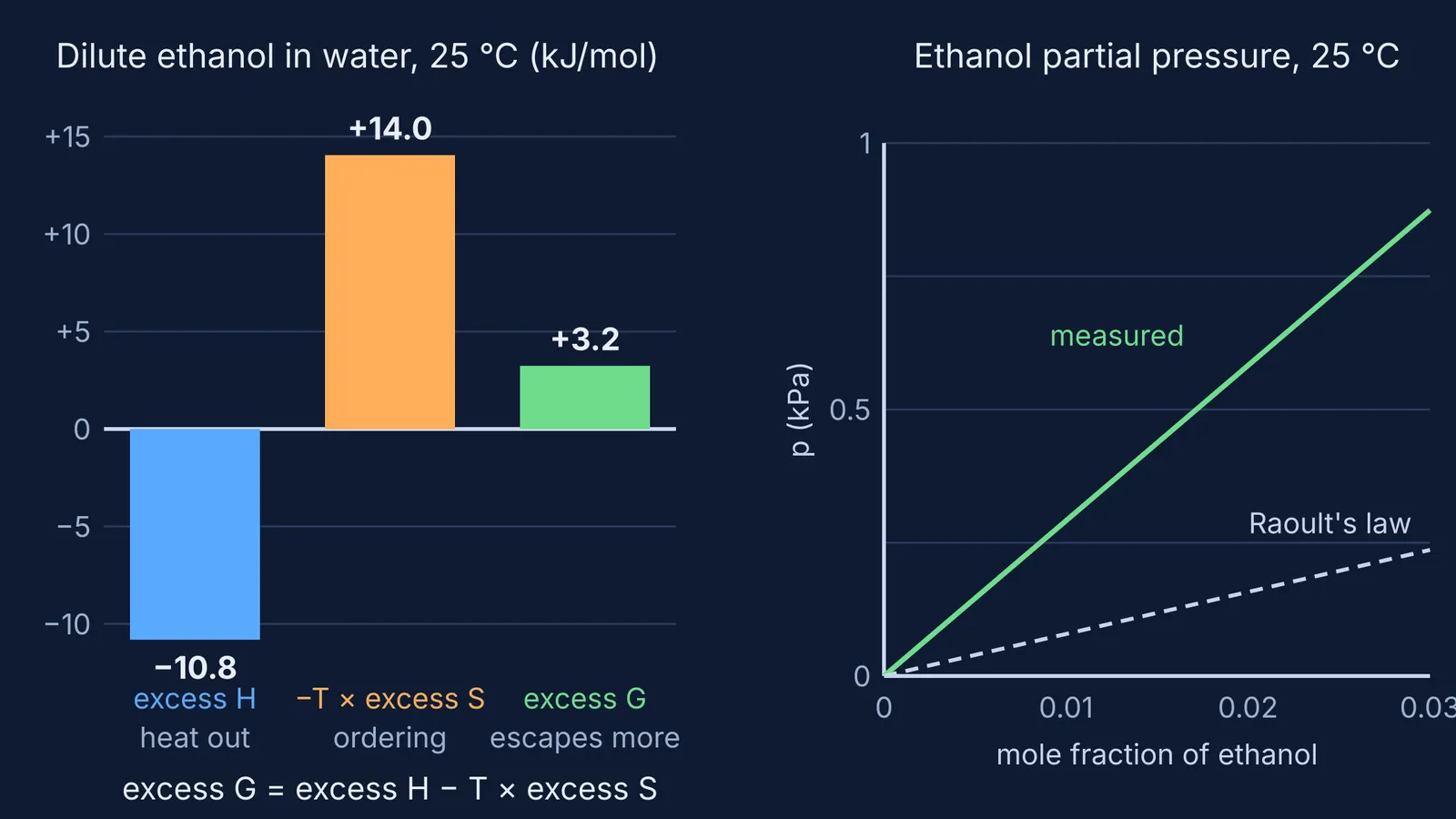
Measured partial pressure of ethanol. p = c ÷ H = 553 ÷ 1.9 ≈ 291 Pa = 0.29 kPa.
Raoult's law prediction. p = x × p° = 0.010 × 7.9 = 0.079 kPa.
Activity coefficient. γ = 0.29 ÷ 0.079 ≈ 3.7. Ethanol escapes almost four times more than Raoult's law predicts. The total vapour pressure is about 3.43 kPa against a Raoult value of 3.22 kPa: a positive deviation.
Excess Gibbs energy per mole of ethanol. RT ln γ = 8.314 × 298 × ln 3.7 ≈ +3.2 kJ/mol.
Enthalpy. Ethanol gets more soluble on cooling, so dissolving it from the gas is exothermic: ΔH = −R × 6400 ≈ −53.2 kJ/mol. Go round a cycle: liquid ethanol → vapour (+42.4 kJ/mol) → dissolved in water (−53.2 kJ/mol). Net: about −10.8 kJ/mol. Dissolving liquid ethanol in a lot of water gives out roughly 10 kJ per mole.
Entropy. TS^E = H^E − G^E = −10.8 − 3.2 = −14.0 kJ/mol, so S^E ≈ −14 000 ÷ 298 ≈ −47 J K⁻¹ mol⁻¹.
Heat is given out, yet the escaping tendency rises, because the entropy term is the largest of the three. Treat the enthalpy as approximate: the temperature coefficients in the compilation range from about 5700 to 6600 K, and the evaluated values of 6300 to 6400 K give −10.0 to −10.8 kJ/mol. The sign does not change. These are per mole of ethanol in very dilute solution; for mid-range mixtures the numbers are smaller, but the signs hold.
Does the rule work for acetone and chloroform?
Yes. There the C–H···O hydrogen bond between chloroform and acetone releases heat and also lowers the escaping tendency, so H^E < 0 and G^E < 0 agree, and the deviation is negative. The rule fails only when the entropy term outweighs the heat.
What should you write in the exam?
One-mark answers: ethanol–water shows positive deviation and forms a minimum boiling azeotrope near 95% ethanol. The details of that azeotrope are in minimum and maximum boiling azeotropes.
"Why positive deviation?": the NCERT-style line, that ethanol molecules break up part of water's hydrogen-bond network, is what markers expect. If space allows, add one line on entropy.
Sign questions on ΔmixH for ethanol–water specifically: write that it is negative at room temperature and the deviation is entropy-driven. Avoid saying ethanol–water hydrogen bonds are weaker; they are not.
Temperature: H^E for this system changes with temperature and composition, so attach "at 25 °C" to any sign you quote.
If Solutions questions keep catching you on signs, Fermi Test Prep for JEE Main and Advanced comes with an AI tutor that can take you through questions like these one step at a time.
Quick checklist
Vapour pressure follows G^E, not H^E.
Positive deviation means γ > 1 and G^E > 0.
G^E = H^E − TS^E: a negative H^E can still give a positive G^E if TS^E is more negative.
Ethanol–water at 25 °C: H^E < 0, V^E < 0, G^E > 0, S^E strongly negative.
Exam default: positive deviation goes with ΔmixH > 0 in general; ethanol–water is the known exception.