

On this page
Why do ethanol and water mixed give less total volume?
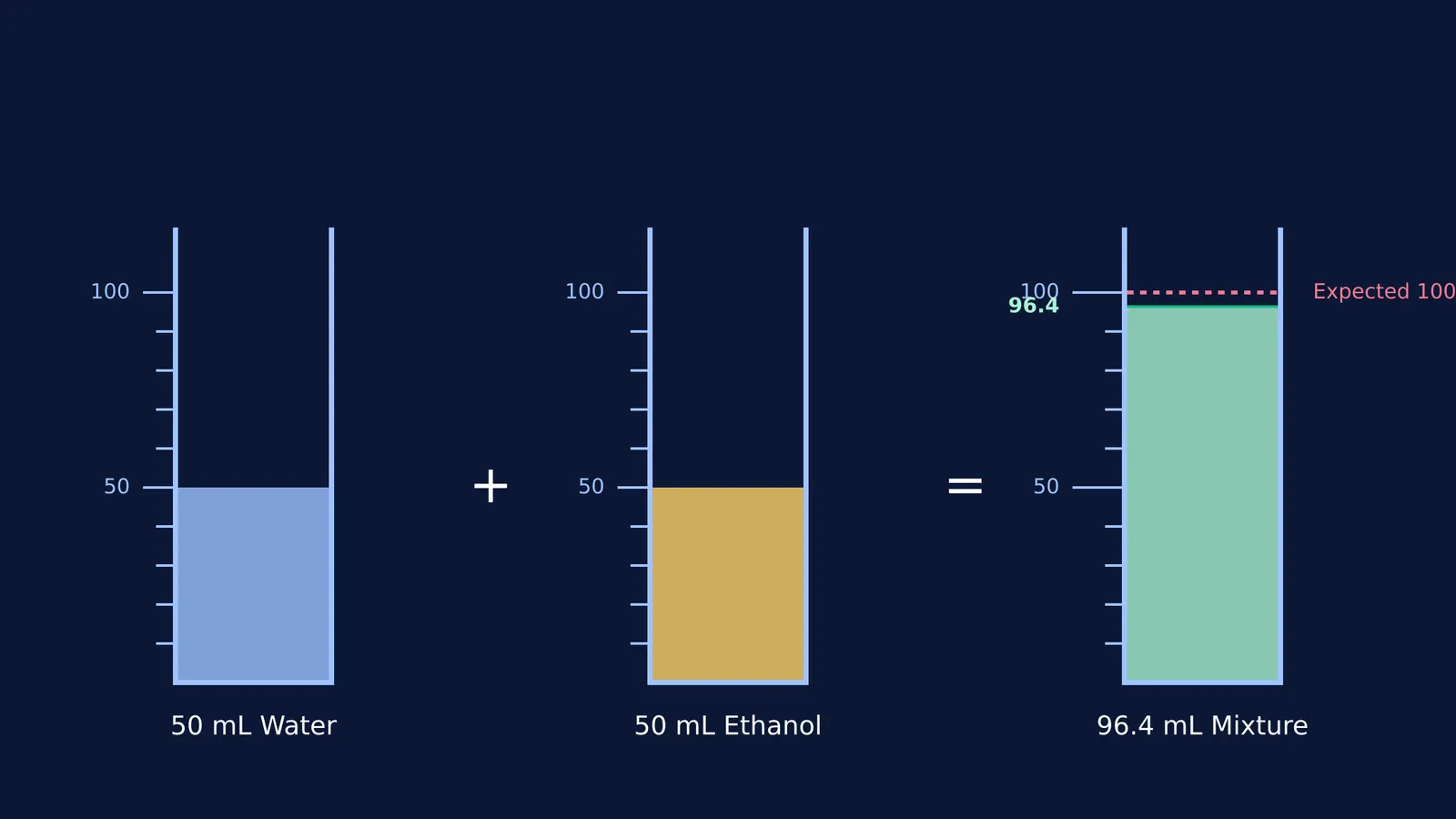
If you pour 50 mL of pure ethanol and 50 mL of water into a beaker, you might expect exactly 100 mL of liquid. Instead, the final volume comes out to about 96.4 mL at 20 °C. The mixture shrinks by roughly 3.6%.
This volume contraction happens because ethanol and water form what chemists call a non-ideal solution. In a textbook ideal solution, molecules of liquid A and molecules of liquid B are completely indifferent to one another. Their intermolecular forces are roughly identical, meaning that when you mix them together, they just slide past each other without pulling any tighter, and their individual volumes simply add up. However, real-world mixtures are rarely perfectly ideal. Water (H₂O) and ethanol (C₂H₅OH) are both highly polar molecules that interact strongly when placed in the same container.
When mixed, they form strong hydrogen bonds with each other. A hydrogen bond occurs when a slightly positive hydrogen atom is attracted to a highly electronegative oxygen atom nearby. The attraction between an ethanol molecule and a water molecule is notably stronger than the attraction between two bulky ethanol molecules on their own. These enhanced intermolecular forces essentially grab the unlike molecules and pull them much closer together than they were allowed to be in their separated, pure liquid states.
If you are tackling problems on ideal mixtures and Raoult's law, you can explore the thermodynamics behind this in the Fermi Concept Library.
How do the molecules pack together?
Beyond hydrogen bonding, the physical size and shape of the molecules play a large role. This is often explained using a packing analogy.
Imagine filling a large glass jar with 500 mL of large, irregularly shaped rocks, and another identical jar with 500 mL of very fine sand. If you pour the sand into the jar of rocks and shake it up, you will quickly notice that the total combined volume is nowhere near 1000 mL. Instead of sitting strictly on top, the fine sand grains sift down and fall into the large, empty spaces between the rocks.
A similar packing effect occurs at the molecular level. Water has a relatively open, loose molecular structure with significant interstitial space. Ethanol molecules are bulkier. When you mix the two, the smaller water molecules can pack tightly into the gaps between the larger ethanol chains, reducing the overall empty space in the liquid. The result is a denser, more compact mixture. The US Bureau of Standards first mapped this density curve precisely in 1913, proving that an ethanol-water mixture is significantly denser than the average of its parts.
What happens to the heat and mass?
While the volume changes, the mass is perfectly conserved. The process also releases energy. Because the new hydrogen bonds formed between ethanol and water are stronger and more stable than the bonds in the pure liquids, the mixture drops to a lower energy state. This releases heat into the surroundings—a phenomenon called an exothermic heat of mixing (ΔH < 0). If you hold the beaker while mixing them, you will feel it get noticeably warm.
How do you calculate the mixture's density?
You can prove the contraction yourself using the mass of the liquids. Here is how to work it out:
Find the mass of water: 50 mL of pure water has a density of roughly 0.998 g/mL at 20 °C.
50 × 0.998 = 49.9 g
Find the mass of ethanol: 50 mL of pure ethanol has a density of about 0.789 g/mL at 20 °C.
50 × 0.789 = 39.45 g
Add the masses: The total mass is conserved.
49.9 + 39.45 = 89.35 g
Compare densities: If the volume were 100 mL, the mixture's density would be 89.35 / 100 = 0.8935 g/mL. However, standard density tables from the US Bureau of Standards show that a mixture of equal volumes actually has a density of about 0.927 g/mL.
Find the true volume: Divide the total mass by the true density.
89.35 / 0.927 ≈ 96.4 mL
This calculation proves that the molecules must be packing closer together to increase the overall density. If you are calculating mole fractions or trying to find the final molarity of a contracted mixture, the Fermi Problem Library has a step-by-step solver that explains the reasoning rather than just printing an answer.


