On this page
You are 100 m from the bus stop and it starts to rain. Should you walk or run? Most people run on instinct, and others argue that running only makes you hit more drops. Both sides have a point, and a short relative-velocity argument settles how much each one matters. It is also a good model of the estimation questions JEE and olympiad papers like to set: a real situation, a few stated assumptions, and a clean answer.
Does running in the rain keep you drier than walking?
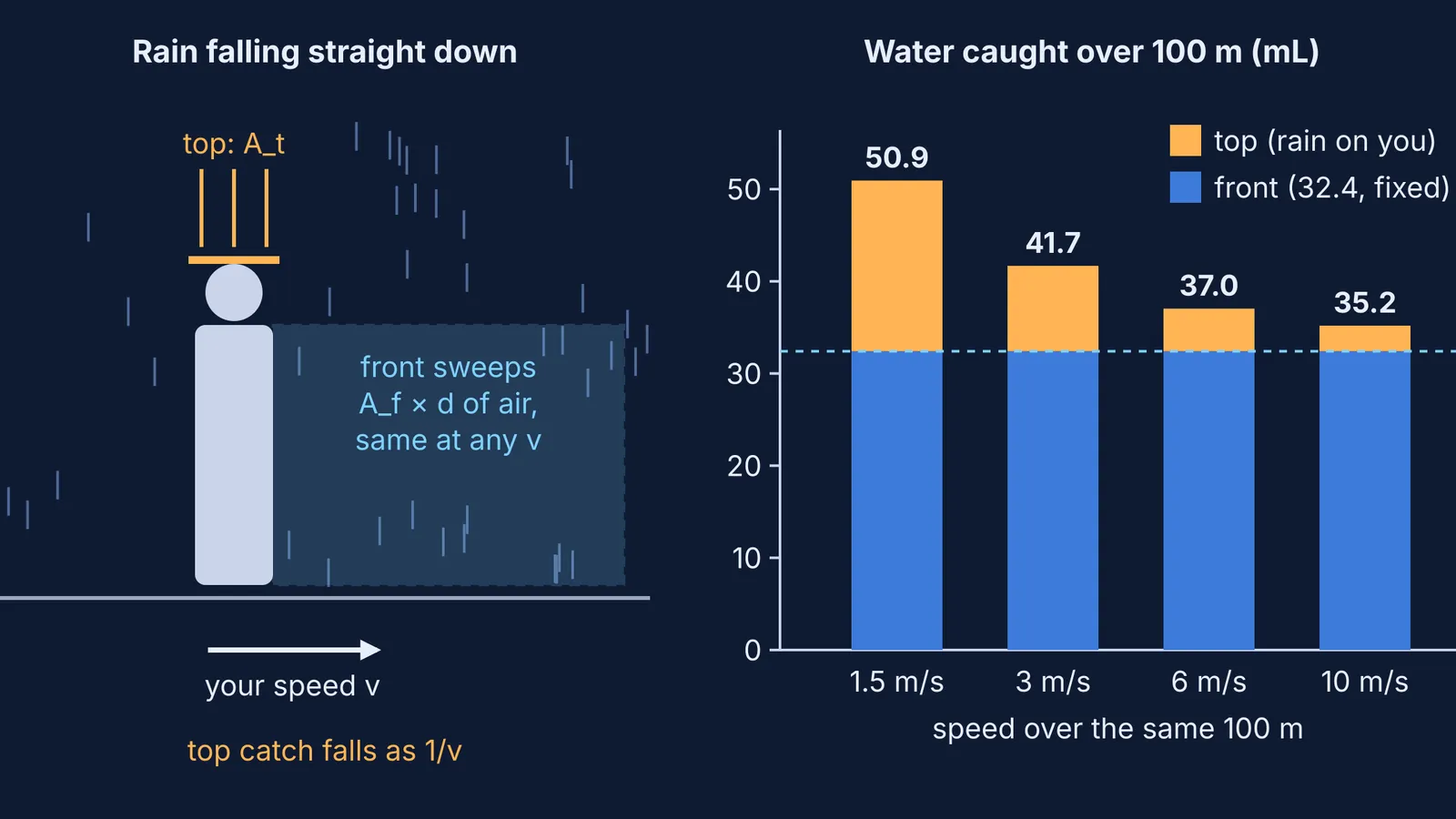
In still air with rain falling straight down, yes, but less than you might think. Split your body into two surfaces:
The top (head and shoulders), area A_t. Rain lands on it for as long as you are out in it.
The front (chest and legs), area A_f. It runs into drops that are already in the air ahead of you.
Running cuts the time you spend in the rain, so the top catches less. But the front catch does not change with speed at all. That fixed front share is the floor below which no speed can take you.
How much water is in the air during rain?
Rainfall is measured as a rate R, in millimetres per hour. That is a volume of water per square metre of ground per unit time, so R is really a speed: 10 mm/h = 0.01 m/3,600 s = 2.78 × 10⁻⁶ m/s.
If the drops fall at speed u, the water they carry through a horizontal square metre each second sits in a column u metres tall. So the volume of water in each cubic metre of air is:
water per m³ of air = R/u
This is the same flux idea as rain filling a bucket: flux = (amount per volume) × speed. Real drops of different sizes fall at different speeds, as Gunn and Kinzer measured in the laboratory (Journal of Meteorology, 1949006%3C0243:TTVOFF%3E2.0.CO;2)). Below we use one round illustrative value, u = 6 m/s, for all the drops.
Why does the front catch the same water at any speed?
Work in the frame of the ground. As you move a distance d, your front sweeps out a slab of air of volume A_f × d. Every drop in that slab hits your front, and no drop outside it does, because the drops only move vertically. So:
front catch = A_f × d × R/u
There is no v in it. Run faster and you meet drops more often, but you are out for less time; the two effects cancel exactly. You can also see it in your own frame: the rain comes at you slanted, at the angle you would tilt an umbrella to, as worked in at what angle to hold an umbrella while walking in rain. The horizontal part of the rain's velocity relative to you is v, the time is d/v, and v × d/v = d.
The top is different. It catches the vertical flux R on area A_t for time d/v:
top catch = A_t × R × d/v
That falls as 1/v. Double your speed and the top catch halves.
Worked example: walk or run 100 m in 10 mm/h of rain
Take illustrative values: R = 10 mm/h, u = 6 m/s, top area A_t = 0.10 m², front area A_f = 0.70 m², d = 100 m.
Rate as a speed. R = 0.01/3,600 = 2.78 × 10⁻⁶ m/s.
Water in the air. R/u = 2.78 × 10⁻⁶/6 = 4.63 × 10⁻⁷ m³ per m³, about 0.46 mL in every cubic metre. Units: (m/s)/(m/s) is a pure number, a volume per volume.
Front catch. A_f × d = 0.70 × 100 = 70 m³ of air swept. 70 × 0.463 mL = 32.4 mL, at any speed.
Top catch while walking at 1.5 m/s. Time = 100/1.5 = 66.7 s. The top gets A_t × R = 0.10 × 2.78 × 10⁻⁶ m³/s = 0.278 mL each second, so 0.278 × 66.7 = 18.5 mL. Total 50.9 mL.
Other speeds. At 3 m/s the top gets 9.3 mL (total 41.7 mL). Running at 6 m/s it gets 4.6 mL (total 37.0 mL). A sprint at 10 m/s gives 2.8 mL (total 35.2 mL).
So running at 6 m/s instead of walking at 1.5 m/s saves about 14 mL, roughly 27%. However fast you go, you cannot get below the 32.4 mL front share. Leaning forward while running changes A_t and A_f a little, which this model ignores.
What changes if there is wind?
Wind tilts the rain, and then the answer changes. Let the drops also move horizontally at speed w in the direction you are going (a tailwind). Relative to you their horizontal speed is v − w, so the front (or the back, if the rain overtakes you) catches:
front or back catch = A_f × (R/u) × |v − w| × d/v
With w = 2 m/s and the numbers above:
Walking at 1.5 m/s: back 10.8 mL + top 18.5 mL = 29.3 mL.
Moving at 2 m/s, matching the wind: front and back stay dry, top 13.9 mL.
Running at 6 m/s: front 21.6 mL + top 4.6 mL = 26.2 mL.
So in a tailwind, the driest choice is to move with the wind. In this model that happens when the tailwind exceeds A_t u/A_f, here 0.86 m/s. With a headwind, the front catch only gets bigger at low speed, so running as fast as you can is better again. The same moving-frame reasoning explains why rain hits the front windscreen of a car but not the back.
Physicist Franco Bocci modelled this with several body shapes and wind directions and found the answer really does depend on both: for some shapes running as fast as possible is the right call, for others there is an optimal speed (European Journal of Physics, 2012). Our two-box body is the simplest version of that analysis.
How would an exam frame a walk-or-run problem?
Expect it as a relative-velocity or estimation question: given a rainfall rate, a drop speed and body areas, find the water collected at two speeds, or show that the front catch does not depend on speed. The traps are the unit change from mm/h to m/s and forgetting that the front catch has no v in it.
If you want more relative-velocity problems worked step by step, the Fermi Problem Library has a solver that explains the reasoning. If you are preparing for JEE, Fermi Test Prep offers personalised preparation for JEE Main & Advanced with an AI tutor, live classes, adaptive mocks, mentorship and a study plan that updates based on mastery.
Quick checklist
Rainfall rate R in mm/h is a speed; convert with ÷ 3,600,000 to get m/s.
Water per cubic metre of air = R/u.
Front catch = A_f × d × R/u, the same at every speed in still air.
Top catch = A_t × R × d/v, which halves when you double your speed.
In still air, run: you save the top share, never the front share.
With a tailwind, moving at the wind's speed can beat running.