On this page
On a monsoon drive, the rain outside falls almost straight down. Yet the front windscreen streams with water while the rear window collects only a few drops. The rain has not changed. The frame you watch it from has.
Why does the front windscreen get wetter than the back?
The velocity of an object relative to frame S equals its velocity relative to frame S′ plus the velocity of S′ relative to S, as set out in OpenStax University Physics, section 4.5 on relative motion. Rearranged for a car: rain's velocity relative to the car equals rain's velocity relative to the ground minus the car's velocity.
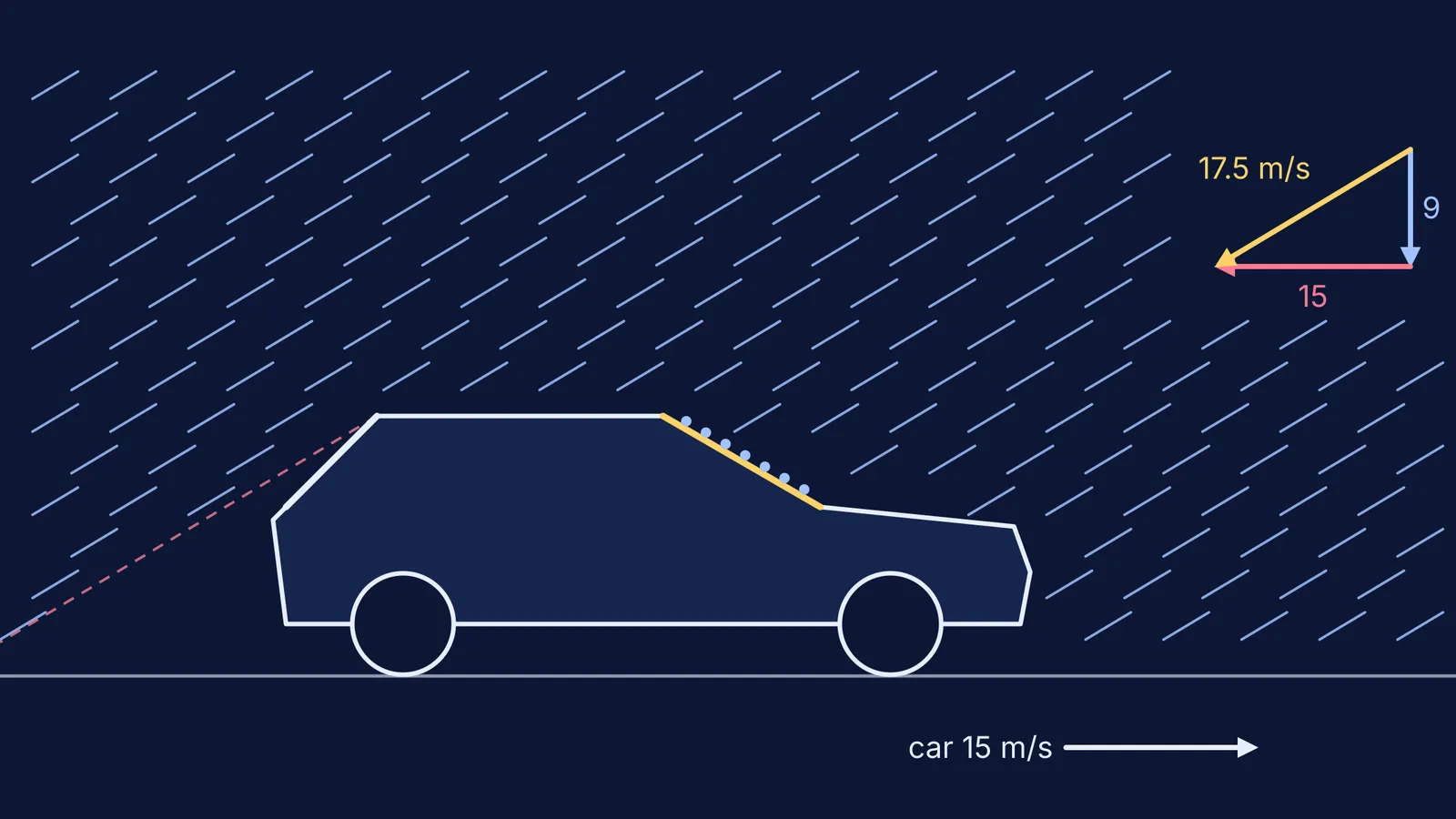
Subtracting the car's forward velocity u gives every drop an extra backward velocity u. Seen from inside, the drops come down and towards you at once. The rain slants towards the front of the car.
The front windscreen faces forward and up, into that slanted rain, so it gets hit at every speed. The rear window faces backward, away from it. And because the drops arrive on a slant, the roof leaves a rain shadow just behind it.
The largest raindrops fall at up to 9 metres per second, according to Plymouth State University's meteorology tutorial on terminal velocity. Slower, smaller drops slant even more.
What angle does rain hit a moving car at?
This worked example uses the 9 m/s fall speed from the Plymouth State tutorial, a car at 54 km/h and no wind.
Convert the car's speed: 54 km/h ÷ 3.6 = 15 m/s.
Write both velocities as components, with forward as +x and up as +y. Rain relative to the ground: (0, −9) m/s. Car: (15, 0) m/s.
Subtract: rain relative to the car = (0 − 15, −9 − 0) = (−15, −9) m/s. The drops move backwards at 15 m/s and down at 9 m/s.
Speed: √(15² + 9²) = √306 ≈ 17.5 m/s.
Angle: tan θ = 15/9, so θ ≈ 59° from the vertical, slanting towards the front of the car. That is only about 31° below the horizontal.
Repeat the steps at other speeds and the slant grows:
18 km/h (5 m/s): about 29° from the vertical
36 km/h (10 m/s): about 48°
72 km/h (20 m/s): about 66°
90 km/h (25 m/s): about 70°
It also explains busier wipers at speed. For a windscreen tilted 30° from the horizontal, drops strike at a rate proportional to the relative velocity's component into the glass: 9 cos 30° ≈ 7.8 m/s when parked, but 15 sin 30° + 7.8 ≈ 15.3 m/s at 54 km/h. That is about twice as many drops per second in the same rain.
When does the rear window stay completely dry?
Call the rear glass's angle from the horizontal β. In the car's frame, the rain travels at an angle below the horizontal whose tangent is fall speed ÷ car speed. If the rain is flatter than the glass, drops that clear the roof's back edge pass over the window. So the rear glass stays dry when tan β is greater than fall speed ÷ car speed.
Using the 9 m/s figure from Plymouth State:
Steep hatchback glass, β = 45°: dry above 9 m/s, about 32 km/h.
Sloping saloon glass, β = 30°: dry above about 15.6 m/s, about 56 km/h.
Parked car: the rain falls straight down and both windows get wet.
This is an idealised model with drops moving in straight lines. Swirling air behind the car and spray from other vehicles can still wet the rear glass, so treat the rule as a first answer, not the whole story.
How do exam questions twist the same idea?
The umbrella version asks how far to tilt an umbrella while walking in vertical rain: see the angle to hold an umbrella while walking in rain. The river version swaps rain for a current, covered in relative velocity problems with rivers, rain and moving observers. And the closest approach of two moving bodies uses the same subtraction.
One checklist works for all of them:
Name the observer: the driver, the walker or the boat.
Write every velocity relative to the ground, as components.
Subtract the observer's velocity from the object's velocity.
Read the result: direction gives the slant, size gives the speed the observer sees.
The usual slip is subtracting the wrong way round, which makes the rain lean towards the back of the car. The sanity check: in still air, rain seen from a moving car always seems to come from ahead.
If the vector triangle is hard to picture, the Fermi Simulation Lab has interactive simulations for ideas that are easier to see than to read. To practise, the Fermi Problem Library has worked problems with a step-by-step solver that explains the reasoning rather than printing an answer.