

On this page
Why does vertical rain hit your front when you walk?
Stand still on a calm afternoon, and raindrops fall vertically onto your umbrella. Step into a brisk walk, and drops immediately strike your chest and knees. The rain has not changed path; your forward motion changes the angle of collision.
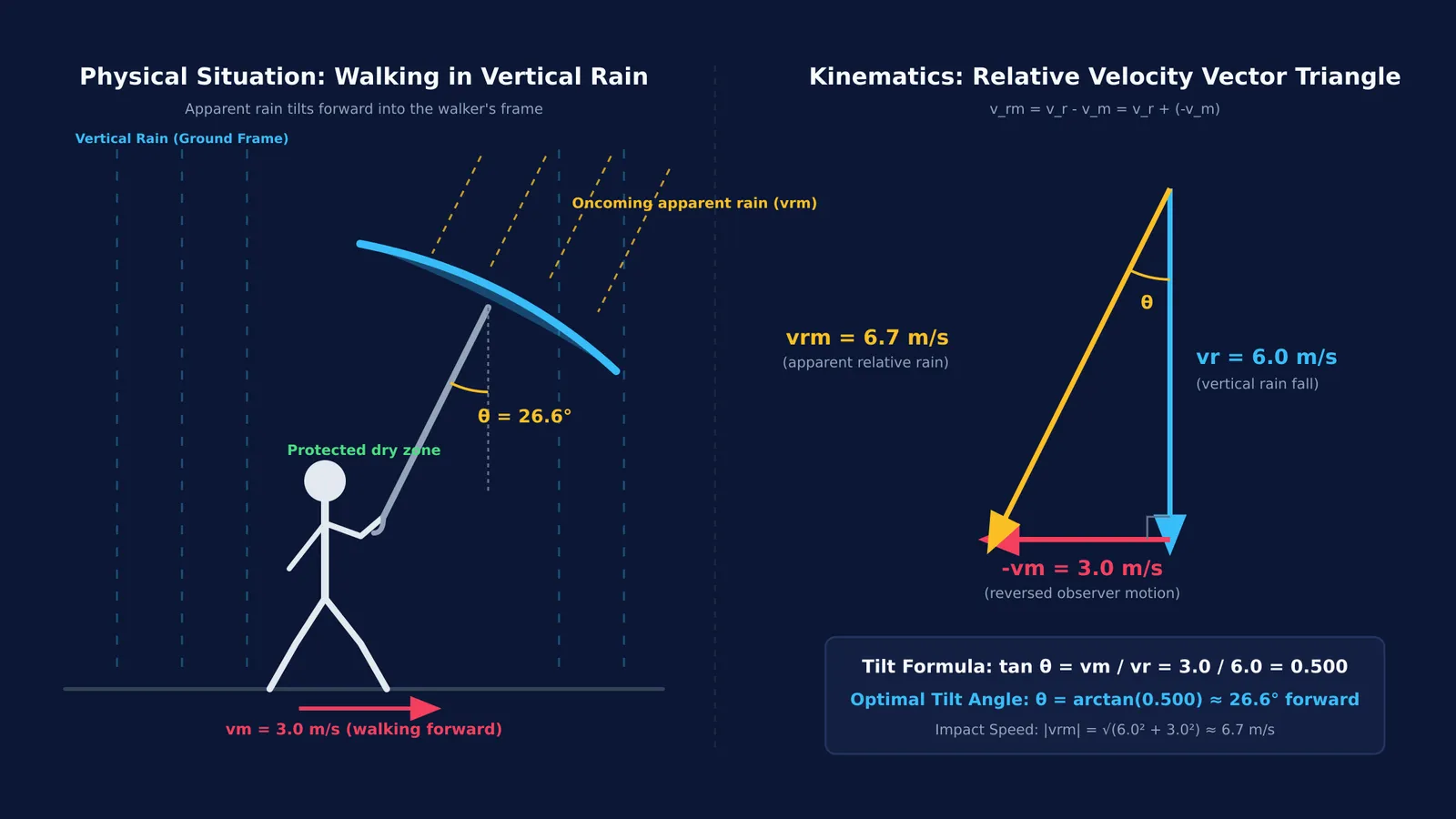
In physics, motion depends on your frame of reference. Relative to the ground, rain falls with velocity v_r. Relative to the ground, you walk horizontally with velocity v_m. To find the velocity of rain relative to you (v_rm), kinematics subtracts your velocity: v_rm = v_r - v_m. Subtracting your velocity is identical to adding an equal backward velocity to the rain. In your own frame, you are at rest while an artificial headwind drives drops into your face.
In the *Journal of Meteorology*, Ross Gunn and Gilbert D. Kinzer006<0243:TTVOFF>2.0.CO;2) measured raindrop terminal speeds in stagnant air, showing drops fall at 4.0 m/s for 1.0 mm drizzle up to 9.17 m/s for 5.8 mm thunderstorm drops. Because walking at 1.5 m/s is a substantial fraction of fall speed, the apparent trajectory tilts forward noticeably.
At what angle should you tilt the umbrella?
In the *European Journal of Physics*, Tarek Echekki modeled rain shelter dynamics using transport theorems, establishing that optimal umbrella shielding requires aligning the canopy perpendicularly to the incoming relative velocity vector v_rm. If you hold it upright while moving, tilted rain sweeps beneath the canopy.
The tilt angle θ from the vertical follows directly from the right-angled vector triangle: tan θ = (horizontal relative speed) / (vertical relative speed) = v_m / v_r.
Thus, θ = arctan(v_m / v_r). For typical 6.0 m/s raindrops:
Strolling at 1.0 m/s (3.6 km/h): tan θ = 1.0 / 6.0 ≈ 0.167, giving θ ≈ 9.5° forward.
Walking at 1.5 m/s (5.4 km/h): tan θ = 1.5 / 6.0 = 0.250, giving θ ≈ 14.0° forward.
Jogging at 3.0 m/s (10.8 km/h): tan θ = 3.0 / 6.0 = 0.500, giving θ ≈ 26.6° forward.
The impact speed also increases with motion: |v_rm| = √(v_r² + v_m²). At 3.0 m/s through 6.0 m/s rain, drops hit your umbrella at √(6.0² + 3.0²) ≈ 6.7 m/s.
What happens when you run faster or meet a headwind?
Real rainfall often includes wind. When horizontal wind blows with velocity v_w along your heading, the rain's ground velocity is v_r = v_w i - v_fall j. The relative velocity relative to your walking speed v_m becomes v_rm = (v_w - v_m) i - v_fall j.
In the *European Journal of Physics*, Franco Bocci examined how runner speed and wind affect wetness, showing that the optimal pace depends heavily on wind direction:
Tail wind matching your pace (v_w = v_m): The horizontal terms cancel. Rain falls vertically in your frame, requiring an upright umbrella (θ = 0°).
Headwind opposing you (wind at -v_w): Relative speed becomes v_m + v_w, steepening the required tilt to tan θ = (v_m + v_w) / v_fall.
Getting vector signs backward is among the most frequent common errors in vector signs in exam mechanics. For multistep problems with moving frames, the Fermi Problem Library offers worked problems with a step-by-step solver that explains the reasoning rather than printing an answer.
How do you test relative velocity vectors before computing?
Research in physics education shows that many students compute relative motion formulas without forming an accurate visual representation. In the *Journal of Science Education and Technology*, James M. Monaghan and John Clement showed that students relying on rote algorithms struggle with two-dimensional reference frames, whereas dynamic visual simulations help build correct mental models. Furthermore, Carl E. Wieman, Katherine K. Perkins, and Wendy K. Adams demonstrated in the *American Journal of Physics* that interactive simulations produce the largest learning gains when students commit to a prediction before experimenting.
To solve relative velocity problems with river and rain, apply this 4-step prediction routine:
Predict the tilt: Before calculating, sketch the ground vectors and guess whether doubling your speed doubles the tilt angle θ.
Invert the observer: Draw -v_m horizontally backward from the tip of the downward rain vector v_r.
Test in simulation: In the Fermi Simulation Lab, interactive simulations for ideas easier to see than to read let you slide walker speed from 0 to 6 m/s, watching how the vector triangle and streak angles respond.
Resolve the difference: Check why doubling speed does not double θ (since tan θ is non-linear), verifying the geometric relationship.
As explored in learning kinematics with a simulation, visualizing vector addition directly turns an abstract formula into an instinctive mental habit.


