On this page
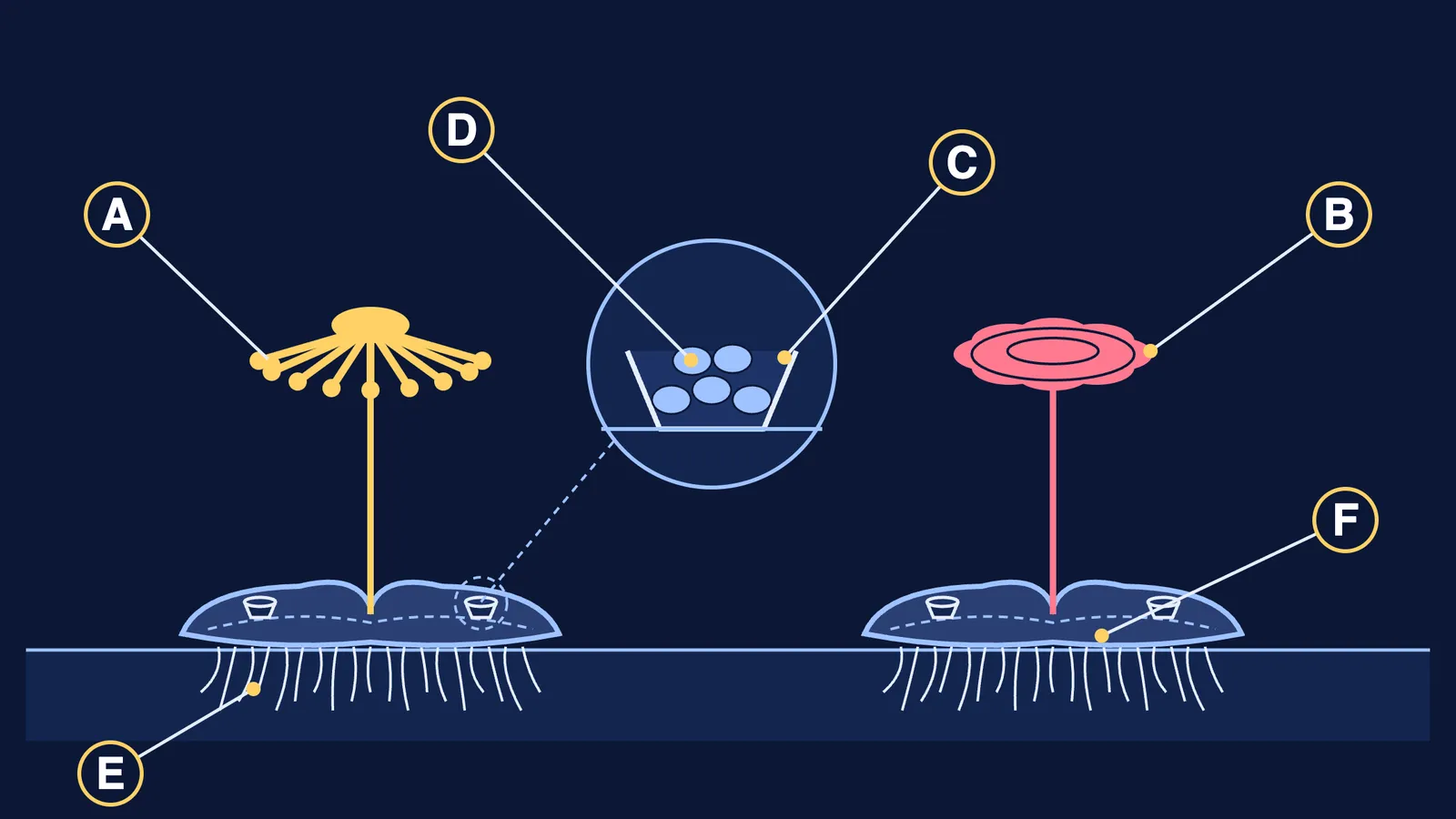
Q1 to Q6 use the lettered schematic above (two liverwort thalli and a magnified cup); Q7 to Q14 describe the chapter's other figures in words.
Where does Plant Kingdom sit in the NEET syllabus?
The NEET (UG) 2026 syllabus notice from NMC lists the salient features and classification of algae, bryophytes, pteridophytes and gymnosperms under Biology Unit 1, Diversity in Living World.
Each reason below comes from NCERT Class 11 Biology, Chapter 3 (Reprint 2026-27). The current chapter has five figures (algae, bryophytes, pteridophytes, gymnosperms, angiosperms), and this set uses only those. All 14 items are our own practice questions, not forecasts. Text-only formats are in our Plant Kingdom statement and match-the-list set.
How do you crack a figure of a whole plant?
Work in this order:
Find the ground line. Anything below it anchors the plant; anything flat on it is the main body.
Look for stalks rising from that body, and ask which sex or stage each one belongs to.
Treat a zoomed circle as its own question: it shows something too small for the main drawing.
Can you name parts A to F on the Marchantia thalli?
How to attack: name every letter before reading Q1. For match items, lock your surest pair and cross off options that break it.
Two-statement codes (Q3, Q9, Q11 and Q13): (1) Both statements are true (2) Statement I true, Statement II false (3) Statement I false, Statement II true (4) Both statements are false
Q1. Which letter marks the units that form inside a receptacle and spread the plant asexually? (1) C (2) F (3) D (4) A
Q2. Match the letters. List-I: A, C, E, F. List-II: (i) Small receptacle on the thallus (ii) Anchors the plant to the substratum (iii) Stalked structure of the female thallus (iv) Dorsiventral body pressed close to the substrate. (1) A-i, C-iii, E-ii, F-iv (2) A-iii, C-i, E-iv, F-ii (3) A-iv, C-i, E-ii, F-iii (4) A-iii, C-i, E-ii, F-iv
Q3. Statement I: F is haploid and produces gametes. Statement II: D can grow into a new plant only after two gametes fuse.
Q4. Which letter is found only on the male thallus? (1) B (2) A (3) E (4) C
Q5. Which is correct? (1) E are true roots with vascular tissue (2) C forms spores after meiosis (3) D detach from the parent and germinate into new individuals (4) F is the sporophyte generation
Q6. Which two letters work together in asexual reproduction? (1) A and B (2) E and F (3) A and D (4) C and D
Answer key for the lettered diagram
A: archegoniophore. B: antheridiophore. C: gemma cup. D: gemma. E: rhizoids. F: thallus.
Q1: (3). Gemmae develop in gemma cups and grow into new plants.
Q2: (4). The liverwort thallus is dorsiventral; rhizoids attach it to the substratum.
Q3: (2). Gemmae germinate directly into new individuals, with no gamete fusion.
Q4: (1). NCERT's figure labels the antheridiophore on the male thallus.
Q5: (3). Bryophytes lack true roots, and spores form in the sporophyte's capsule.
Q6: (4). Gemmae develop in gemma cups on the thalli.
Can you picture the other Chapter 3 figures from a description?
How to attack: sketch the described plant, name its group, then test each option against that group.
Q7. Figure 3.1 shows green, brown and red algae. Which alga-cell wall pairing is correct? (1) Volvox: cellulose and algin (2) Polysiphonia: cellulose, pectin and polysulphate esters (3) Dictyota: cellulose alone (4) Ulothrix: pectin and polysulphate esters
Q8. The brown algae panel shows Laminaria, Fucus and Dictyota. What do all three share? (1) Food stored as floridean starch (2) Food stored as laminarin or mannitol (3) Chlorophyll b as a major pigment (4) No flagellated cells at any stage
Q9. Figure 3.2 (d) shows a Sphagnum gametophyte. Statement I: Species of Sphagnum provide peat, long used as fuel. Statement II: Its water-holding capacity makes it useful for packing living material for trans-shipment.
Q10. Figure 3.3 shows Selaginella, Equisetum, a fern and Salvinia. In these plants, spores form by: (1) mitosis in the gametophyte (2) fusion of two gametes (3) fragmentation of the thallus (4) meiosis in spore mother cells
Q11. Look again at the fern in Figure 3.3. Statement I: The fern plant shown is a sporophyte with true root, stem and leaves. Statement II: Its spores grow into a large, conspicuous gametophyte that bears those leaves.
Q12. Figure 3.4 shows Cycas, Pinus and Ginkgo. List-I: (a) Male strobilus (b) Female strobilus (c) Coralloid roots (d) Mycorrhiza. List-II: (p) Bears megasporophylls with ovules (q) Bears microsporophylls and microsporangia (r) Cycas roots with nitrogen-fixing cyanobacteria (s) Fungal association in Pinus roots. (1) a-p, b-q, c-r, d-s (2) a-q, b-p, c-s, d-r (3) a-q, b-p, c-r, d-s (4) a-r, b-p, c-q, d-s
Q13. The gymnosperm figures show only the sporophyte. Statement I: Gymnosperm male and female gametophytes live free on the soil. Statement II: Air currents carry pollen grains to the opening of ovules.
Q14. Figure 3.5 shows a dicotyledon and a monocotyledon. Which is correct? (1) The ovules stay exposed after fertilisation (2) The male gametophyte is free-living (3) Seeds are enclosed in fruits (4) Flowers are absent
Answers and reasons, Q7 to Q14
Q7: (2). Table 3.1: red algal walls have cellulose, pectin and polysulphate esters; brown walls add algin.
Q8: (2). Brown algae store laminarin or mannitol; floridean starch belongs to red algae.
Q9: (1). NCERT gives both uses of Sphagnum in section 3.2.
Q10: (4). Pteridophyte sporangia make spores by meiosis in spore mother cells.
Q11: (2). Fern spores grow into a small, inconspicuous prothallus.
Q12: (3). Male strobili carry microsporophylls; Cycas has coralloid roots, Pinus mycorrhiza.
Q13: (3). The gametophytes stay within sporangia on the sporophyte; air carries the pollen.
Q14: (3). Angiosperm seeds sit inside fruits; pollen and ovules form in flowers.
How should you use the questions you got wrong?
Sort each miss: wrong group, wrong generation, or a borrowed example.
Redraw the two thalli from memory with names instead of letters.
Revise terms with our Plant Kingdom key terms, then compare all five groups in our Plant Kingdom Class 11 guide.
Mixing up liverworts, mosses and ferns? Fermi's AI tutor works out what you already know and builds a plan for the session.