On this page
Draw a loop without lifting your pen or crossing your own line. The page is now split into the part your loop fences in and the part it doesn't. That is the Jordan curve theorem.
What does the Jordan curve theorem say?
A Jordan curve, or simple closed curve, is a loop in the plane that ends where it starts and never crosses itself. Formally, it is the image of a continuous one-to-one map of a circle into the plane, as the Wikipedia article on the Jordan curve theorem defines it.
The theorem says the rest of the plane falls into exactly two connected pieces: a bounded interior and an unbounded exterior, with the curve as the boundary of each (Jordan curve theorem, Wikipedia). Any continuous path from a point inside to a point outside must cross the curve somewhere.
Every word matters. A figure of eight crosses itself and makes three regions. An arc that does not close up fences nothing in: its complement is one connected region, the same article notes. Camille Jordan published the first claimed proof in his Cours d'analyse in 1887.
How do you tell if a point is inside a closed curve?
You don't trace the maze. Shoot a ray and count. In his paper Jordan's proof of the Jordan curve theorem, the mathematician Thomas Hales builds this tool for polygons. He draws a ray from the point, counts how many times it meets the polygon, and calls the point inside if the count is odd and outside if it is even. He notes that the answer is the same whichever direction you aim the ray, and that every point in the unbounded region has even parity.
Why it works: far along the ray you are outside, and walking back to your point, every crossing flips you between outside and inside. Computers use the same rule. W. R. Franklin's PNPOLY point-in-polygon notes describe running a semi-infinite ray from the test point and say that at each crossing the ray switches between inside and outside.
Worked example: is the dot inside the maze?
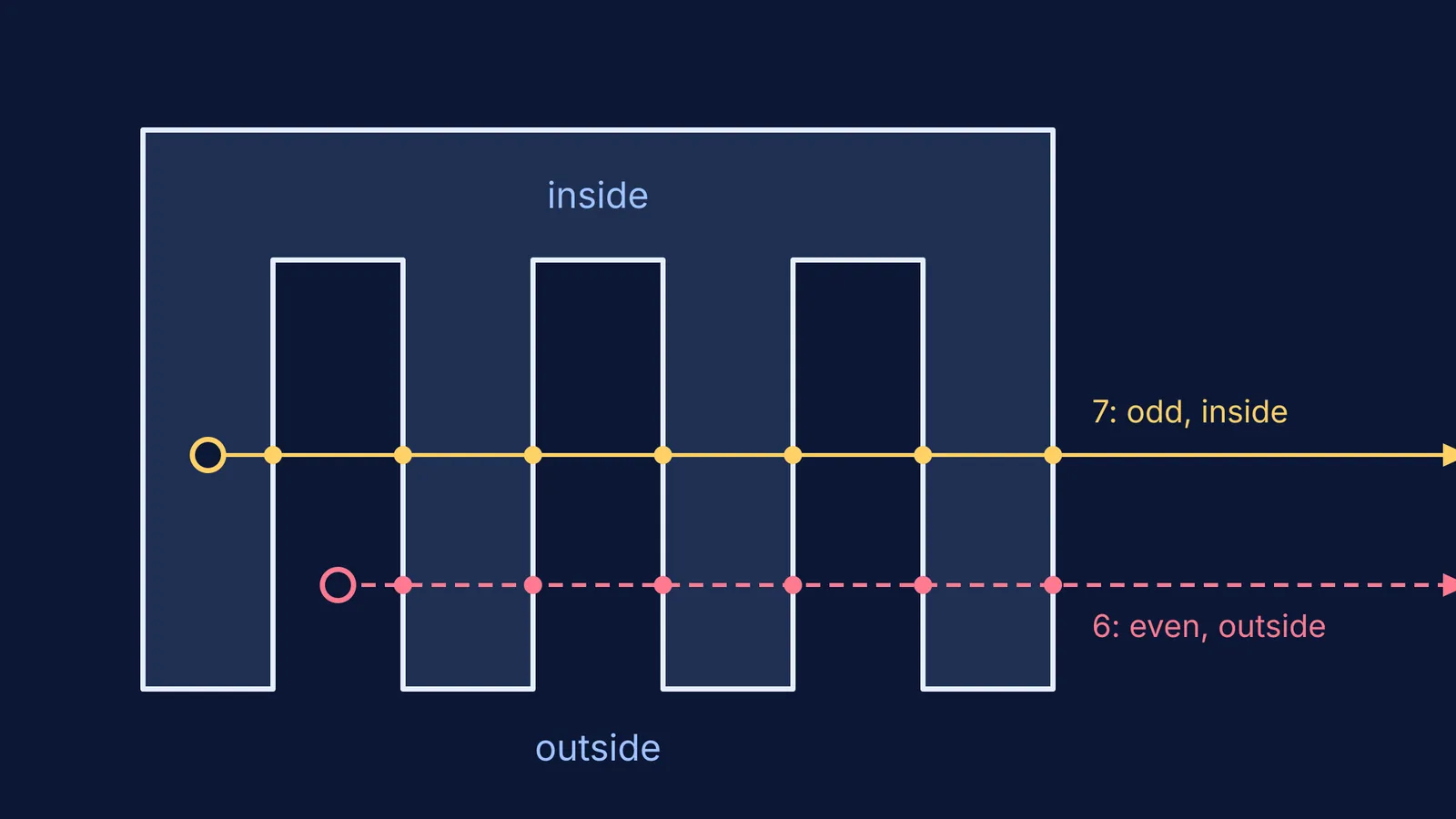
Look at the diagram at the top of this post. The white outline is one closed loop, a comb with four teeth hanging from a top bar.
The yellow dot sits in the first tooth. Its ray to the right leaves that tooth, enters the next, leaves it, and so on. It meets the outline 7 times. Seven is odd, so the dot is inside.
The pink dot sits in the gap between the first and second teeth. Its ray meets the outline 6 times. Six is even, so the dot is outside. Check: you can walk straight down and out of the gap without touching the line.
Now try a point in the top bar. A ray to the right meets the outline once, at the right-hand edge. One is odd, so the point is inside.
Why is the Jordan curve theorem so hard to prove?
For polygons, the parity argument is close to a complete proof. But a curve can be any continuous loop, including nowhere-smooth ones such as the Koch snowflake, as the Wikipedia article points out.
In 1903 William Osgood published A Jordan curve of positive area in the Transactions of the American Mathematical Society: a loop that never crosses itself yet covers a region of positive area. On wild curves like these, a ray can meet the curve infinitely many times, so you cannot simply count.
In 1905 Oswald Veblen published Theory on plane curves in non-metrical analysis situs. As Hales quotes him, Veblen said Jordan's proof 'is unsatisfactory to many mathematicians' because it assumed the polygon case. Nearly every modern citation Hales found named Veblen's as the first correct proof.
Hales disagreed. He had finished a computer-checked formal proof in January 2005, and when he then read Jordan's original he found nothing objectionable in it (Hales, 2007). He writes about the theorem and his formal proof in The Jordan curve theorem, formally and informally, published in The American Mathematical Monthly in 2007. The lesson: 'obvious' and 'proved' are different things.
How can you practise an idea like this?
Say the theorem with its three key words: simple, closed, plane.
Draw a figure of eight and an open arc, and see what fails.
Run the ray test on loops a friend draws, including one where the ray hits a corner.
Connect it to graphs. Our post on planar graphs, Euler's formula, K5 and K3,3 uses the same inside-outside reasoning, and finding the area under a cycloid shows how to measure the region a curve encloses.
If words like connected and bounded are what stop you, the Fermi Concept Library gives every concept in mathematics its own lesson and its place in the map, so you can see what topology builds on. For practice, the Fermi Problem Library has worked problems with a step-by-step solver that explains the reasoning rather than printing an answer.
Next time you see a maze, don't trace it. Count.