On this page
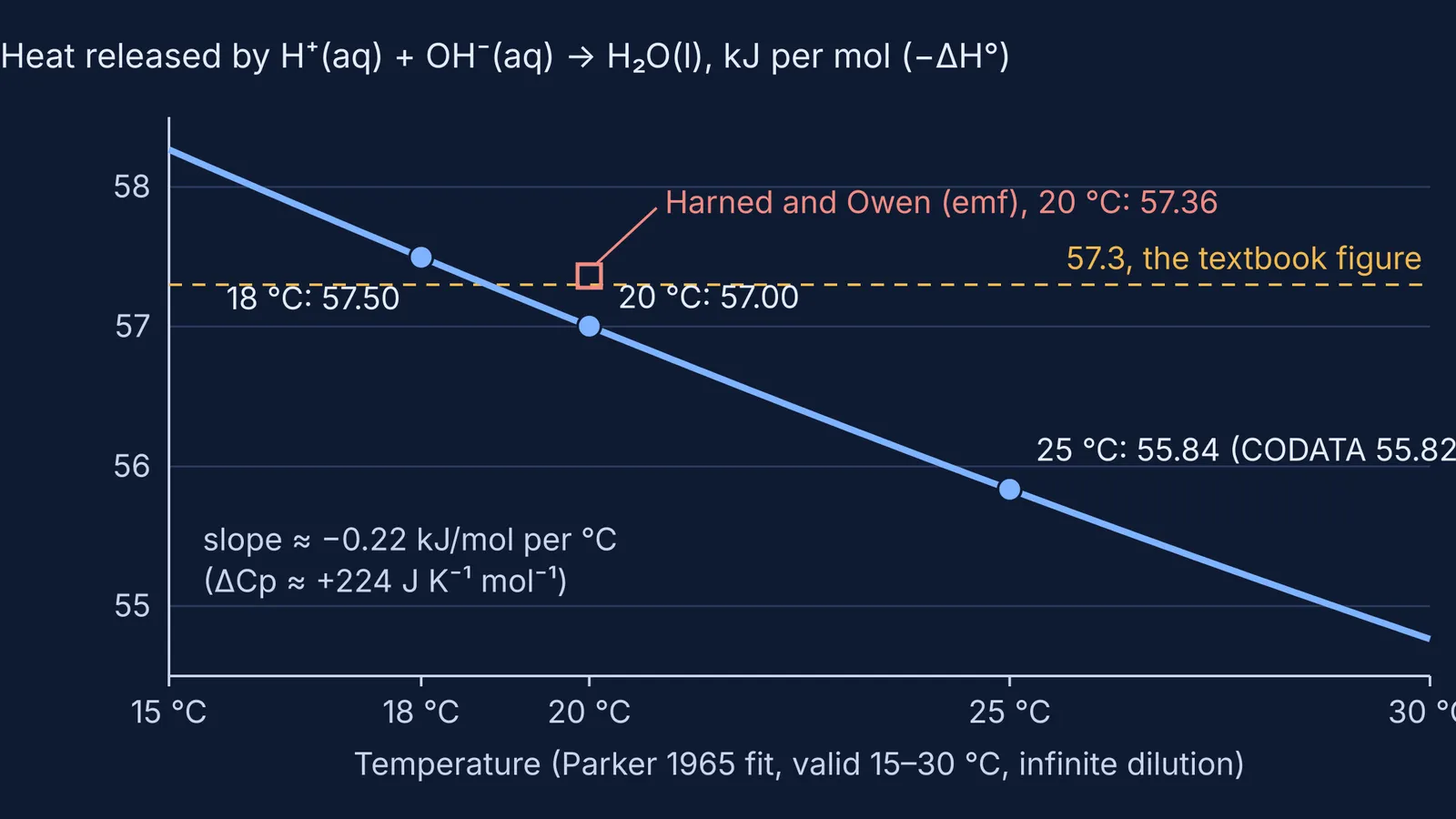
Ask a coaching teacher for the enthalpy of neutralisation of a strong acid by a strong base and you will hear −57.1 or −57.3 kJ/mol. Work it out from reference data, as our calorimetry practical post does, and you get −55.8 kJ/mol at 25 °C. Neither number is a typo. The heat released by H⁺(aq) + OH⁻(aq) → H₂O(l) changes by about 0.22 kJ/mol for every degree, because the reaction has an unusually large heat capacity change.
How much does the enthalpy of neutralisation change with temperature?
The standard critical review is Vivian Parker's Thermal Properties of Aqueous Uni-univalent Electrolytes, NSRDS-NBS 2 (1965). Parker recalculated five sets of calorimetric measurements to infinite dilution at 25 °C. They ranged from 13,331 to 13,366 cal/mol, and the selected value is 13,345 ± 25 cal/mol, which is −55.84 kJ/mol (1 cal = 4.184 J). As a cross-check, the CODATA Key Values for Thermodynamics give ΔfH° = −285.830 kJ/mol for H₂O(l) and −230.015 kJ/mol for OH⁻(aq), with H⁺(aq) set to zero. That gives ΔH° = −55.815 kJ/mol, within 0.03 kJ of Parker.
Parker also gave the temperature dependence, fitted for 15 to 30 °C:
ΔH°(t) = −13,345 + 53.5(t − 25) − 0.46(t − 25)² cal/mol, with t in °C.
Converted to kJ/mol:
15 °C: −58.27
18 °C: −57.50
20 °C: −57.00
25 °C: −55.84
30 °C: −54.76
On this curve, −57.3 belongs to about 19 °C (−57.25), not 25 °C. Parker also notes that Harned and Owen's value at 20 °C, 13,710 cal/mol (−57.36 kJ/mol), worked out from cell emf measurements, is 85 cal above his equation, and that heats obtained from emf data are generally less reliable than calorimetric ones. So the familiar figure matches data from about 18 to 20 °C. Which source a given textbook used, we cannot tell.
Why does a reaction enthalpy depend on temperature?
Kirchhoff's equation says d(ΔH)/dT = ΔCp, the heat capacity of the products minus that of the reactants. Our worked Kirchhoff equation example applies it to ammonia synthesis. If the products hold more heat per kelvin than the reactants, ΔCp is positive and ΔH rises, that is, becomes less negative, as the temperature goes up.
For neutralisation, Parker's linear coefficient is the ΔCp at 25 °C: 53.5 cal K⁻¹ mol⁻¹ = +224 J K⁻¹ mol⁻¹. The squared term means ΔCp drifts too, from about 262 J K⁻¹ mol⁻¹ at 15 °C to 205 at 30 °C. Compare the ammonia synthesis, where four moles of gas become two and ΔCp is only −44 J K⁻¹ mol⁻¹. Neutralisation, with one mole of water formed, has five times that size.
Why is ΔCp for H⁺ + OH⁻ so large?
Because the reactants have a negative heat capacity. Parker tabulates the apparent molal heat capacity at infinite dilution, Φc°, at 25 °C: HCl −32.6, NaOH −24.4 and NaCl −21.5 cal K⁻¹ mol⁻¹. Use the full equation, HCl(aq) + NaOH(aq) → NaCl(aq) + H₂O(l). Na⁺ and Cl⁻ appear on both sides, so they cancel and leave H⁺ + OH⁻ → H₂O.
Heat capacity of the ions: Cp(H⁺) + Cp(OH⁻) = Φc°(HCl) + Φc°(NaOH) − Φc°(NaCl) = −32.6 − 24.4 + 21.5 = −35.5 cal K⁻¹ mol⁻¹ = −148.5 J K⁻¹ mol⁻¹.
Heat capacity of the product: liquid water at 25 °C is 75.4 J K⁻¹ mol⁻¹, from the NIST WebBook heat capacity equation for water.
ΔCp: 75.4 − (−148.5) = +223.9 J K⁻¹ mol⁻¹, which is 53.5 cal K⁻¹ mol⁻¹, Parker's coefficient exactly.
A negative heat capacity sounds impossible, but these are partial molar values: how much the heat capacity of a large amount of water changes when one mole of ions is added. Ions lower it. The usual picture is that an ion's electric field holds its nearest water molecules tightly. When pure water is warmed, part of the heat goes into breaking hydrogen bonds, and water held by an ion no longer joins in. When H⁺ and OH⁻ combine, that held water is released and the new molecule joins the ordinary liquid, so the heat capacity jumps.
Worked example: from 25 °C to 18 °C
Question: ΔH° for H⁺ + OH⁻ → H₂O is −55.84 kJ/mol at 25 °C and ΔCp = +224 J K⁻¹ mol⁻¹. Find ΔH° at 18 °C, and the effect on a school calorimetry run.
Temperature change: ΔT = 18 − 25 = −7 K.
ΔCp × ΔT: 224 × (−7) = −1567 J = −1.57 kJ/mol.
New ΔH°: −55.84 − 1.57 = −57.41 kJ/mol.
Check: Parker's full equation gives −57.50. The 0.09 kJ gap appears because ΔCp is larger below 25 °C. Over a few degrees a constant ΔCp is good enough.
In the lab: 50 mL of 1.0 M HCl and 50 mL of 1.0 M NaOH form 0.050 mol of water. Between 25 °C and 18 °C the heat differs by 0.050 × (57.50 − 55.84) kJ = 83 J. In 100 g of solution with c = 4.18 J g⁻¹ K⁻¹, that is 83 ÷ 418 = 0.20 K.
A 0.2 K difference is lost in a coffee-cup calorimeter, so a classroom run cannot decide between 57 and 55.8. Careful calorimetry can. In Parker's table, Richards and Rowe's runs gave 59.05 kJ/mol at 15.67 °C and 58.82 kJ/mol at 16.80 °C, about 0.20 kJ less per degree warmer, the same size of effect.
Is temperature the only reason textbook values are higher?
No. The standard value is for infinite dilution, and real experiments mix fairly concentrated solutions, which adds heats of dilution. Richards and Rowe used 100 mol of water per mole of acid or base, about 0.55 mol/kg. Parker's table corrects their NaCl runs to 25 °C and gives 57.27 kJ/mol at that concentration, but 55.91 kJ/mol once extrapolated to infinite dilution. Pitzer's runs at 25 °C drop from 57.86 to 55.92 kJ/mol the same way. A result near 57 can come from temperature, concentration or both. The −55.8 figure means 25 °C and infinite dilution.
What should you write in the exam?
Numericals: use the value given. NCERT's Class 11 thermodynamics chapter does not print one. If a question needs a value and gives none, state the one you use (−57.1 or −57.3 are the usual textbook figures).
Weak-acid ionisation enthalpies: subtract from the same baseline the question uses. Mixing −55.8 with a weak-acid value measured near 18 °C shifts your ionisation enthalpy by more than 1.5 kJ/mol. The weak-acid comparison is set up in why strong acid–strong base neutralisation is constant.
Reason questions: "constant for all strong acids and bases" is still right, because the reaction is always H⁺ + OH⁻ → H₂O. "Constant at all temperatures" is not.
To practise Kirchhoff-type conversions, the Fermi Problem Library has worked problems with a step-by-step solver that explains the reasoning. If partial molar quantities are new to you, the Fermi Concept Library gives each concept its own lesson.
Quick checklist
ΔH° for H⁺ + OH⁻ → H₂O is −55.84 kJ/mol at 25 °C and infinite dilution.
ΔCp ≈ +224 J K⁻¹ mol⁻¹, so ΔH changes by about 0.22 kJ/mol per °C.
The ions have a negative heat capacity (−148.5 J K⁻¹ mol⁻¹); water has +75.4.
−57.3 matches 18 to 20 °C data; concentrated solutions also read higher.
Parker's equation is only for 15 to 30 °C. Do not extend it.