On this page
In an apartment block or housing society, the supply usually arrives as three phases and one shared neutral. Each flat is connected between one phase and that neutral, so it gets 230 V. If the shared neutral breaks upstream, the building does not simply go dark. Lamps in one flat glow too bright and burn out while a heater next door barely warms. The reason is plain Class 12 current electricity: loads that used to sit in parallel across 230 V suddenly find themselves in series across 400 V.
This post works out the voltages. It does not tell you how to find or fix the fault: electrical faults are for a licensed electrician or your electricity distribution company.
What does the neutral wire actually do?
In a three-phase star (Y) supply, the transformer's three windings meet at a star point, which is connected to the neutral and earthed at the transformer. Each phase is 230 V from the neutral, and the phases are 120° apart, so the voltage between any two phases is 230 × √3 ≈ 398 V, called 400 V. Why that number comes out is covered in why a three-phase supply reads 400 V when each phase is 230 V, along with the neutral current when the phases are loaded unequally.
The job that matters here is this: the neutral holds the common end of every load at the star point's voltage. While it is intact, each load sees its own 230 V, whatever the other phases are doing. The colours and the job of live, neutral and earth inside one home are in live, neutral and earth wires: colours and jobs.
What happens to the voltages when the neutral breaks?
Take the neutral away and the common end of the loads floats to whatever voltage makes the three load currents add to zero, because leftover current has no other path. Call this point N′. Each load now sees the voltage between its phase and N′.
With equal loads N′ stays at the true neutral. With unequal loads, N′ drifts towards the phase with the heaviest load (the lowest resistance). That phase's load then gets a small voltage and the lightly loaded phases get much more than 230 V.
Oulun Energia, a Finnish distribution company, warns that when the neutral breaks the voltage "can rise from 230 volts to 400 volts", damaging appliances and creating a fire risk. Among the signs it lists: some lights exceptionally bright, others very dim, and lamps breaking.
Why do two loads on different phases end up in series?
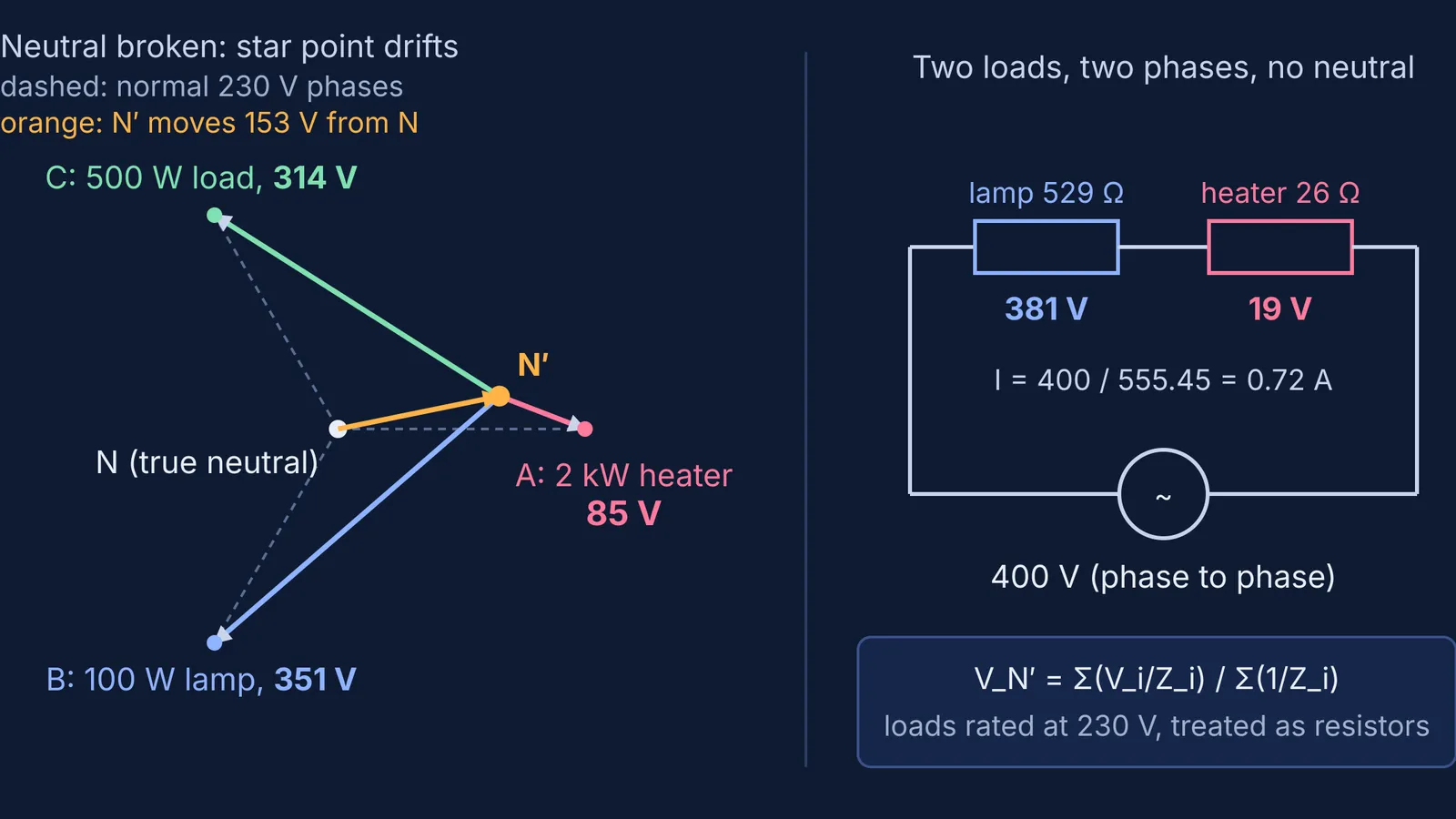
Start with two loads: a 100 W lamp on phase B and a 2 kW heater on phase A, both rated for 230 V, and nothing on phase C. With the neutral gone, current can only go out along phase B, through the lamp, back through the heater and into phase A. The two loads are now in series across the 400 V between the phases.
Treat each load as a fixed resistor, R = V²/P at its rating:
Lamp: R = 230²/100 = 529 Ω.
Heater: R = 230²/2000 = 26.45 Ω.
Total: 555.45 Ω, so I = 400/555.45 = 0.72 A.
Lamp voltage: 0.72 × 529 = 381 V. Heater voltage: 0.72 × 26.45 = 19 V.
The lamp now dissipates 381²/529 = 274 W, about 2.7 times its rating, so it fails quickly. The heater gets only about 14 W.
This is the same rule as in why the higher-watt bulb glows dimmer in series: in series the larger resistance, which is the lower-wattage device, takes the larger share of the voltage. Here the total is 400 V, so the small load is pushed well past its rating.
How do you find the voltages with loads on all three phases?
With three loads, use the fact that the currents into N′ must add to zero. For each phase, current = (V_i − V_N′)/Z_i. Setting the sum to zero gives
V_N′ = Σ(V_i/Z_i) / Σ(1/Z_i)
The V_i are the phase phasors (230 V at 0°, −120° and +120°); for resistive loads Z_i is just R.
Worked example. Phase A has a 2 kW heater, phase B a 100 W lamp and phase C a 500 W load, all rated at 230 V and treated as resistors.
Resistances. R_A = 26.45 Ω, R_B = 529 Ω, R_C = 230²/500 = 105.8 Ω.
Conductances. 1/R_A = 0.03781 S, 1/R_B = 0.00189 S, 1/R_C = 0.00945 S. Sum = 0.04915 S.
Phasors in component form. V_A = 230 + j0, V_B = −115 − j199.2, V_C = −115 + j199.2 (in volts).
Numerator. Σ(V_i/R_i) = 8.696 + (−0.217 − j0.377) + (−1.087 + j1.883) = 7.391 + j1.506 A.
Star point. V_N′ = (7.391 + j1.506)/0.04915 = 150.4 + j30.6 V. That is 153 V at 11.5°, pulled towards phase A, the heaviest load.
Load voltages. Subtract V_N′ from each phase. Heater: (230 − 150.4) − j30.6 = 79.6 − j30.6, size 85 V. Lamp: −265.4 − j229.8, size 351 V. 500 W load: −265.4 + j168.6, size 314 V.
Check. The currents are 85.3/26.45 = 3.23 A, 351.1/529 = 0.66 A and 314.4/105.8 = 2.97 A. As phasors they add to zero, as they must.
The lamp takes 233 W, over twice its rating, and the 500 W load 934 W. The heater gets only 275 W.
Treat these numbers as estimates. A filament's resistance rises as it heats, and electronic loads such as chargers and LED drivers draw current in their own ways. The direction does not change: lightly loaded phases see overvoltage, the heavily loaded phase sees undervoltage.
Why doesn't the fuse or MCB trip on a broken neutral?
A fuse or a miniature circuit breaker (MCB) responds to too much current. Look at the currents in the worked example: 3.23 A, 0.66 A and 2.97 A. The heater draws less than its normal 8.7 A, and the other two draw only a little more than their normal 0.43 A and 2.17 A. None of this is an overload, so the MCB stays closed while the lamp sits at 351 V. An RCCB stays closed too, because no current is leaking to earth.
Protection against this fault needs a device that senses voltage. The international standard IEC 63052 covers power-frequency overvoltage protective devices for household use that switch a circuit off when phase-to-neutral voltage goes too high. Whether one suits your home is for a licensed electrician to decide.
What should you do if you suspect a broken neutral?
Do not open the distribution board. Oulun Energia's advice to its customers is to switch off the power at the main switch and then call for help, and to avoid touching the metal case of the distribution panel, which may be live. Finding and repairing the fault is a job for your electricity distribution company or a licensed electrician.
To practise the ideas behind this, the Concept Library explains voltage division and AC phasors step by step.
Quick checklist
An intact neutral gives each load its own 230 V.
Neutral broken: loads on different phases go in series across about 400 V.
Three loads: V_N′ = Σ(V_i/Z_i)/Σ(1/Z_i); each load sees its phase minus V_N′.
Fuses and MCBs sense current, not voltage, so they stay closed.
Faults are for a licensed electrician or the utility, not for you.