On this page
Table 5.1 in the NCERT Class 11 Thermodynamics chapter lists melting points, boiling points and phase-change enthalpies for nine substances. Read the carbon monoxide row and something odd appears: melting 1 mol of solid CO takes 6.836 kJ, more than the 6.04 kJ needed to boil the liquid. No other row does that. This is not a reason to distrust the book. It is a chance to practise a skill every chemist uses: checking a data table before trusting a number in it. Three quick checks show that 6.836 kJ/mol cannot be right, and each works on any table.
What does NCERT Table 5.1 say about carbon monoxide?
In the Reprint 2026-27 of NCERT's Thermodynamics chapter (page 147), Table 5.1 gives these two rows, in the order melting point, ΔfusH, boiling point, ΔvapH:
N₂: 63.15 K, 0.72 kJ/mol, 77.35 K, 5.59 kJ/mol
CO: 68.0 K, 6.836 kJ/mol, 82.0 K, 6.04 kJ/mol
N₂ and CO are near twins: both have 14 electrons and a molar mass of 28 g/mol. They melt 5 K apart, boil 5 K apart, and their enthalpies of vaporisation differ by 8%. Yet CO's printed fusion enthalpy is 9.5 times N₂'s. When two similar molecules agree on everything but one number, look hard at that number.
Why should ΔvapH always be bigger than ΔfusH?
Melting only loosens the solid: the molecules stay in contact and keep most of their attractions. Boiling pulls them completely apart, which costs far more energy. Our post on why latent heat of vaporisation is larger than fusion explains this with water.
Now scan Table 5.1 using the ratio ΔvapH ÷ ΔfusH:
CCl₄ 12.0, HCl 8.1, N₂ 7.8, H₂O 6.8, NaCl 5.9, acetone 5.1, NH₃ 4.1, C₆H₆ 3.1
CO 0.88
Eight rows sit between 3 and 12. CO is the only one below 1. That alone is enough to flag the row.
What do the entropies of fusion and vaporisation tell you?
At the transition temperature, the two phases are in equilibrium, so ΔG = 0 and ΔS = ΔH ÷ T. If that step is new to you, see entropy of fusion and vaporisation as ΔH/T. Dividing each column by its temperature gives a sharper check, because entropies of similar changes fall in fairly narrow bands.
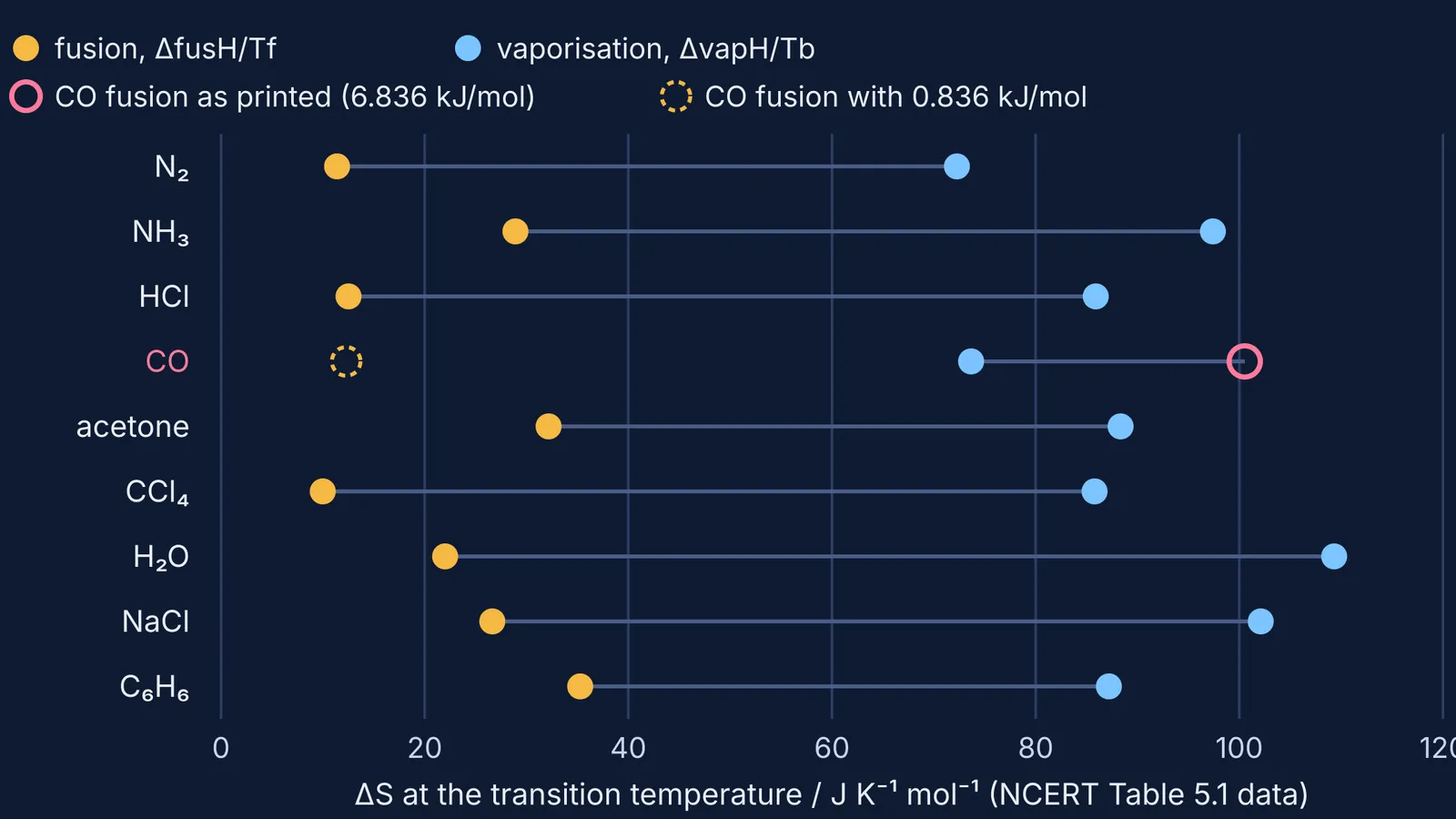
Vaporisation. Table 5.1 gives ΔvapS from 72 to 109 J K⁻¹ mol⁻¹. Most liquids land near the 85 to 88 of Trouton's rule, hydrogen-bonded water is higher at 109, and very low-boiling liquids come out lower. CO gives 6040 ÷ 82.0 = 73.7, right beside N₂ at 5590 ÷ 77.35 = 72.3. The CO vaporisation value passes.
Fusion. The other eight rows give ΔfusS from 10.0 (CCl₄) to 35.3 (benzene) J K⁻¹ mol⁻¹. CO gives 6836 ÷ 68.0 = 100.5. That is the size of a boiling entropy, and it is even larger than CO's own vaporisation entropy. The chart at the top plots every row: CO's printed fusion point sits among the vaporisation points.
Does Hess's law agree with the printed value?
Sublimation goes straight from solid to gas, and by Hess's law ΔsubH ≈ ΔfusH + ΔvapH. With NCERT's numbers that sum is 6.836 + 6.04 = 12.9 kJ/mol.
The NIST Chemistry WebBook page for CO lists three measured enthalpies of sublimation of solid CO: 7.6, 8.1 and 7.9 kJ/mol, at about 58, 60 and 62 K. Those are a few kelvin below the melting point, so the match cannot be exact, but a 5 kJ/mol gap is far too large to blame on that. Take away ΔvapH (NIST also lists about 6.0 kJ/mol) and only about 2 kJ/mol is left for melting and for any heat the solid takes up on its way to 68 K.
A fourth check comes from a NIST reference paper. Goodwin's 1985 review of carbon monoxide properties (J. Phys. Chem. Ref. Data 14, 849) quotes an earlier analysis by Leah giving 4212.76 J/mol as the enthalpy of the liquid at its normal boiling point, measured from the perfect crystal at 0 K. That 4.21 kJ/mol covers everything: warming the solid, melting it and warming the liquid to 81.6 K. Melting alone cannot be 6.836 kJ/mol if the whole climb is only 4.21.
Worked example: auditing the CO row step by step
Use only the printed numbers and the checks above.
Ratio test. ΔvapH ÷ ΔfusH = 6.04 ÷ 6.836 = 0.88. Every other row is above 3. Flag it.
Entropy test. ΔfusS = 6836 ÷ 68.0 = 100.5 J K⁻¹ mol⁻¹ and ΔvapS = 6040 ÷ 82.0 = 73.7 J K⁻¹ mol⁻¹. A fusion entropy larger than the vaporisation entropy is a second flag.
Twin test. N₂, a molecule of the same size and mass, gives ΔfusS = 720 ÷ 63.15 = 11.4 J K⁻¹ mol⁻¹.
Hess test. 6.836 + 6.04 = 12.9 kJ/mol, against measured sublimation enthalpies of 7.6 to 8.1 kJ/mol.
Form a hypothesis. The simplest slip is a stray first digit. Suppose the intended value is 0.836 kJ/mol and re-run each test.
Re-test. Ratio 6.04 ÷ 0.836 = 7.2, next to N₂'s 7.8. ΔfusS = 836 ÷ 68.0 = 12.3 J K⁻¹ mol⁻¹, next to N₂'s 11.4. The Hess sum becomes 6.9 kJ/mol, within about 1 kJ/mol of the sublimation values measured on colder solid instead of 5 kJ/mol above them, and 0.836 sits well under the 4.21 kJ/mol ceiling.
The printed 6.836 kJ/mol fails every check, and 0.836 kJ/mol passes all of them. You did not need the "right" answer to see the problem; the table's own rows did most of the work.
Is anything else in Table 5.1 slightly off?
The NaCl row is close but not exact. The NIST-JANAF table for solid and liquid NaCl puts the melting point at 1073.8 K, not 1081 K, with ΔfusH = 72.905 − 44.747 = 28.16 kJ/mol against the printed 28.8. The printed 170 kJ/mol matches JANAF's 170.2 kJ/mol for turning liquid NaCl into gaseous NaCl molecules near 1600 K, but the vapour also holds Na₂Cl₂ dimers: about 0.12 bar beside 0.56 bar of monomer at 1700 K. A salt's "boiling point" is a less tidy number than a molecular liquid's.
How can you sanity-check any data table?
The same habits work for any table:
Compare each value with its neighbours and with a similar molecule.
Turn raw numbers into a ratio or a per-kelvin quantity (ΔH/T), where values fall into known bands.
Check a value against a relationship it must obey, such as Hess's law.
When one value fails, guess the simplest slip (a stray digit, a shifted decimal) and re-test it.
If ΔS = ΔH/T or Hess's law feels shaky, the Concept Library has a lesson for each chemistry concept. For practice on NCERT data, Fermi Test Prep covers JEE Main and Advanced, with an AI tutor.
Quick checklist
NCERT Table 5.1 prints ΔfusH(CO) = 6.836 kJ/mol, larger than ΔvapH = 6.04 kJ/mol.
Ratio, entropy, twin (N₂) and Hess checks all reject it.
0.836 kJ/mol passes every check and is the likely intended value.
In Table 5.1, ΔfusS runs from about 10 to 35 J K⁻¹ mol⁻¹ and ΔvapS from about 70 to 110; CO's printed 100.5 for fusion is out of place.
In an exam, use the value the question gives.