

On this page
Frederick Trouton, then at Trinity College Dublin, published a short paper in 1884 called On molecular latent heat in the Philosophical Magazine. His rule is still used to estimate enthalpies of vaporisation: divide a liquid's molar enthalpy of vaporisation by its boiling point and you get nearly the same number for many different liquids. Here is why, checked against real data, and why water and ethanol break it.
What does Trouton's rule say?
The entropy of vaporisation at the normal boiling point is ΔS vap = ΔH vap / T b, because boiling at 1 atm is a reversible phase change at constant temperature (we work through that formula in entropy of fusion and vaporisation as ΔH/T).
Trouton's rule states that this ratio is about 85-88 J/(K·mol) for many liquids at their boiling points; some textbooks use 85 J/(K·mol) as the typical value, others 88 (Trouton's rule summary). The LibreTexts chemistry page on Trouton's rule uses about 85 J/(K·mol) and puts benzene and many other "normal" liquids in the range 80-90. Either way, it is an approximate rule, not a law.
Does Trouton's rule match real data?
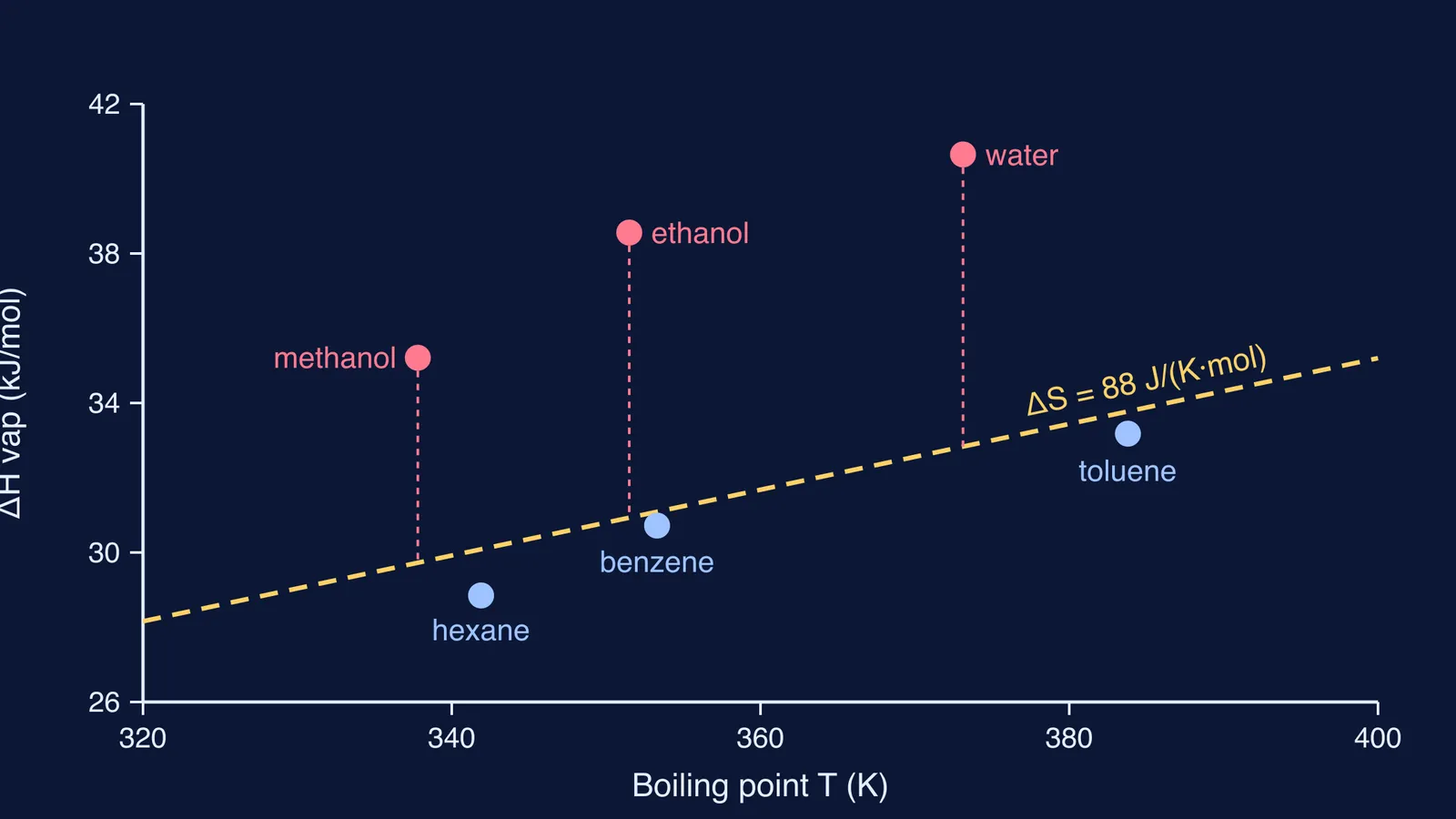
We divided each liquid's enthalpy of vaporisation at its boiling point by that boiling point, both from the NIST Chemistry WebBook:
n-Hexane: 28.85 kJ/mol ÷ 341.9 K = about 84 J/(K·mol) (NIST, hexane)
Toluene: 33.18 kJ/mol ÷ 383.8 K = about 86 J/(K·mol) (NIST, toluene)
Benzene: 30.72 kJ/mol ÷ 353.3 K = about 87 J/(K·mol) (NIST, benzene)
Methanol: 35.21 kJ/mol ÷ 337.8 K = about 104 J/(K·mol) (NIST, methanol)
Ethanol: 38.56 kJ/mol ÷ 351.5 K = about 110 J/(K·mol) (NIST, ethanol)
Water: about 40.65 kJ/mol ÷ 373.12 K = about 109 J/(K·mol) (NIST saturation data for water)
The three hydrocarbons sit in a tight band around 84-87 J/(K·mol). The three liquids with O-H groups sit well above it.
Why do so many liquids land near 88 J/(K·mol)?
Entropy measures how many ways a system's energy and particles can be arranged. When a liquid boils at 1 atm, it becomes a gas at roughly the same pressure. Gases at similar conditions have similar freedom of movement, so the jump in disorder from liquid to vapour is similar too.
That only works if the liquids themselves are similarly disordered. Hexane, benzene and toluene molecules are held together by fairly non-directional London forces. Their liquids are jumbled, so they all start from roughly the same baseline.
Why do water and ethanol deviate from Trouton's rule?
Water, ethanol and hydrogen fluoride show positive deviation because hydrogen bonding gives the liquid an ordered structure; as the LibreTexts page explains, the liquid's entropy is then particularly low, so the entropy gained on vaporisation is greater. It puts these three liquids at 105-115 J/(K·mol).
Hydrogen bonds are directional, so they lock molecules into partial networks: the liquid has fewer possible arrangements, which means lower entropy. In the vapour at 1 atm, those networks are almost entirely gone. The gap between an ordered start and a disordered finish is bigger, so ΔS vap is bigger. More on the bonding side in our explainer on intermolecular hydrogen bonding.
How do you use Trouton's rule in an exam problem?
A common question gives a boiling point and asks you to estimate ΔH vap. The method:
Write the rule: ΔH vap ≈ 88 J/(K·mol) × T b.
Convert T b to kelvin. Benzene boils at 353.3 K.
Multiply: 88 × 353.3 = 31,090 J/mol, about 31.1 kJ/mol.
Compare: NIST gives 30.72 kJ/mol for benzene, so the estimate is about 1% high. Good enough.
Now try water: 88 × 373.12 = about 32.8 kJ/mol. NIST data for water give about 40.65 kJ/mol, so the rule is about 19% low. That gap is the hydrogen-bonding effect in numbers.
Before trusting the rule, check:
Does the molecule have O-H, N-H or H-F groups? Expect ΔS vap above the Trouton value. Formic acid is an exception: it forms dimers even in the vapour, so it deviates the other way (LibreTexts).
Is it a non-polar or weakly polar liquid like hexane, benzene or toluene? The rule usually works well. Very low-boiling substances such as nitrogen or methane, whose liquids boil below 150 K, come out lower, at 65-75 J/(K·mol).
Does the question say "assume Trouton's rule"? Use the value it gives.
If the ΔH/T idea itself feels shaky, the Fermi Concept Library covers every concept in chemistry, each with its own lesson and its place in the map. For practice, the Fermi Problem Library has worked problems with a step-by-step solver that explains the reasoning rather than printing an answer. Next, see how ΔH vap controls vapour pressure in the Clausius-Clapeyron equation.


