On this page
Class 10 science tells you that copper in moist air slowly turns green because it forms basic copper carbonate. That is the answer to write in your board exam. But if you analyse the green on an old copper roof or statue in a city, you will mostly find something else: a basic copper sulphate called brochantite. The sulphur comes from sulphur dioxide in the air. Here is what the green layer on outdoor copper is made of, how it forms, and how to keep the exam answer and the fuller picture side by side.
What does NCERT say turns copper green?
The Class 10 chapter Metals and Non-metals (jesc103, Reprint 2026-27), section 3.5 on corrosion, says: "Copper reacts with moist carbon dioxide in the air and slowly loses its shiny brown surface and gains a green coat. This green substance is basic copper carbonate."
The equation usually expected with this answer is:
2Cu + H₂O + CO₂ + O₂ → Cu(OH)₂·CuCO₃
It balances: 2 Cu, 2 H, 1 C and 5 O on each side. Copper goes from 0 to +2, so the two copper atoms lose 4 electrons, and one O₂ takes 4 electrons. Our posts on why copper vessels turn green and how lemon cleans them and why copper and silver corrode but never rust use the same textbook picture.
This is a sensible simplification for a first lesson on corrosion. What it leaves out is a trace gas that matters most outdoors.
What is the green on copper roofs and statues actually made of?
The clearest open source we found is a 2019 study from the University of Chemistry and Technology, Prague: Bureš, Klajmon, Fojt, Rak, Jílková and Stoulil, Artificial patination of copper and copper alloys in wet atmosphere with increased content of SO₂, Coatings 9, 837. Its introduction reviews natural patina and says:
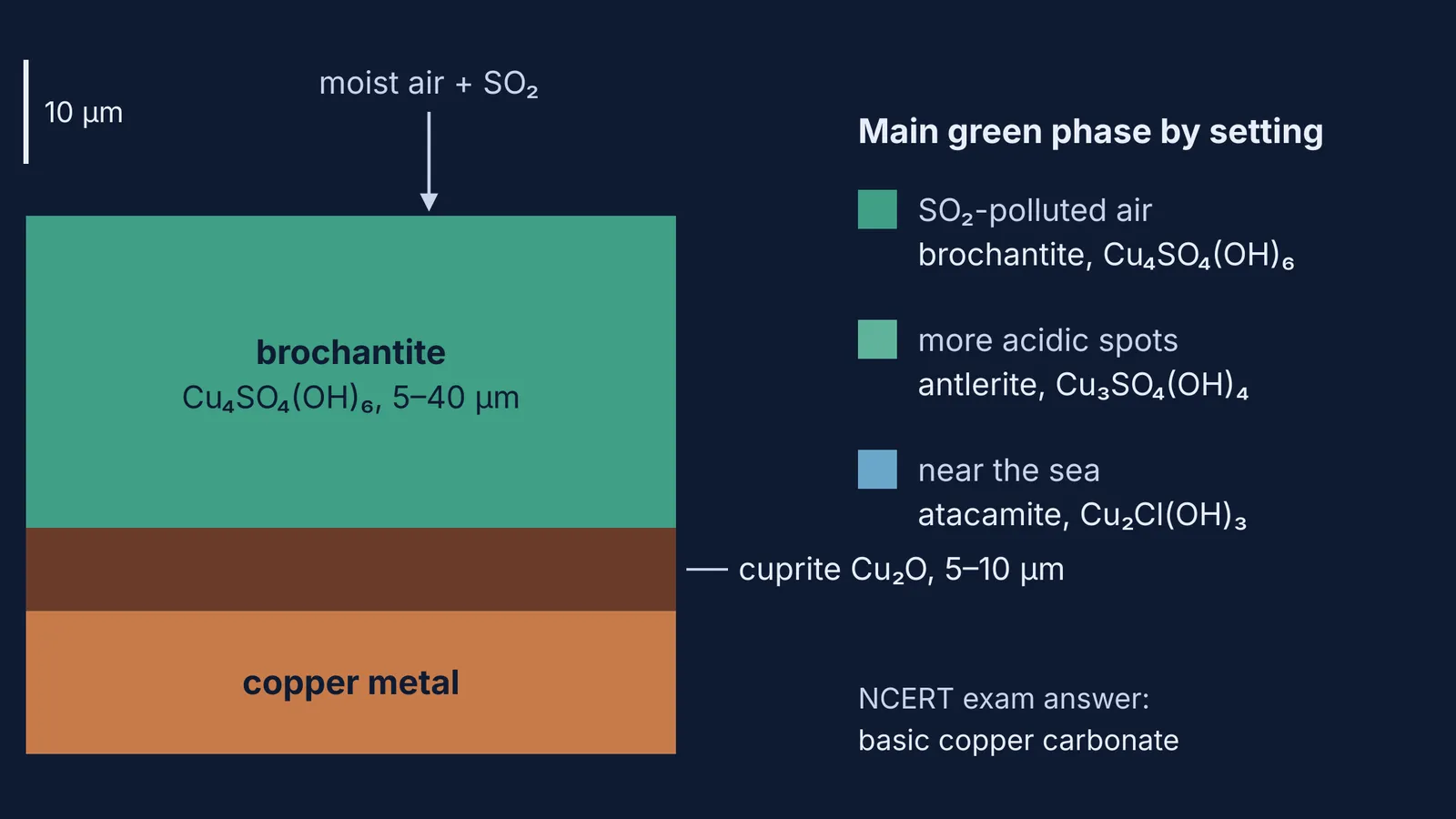
First, a thin layer of cuprite, Cu₂O, forms on the metal and turns it brown to dark brown. It is typically 5–10 µm thick.
Then cupric ions react with pollutants to form the green layer. "In industrial atmosphere, the green copper patina is usually based on sulphates, whereas patina formed close to the ocean is based on chlorides."
"The main components of outdoor patinas are cuprite, brochantite, antlerite, posnjakite and atacamite."
"Brochantite is the main phase of copper patina in atmospheres polluted by SO₂." It grows on top of the cuprite, usually 5–40 µm thick.
Basic copper carbonate (the mineral malachite, Cu₂CO₃(OH)₂) is not on that list of main components. The minerals that are:
Brochantite, Cu₄SO₄(OH)₆, also written CuSO₄·3Cu(OH)₂.
Antlerite, Cu₃SO₄(OH)₄, which is more stable at lower pH.
Posnjakite, Cu₄SO₄(OH)₆·H₂O, a precursor that turns into brochantite.
Atacamite, Cu₂Cl(OH)₃, the chloride phase near the sea.
The same paper notes that a natural patina usually takes several decades to form.
Where does the sulphate in copper patina come from?
From sulphur dioxide. Bureš and co-workers explain that SO₂ in the air is oxidised to sulphuric acid, either in the gas phase through reaction with hydroxyl radicals or inside cloud droplets and wet films. Overall, 2SO₂ + O₂ + 2H₂O → 2H₂SO₄. On a damp copper surface this sulphate meets cupric ions and the basic sulphate precipitates.
The paper gives the step from cuprite to brochantite as:
2Cu₂O + SO₄²⁻ + 4H₂O → CuSO₄·3Cu(OH)₂ + 2H⁺ + 4e⁻
Check it: 4 Cu, 1 S, 10 O and 8 H on each side, and a total charge of −2 on each side. Copper goes from +1 to +2, so four Cu atoms release the four electrons shown.
Timing follows the pollution. The paper says a sulphate patina takes almost a year to appear, while chloride patinas can show up within a month near the sea. It also notes that with less air pollution than in past decades, patination now takes longer. India's move to low-sulphur fuel, explained in why BS6 fuel has low sulphur, works on the same SO₂.
Why is the Statue of Liberty's patina sulphate if it stands by the sea?
You might expect a harbour statue to wear chloride. Bureš and co-workers, citing earlier studies by Graedel and others, write that the patina on the Statue of Liberty has brochantite and antlerite as its most common compounds. The reasons they give: sulphates are more stable than chlorides, and the composition is probably a consequence of acidic precipitation in New York Harbour, which favours antlerite, which is "even more stable than brochantite at lower pH levels".
Acid only helps up to a point. The paper warns that too much SO₂ makes the surface film so acidic that it dissolves brochantite, so "acid rains can be harmful for patina". In their test chamber, patina formed fastest with a surface electrolyte near pH 3.
Worked example: balance the formation of brochantite from copper
Question: Write a balanced equation for copper metal forming brochantite, Cu₄SO₄(OH)₆, with oxygen, water and sulphuric acid.
Oxidation states. Cu goes from 0 to +2. S stays at +6 in sulphate. Oxygen in O₂ goes from 0 to −2.
Electrons. Four Cu atoms lose 4 × 2 = 8 electrons. Each O₂ gains 4, so you need 2O₂.
Skeleton. 4Cu + 2O₂ + H₂SO₄ + ? H₂O → Cu₄SO₄(OH)₆.
Hydrogen. The product has 6 H. H₂SO₄ gives 2, so add 2H₂O for the other 4.
Check oxygen. Left: 4 (O₂) + 4 (H₂SO₄) + 2 (H₂O) = 10. Right: 4 + 6 = 10. Balanced.
4Cu + 2O₂ + H₂SO₄ + 2H₂O → Cu₄SO₄(OH)₆
Starting from SO₂ instead, sulphur also moves from +4 to +6, which adds two more electrons per brochantite: 8Cu + 2SO₂ + 5O₂ + 6H₂O → 2Cu₄SO₄(OH)₆. Count it yourself: 8 Cu, 2 S, 20 O, 12 H on each side.
Follow-up: percentage of copper. Molar mass of Cu₄SO₄(OH)₆ = 4(63.55) + 32.06 + 10(16.00) + 6(1.008) ≈ 452.3 g/mol. Copper is 254.2/452.3 ≈ 56.2%. For malachite, Cu₂CO₃(OH)₂ ≈ 221.1 g/mol, copper is about 57.5%. The two are close, so copper content alone cannot tell them apart. Chemists use X-ray diffraction, which is how the Prague study identified its brochantite.
So is the NCERT statement wrong?
Not for its purpose. It describes copper with moist air and carbon dioxide in a simple setting, and the exam expects that answer. For outdoor copper in polluted or coastal air, it is incomplete: the main green phase is a basic sulphate (or a basic chloride near the sea). This does not mean the carbonate never forms; the claim is only about the main phase of outdoor atmospheric patina. A kitchen vessel's green coat may differ again, and we did not find a study of vessels, so we make no claim about them. The chloride story on old bronzes is covered in why a speck of CuCl can eat an old bronze.
If you want to see how oxidation states, mole ratios and corrosion fit together across topics, the Concept Library covers every concept in chemistry.
Quick checklist
NCERT Class 10: the green coat is basic copper carbonate. Write that in the exam.
Outdoors, copper first grows brown cuprite, Cu₂O, then a green layer on top.
In SO₂-polluted air the green is mainly brochantite, Cu₄SO₄(OH)₆ = CuSO₄·3Cu(OH)₂.
Antlerite forms in more acidic spots; atacamite near the sea.
Statue of Liberty: mostly brochantite and antlerite.