

On this page
A green crust on an old bronze is usually a good sign. It is a stable patina that protects the metal underneath. Pale green, powdery spots that keep coming back after cleaning are a different story. Conservators call this bronze disease, and the cause is a thin, waxy grey layer of copper(I) chloride, CuCl, hidden under the crust. This post shows why CuCl survives when Cu⁺ in water cannot, how a speck of it keeps eating fresh metal, and how museums stop it.
What is bronze disease?
Bronze disease is active, chloride-driven corrosion of copper and copper alloys. The Canadian Conservation Institute describes it as light green powder erupting in spots over the surface, most common on archaeological copper alloys and in damp air (it gives 55% relative humidity and above).
India has a long tradition of bronze icons, such as the Chola-period images of South India. These are copper alloys, usually with tin and sometimes other metals, and the recipe varies from piece to piece; some are described as panchaloha. Any copper alloy that has lain in salty soil, come up from the sea, or been handled for years with sweaty hands can pick up chloride.
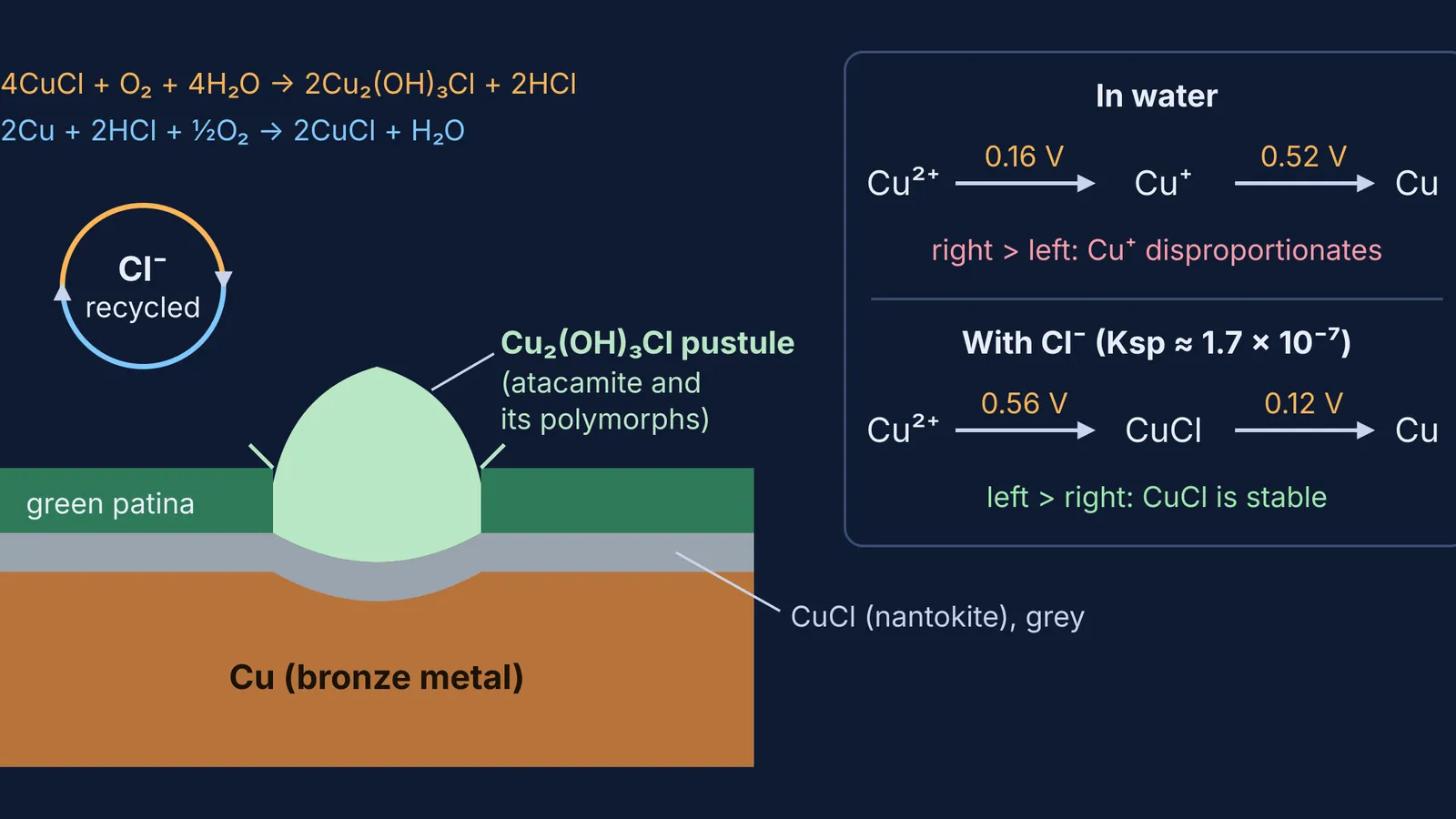
Under the patina, chloride forms copper(I) chloride, the mineral nantokite. In dry air it just sits there. In humid air it turns into pale green copper trihydroxychloride, Cu₂(OH)₃Cl. This formula has several crystal forms: atacamite, paratacamite and clinoatacamite. In David Scott's 1990 study, paratacamite was the main product on copper, so do not assume only atacamite forms.
This is not the same as the green layer on a kitchen vessel. That is mostly basic copper carbonate, which is stable, as explained in why copper vessels turn green.
Why doesn't CuCl disproportionate like Cu⁺ in water?
In water, Cu⁺ disproportionates: 2Cu⁺ → Cu²⁺ + Cu. Using values from the standard electrode potential table):
Cu²⁺ + e⁻ → Cu⁺, E° = +0.159 V
Cu⁺ + e⁻ → Cu, E° = +0.52 V
In the Latimer diagram Cu²⁺ —0.159→ Cu⁺ —0.52→ Cu, the potential to the right of Cu⁺ is higher than the one to its left, so Cu⁺ falls apart. The full proof is in why Cu⁺ is unstable in water, and the rule itself is in Latimer diagrams for predicting disproportionation.
Chloride changes the answer because CuCl is insoluble. Its solubility product is about 1.72 × 10⁻⁷ (CuCl data_chloride)). Once Cu⁺ is locked in a solid, both potentials move.
Worked example: how far does chloride shift the potentials?
(a) Shift the E° values with Ksp. Take standard conditions, [Cl⁻] = 1 M, so [Cu⁺] = Ksp.
Work out the shift: 0.0592 × log(1.72 × 10⁻⁷) = 0.0592 × (−6.76) ≈ −0.40 V.
CuCl + e⁻ → Cu + Cl⁻ is really Cu⁺ + e⁻ → Cu at a tiny [Cu⁺]. By the Nernst equation, E° ≈ 0.52 + (−0.40) = about +0.12 V.
Cu²⁺ + Cl⁻ + e⁻ → CuCl removes the product Cu⁺, which pulls the reaction forward. E° ≈ 0.159 + 0.40 = about +0.56 V.
Write the new Latimer diagram: Cu²⁺ —0.56→ CuCl —0.12→ Cu. Now the left value is higher than the right, so CuCl does not disproportionate.
Run it backwards. Cu²⁺ + Cu + 2Cl⁻ → 2CuCl has E° ≈ 0.56 − 0.12 = +0.44 V. With n = 1, ΔG° = −1 × 96,485 × 0.44 ≈ −42 kJ per mole of Cu²⁺, and K ≈ 3 × 10⁷.
So in chloride the reaction runs the other way. Copper(II) touching copper metal is pulled back down to copper(I). This is comproportionation, and it is why CuCl collects right at the metal surface.
How does a small spot of CuCl keep eating the metal?
The standard scheme in the conservation literature, set out in Scott's book Copper and Bronze in Art (Getty, 2002), has two steps.
Humid air converts CuCl to trihydroxychloride and releases acid: 4CuCl + O₂ + 4H₂O → 2Cu₂(OH)₃Cl + 2HCl.
The acid attacks fresh metal next to it and makes more CuCl: 2Cu + 2HCl + ½O₂ → 2CuCl + H₂O.
Check step 1: Cu 4, Cl 4, O 6, H 8 on each side; four Cu(I) lose four electrons to one O₂. Step 2: Cu 2, Cl 2, H 2, O 1; two electrons go to ½O₂.
(b) Add the steps. Add step 1 and step 2, then cancel the 2HCl and two CuCl that appear on both sides:
2Cu + 2CuCl + 3/2 O₂ + 3H₂O → 2Cu₂(OH)₃Cl
Check: Cu 4, Cl 2, O 3 + 3 = 6, H 6 on each side.
Now follow 1 mol of starting CuCl. Step 1 turns it into atacamite and frees 0.5 mol HCl. That acid corrodes 0.5 mol of fresh copper into 0.5 mol CuCl. The next pass frees 0.25 mol HCl, then 0.125, and so on. Total copper attacked: 0.5 + 0.25 + 0.125 + … = 1 mol. This is a model. It assumes complete reaction and no new chloride. In a real object, sweat, sea air or salty soil keep adding chloride, so the cycle does not die out.
Why do the spots swell and flake?
(c) Compare volumes. Copper metal: 63.55 g/mol ÷ 8.96 g/cm³ ≈ 7.1 cm³ per mole of Cu. Cu₂(OH)₃Cl: 213.6 g/mol ÷ about 3.76 g/cm³ ≈ 57 cm³ per mole, which is about 28 cm³ per mole of Cu. Each copper atom's worth of solid grows about four times in volume.
The powder cannot fit in the space the metal left, so it bulges, cracks the patina and flakes off, letting in more moist air. That is why the damage shows as spreading pustules. If you want more redox and Ksp problems like part (a), the Fermi Problem Library has a step-by-step solver that explains the reasoning.
How do conservators stop bronze disease?
They attack each part of the cycle.
Keep the air dry. In Scott's 1990 experiments, CuCl on copper showed no change over two years at 42–46% relative humidity, but reacted quickly at 70%. He suggested 42–46% for most objects and never above 55% (older advice was below 39%). No water, no step 1.
Wash out chloride. Soaking in sodium sesquicarbonate solution slowly draws chloride out of the corrosion layers. It is slow and can take months.
Seal the CuCl. Benzotriazole (BTA) binds to copper(I) and forms a thin insoluble film that keeps moisture and oxygen away. It is a suspected toxin, so it is a job for trained conservators only.
Remove the pustules mechanically, under a microscope, before treatment.
Quick checklist
Bronze disease: chloride-driven corrosion that shows as pale green, powdery spots.
The hidden cause is CuCl (nantokite) at the metal surface.
In water Cu⁺ disproportionates (0.52 > 0.159 V); in chloride CuCl is stable (0.56 > 0.12 V).
Shift each E° by 0.0592 log Ksp; for CuCl that is about 0.40 V.
Cycle: CuCl + O₂ + H₂O → Cu₂(OH)₃Cl + HCl, then HCl + Cu + O₂ → CuCl.
The product takes about four times the volume of the copper, so it swells and flakes.
Control: low humidity, chloride removal, BTA sealing.


