

On this page
Some bacteria that live in pond and sea mud carry their own compass. Inside each cell is a neat row of tiny magnetite (Fe₃O₄) crystals, and the cell swims along Earth's magnetic field lines. These are magnetotactic bacteria, and the row of crystals is called a magnetosome chain. They raise a physics question you can answer with Class 12 magnetism: is Earth's weak field strong enough to line up something so small, when the cell is being knocked about by water molecules all the time?
How does a chain of magnetite crystals act like a compass?
Each crystal is a tiny permanent magnet with a magnetic moment m. In the chain, the crystals sit end to end with their moments pointing the same way, so the moments add. The whole chain behaves as one bar magnet fixed inside the cell.
In a uniform field B, a dipole feels a torque τ = mB sin θ that turns it towards the field, and its potential energy is U = −mB cos θ. You can revise both in current loops as magnetic dipoles. Two points matter here:
In a uniform field the net force on a dipole is zero. The bacterium is turned, not pulled.
The magnet only steers. The cell swims with its own flagella, and the chain keeps it pointed along the field.
Why compare mB with k_BT?
A bacterium is about a micrometre long, so it is constantly jostled by collisions with water molecules. Each random kick carries energy of order k_BT. The energy that holds the cell aligned is of order mB, the difference between pointing along the field and across it.
So the test is a ratio, x = mB/k_BT:
If x is much larger than 1, the field wins and the cell stays lined up.
If x is much smaller than 1, thermal motion wins and the direction is almost random.
It is the same contest you meet in Curie's law for paramagnets, where atomic moments try to align and heat scrambles them. The difference is size: the chain's moment is roughly a hundred million times one Bohr magneton (9.27 × 10⁻²⁴ A m²), the typical moment of a single atom.
A review of magnetotactic bacteria by Faivre and Schüler in Chemical Reviews (2008) uses exactly this test. It reports magnetosome crystals from about 30 to 140 nm in size, a saturation magnetisation of magnetite of 0.48 × 10⁶ A/m, a measured moment of 1.2 × 10⁻¹⁵ A m² for one chain of 21 magnetosomes, and Earth's field between about 25 and 60 µT.
Worked example: does a chain of 20 crystals line up?
Take illustrative round numbers inside the review's ranges: a chain of 20 cubic magnetite crystals, each 50 nm on a side, in a field of 50 µT, at 300 K.
Volume of one crystal. V = (50 × 10⁻⁹ m)³ = 1.25 × 10⁻²² m³.
Moment of one crystal. m₁ = M_s V = 0.48 × 10⁶ × 1.25 × 10⁻²² = 6.0 × 10⁻¹⁷ A m². (Units: A/m × m³ = A m².)
Moment of the chain. m = 20 × 6.0 × 10⁻¹⁷ = 1.2 × 10⁻¹⁵ A m². This matches the measured value for a real 21-crystal chain quoted in the review.
Magnetic energy. mB = 1.2 × 10⁻¹⁵ × 50 × 10⁻⁶ = 6.0 × 10⁻²⁰ J. (Units: A m² × T = J.)
Thermal energy. k_BT = 1.38 × 10⁻²³ × 300 = 4.14 × 10⁻²¹ J.
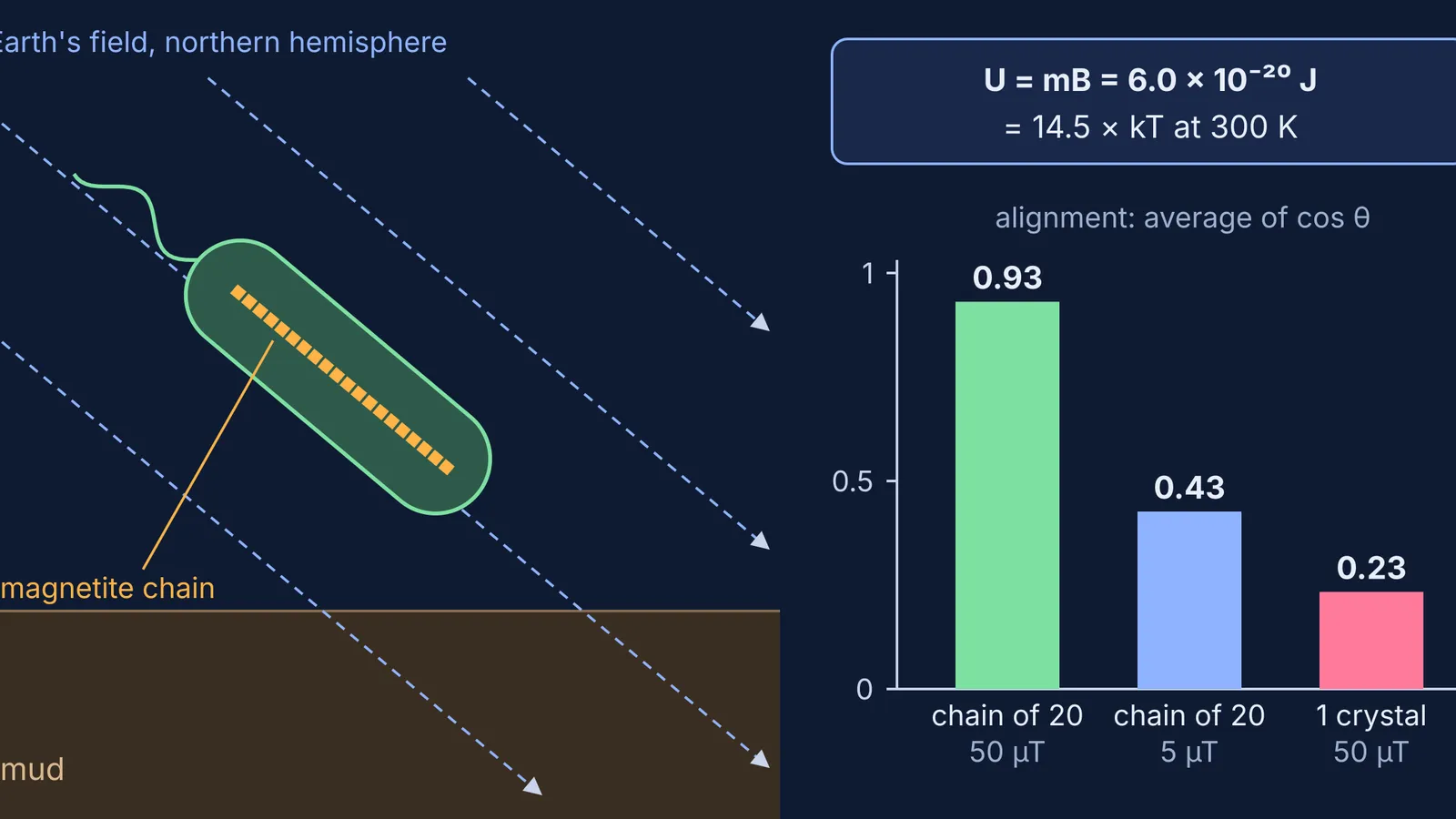
Ratio. x = 6.0 × 10⁻²⁰/4.14 × 10⁻²¹ = 14.5.
The field energy is about 14.5 times the thermal energy. The chain wins comfortably.
How well aligned is the cell on average?
For a free dipole in thermal equilibrium, the average of cos θ is given by the Langevin function:
⟨cos θ⟩ = coth x − 1/x
Chain of 20 in 50 µT: x = 14.5, so ⟨cos θ⟩ = 0.93. The cell points almost straight along the field.
One crystal in 50 µT: m = 6.0 × 10⁻¹⁷ A m², so x = 0.72 and ⟨cos θ⟩ = 0.23. It is mostly jostled about.
Chain of 20 in 5 µT: x = 1.45 and ⟨cos θ⟩ = 0.43. A field ten times weaker would leave the cell wandering.
For small x, coth x − 1/x is close to x/3, which is where Curie's law comes from: one crystal gives 0.72/3 = 0.24, close to the exact 0.23. The review makes the same point another way: at x = 10, cells swim with about 90% efficiency along the field, and the Langevin function gives 0.90 at x = 10.
Why not grow one big crystal instead of twenty small ones? A single cube with the same volume would be about 136 nm across, near the top of the size range the review gives. Larger magnetite crystals split into several magnetic domains pointing different ways, and their net moment drops. A chain of small single-domain crystals keeps every crystal fully magnetised.
Why does following the field take the bacterium down into the mud?
Earth's field is not horizontal. In the northern hemisphere it dips downward, and in the southern hemisphere it points upward. A bacterium that swims along the field in the north therefore swims both north and down, towards the low-oxygen mud it prefers. The review notes that north-seeking cells dominate in the northern hemisphere and south-seeking cells in the southern hemisphere, which is what you expect if the dip is what matters.
Near the magnetic dip equator the field is almost horizontal, and this compass gives no up-or-down signal. That line runs close to the southern tip of India: the rocket range at Thumba near Thiruvananthapuram was set up over the magnetic dip equator to study the upper atmosphere there.
Keep the model's limits in mind. Langevin's formula assumes a free rigid dipole in thermal equilibrium, and a swimming cell is only roughly like that. Crystal size, crystal number and chain moment vary from species to species, so the numbers above are an illustration, not a measurement of one bacterium. Birds sense the field too, but by different means, as described in how migratory birds find their way.
To see how a dipole's average alignment changes as you raise the field or the temperature, the Simulation Lab has interactive simulations for ideas that are easier to see than read.
Quick checklist
Magnetosome chain: crystal moments add, so the chain acts as one bar magnet.
Uniform field: torque mB sin θ, no net force. The magnet steers; flagella drive.
Test for alignment: x = mB/k_BT. Here 6.0 × 10⁻²⁰ J against 4.14 × 10⁻²¹ J gives x = 14.5.
Average alignment: ⟨cos θ⟩ = coth x − 1/x, giving 0.93 for the chain and 0.23 for one crystal.
Downward dip in the northern hemisphere sends north-seeking cells down into the mud.


