On this page
Look at a cable-stayed bridge and you see straight cables fanning down from a tall tower to the deck. Each cable, called a stay, holds up one stretch of the deck. The long, shallow stays at the far end pull hardest, and they also push the deck sideways into the tower. Both facts come from one force triangle.
How is a cable-stayed bridge different from a suspension bridge?
In a suspension bridge, two main cables hang in a curve between towers, and vertical hangers drop from them to the deck. You can read how that design grew in John Roebling's wire-rope suspension bridges.
A cable-stayed bridge has no main cable. Every stay runs in a straight line from the tower to its own anchor point on the deck. So each stay is a single straight rope pulling at one point, and the anchor point is in equilibrium under three forces:
the stay's tension T, along the stay, up and towards the tower;
the weight W of the stretch of deck that stay supports, straight down;
the push or pull from the neighbouring deck, along the deck.
Because every stay pulls the deck towards the tower, the deck of a cable-stayed bridge is squeezed along its length. It is in compression, not just bending.
Why does the shallowest stay carry the most tension?
Call θ the angle the stay makes with the horizontal deck. Resolve T into two parts:
vertical part T sin θ, which must hold up the deck segment, so T sin θ = W;
horizontal part T cos θ, along the deck towards the tower.
From the first line, T = W/sin θ. A vertical stay (θ = 90°) would need T = W exactly. As the stay gets flatter, sin θ gets smaller and T grows. At 30°, sin θ = 0.5, so the stay pulls with twice the weight it holds. This is the same 1/sin θ that makes a nearly flat wire need a huge tension, as shown in why a taut horizontal string cannot be perfectly straight.
In a fan layout, the stays farthest from the tower are the flattest. So the outermost stays, not the steep ones near the tower, carry the most tension.
How hard does a stay push the deck towards the tower?
The horizontal part of the tension is H = T cos θ = W/tan θ. The stay pulls its anchor point towards the tower with this force, and the deck between the anchor and the tower has to resist it. Every stay on that side adds its own H, so the deck section right next to the tower carries the sum of all of them.
For a stay at 45°, H = W. For a stay flatter than 45°, H is bigger than the weight the stay holds.
Worked example: sizing the stays on one side of a tower
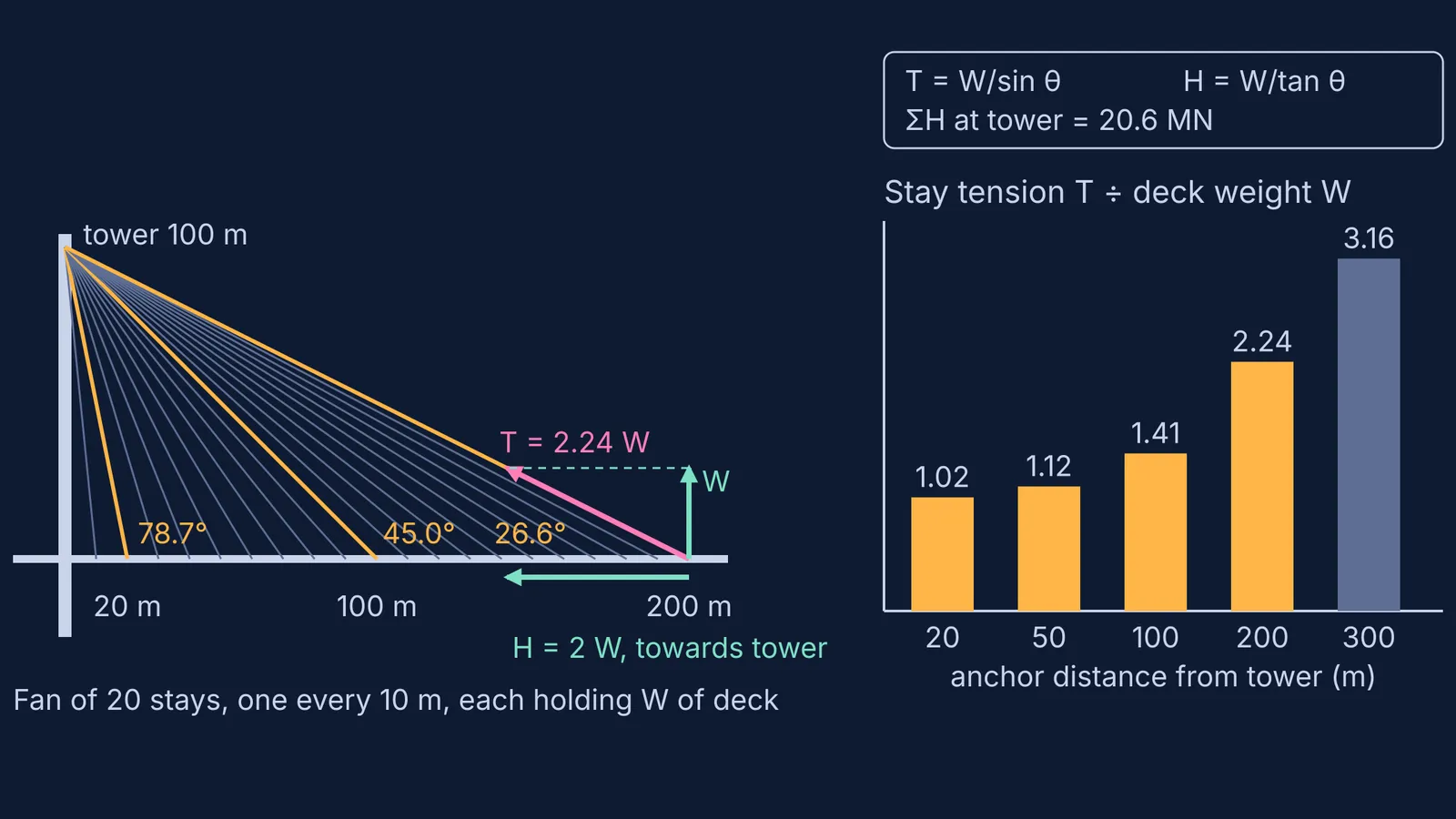
Take a simple classroom model (illustrative, not a real bridge). A tower rises 100 m above the deck. All the stays start at the top of the tower and reach anchors every 10 m, from 10 m to 200 m out. Each stay holds a 10 m deck segment of mass 100 tonnes.
Weight per segment. W = mg = 100,000 kg × 9.81 m/s² = 9.81 × 10⁵ N = 981 kN.
Angle of the outermost stay. tan θ = 100/200 = 0.5, so θ = 26.6° and sin θ = 0.447.
Tension. T = W/sin θ = 981 kN/0.447 = 2,194 kN. That is 2.24 W.
Push on the deck. H = W/tan θ = 981 kN/0.5 = 1,962 kN, exactly 2 W.
Compare other stays. The stay at 20 m rises at 78.7° and pulls with 1,000 kN (1.02 W). At 50 m: 63.4° and 1,097 kN (1.12 W). At 100 m: 45° and 1,387 kN (1.41 W). If the span went on to 300 m, the last stay would sit at 18.4° and need 3.16 W.
Add up one side. The 20 stays hold 20 × 981 kN = 19.6 MN of deck, but together they pull with 29.6 MN. Their horizontal parts add to 20.6 MN, which is the compression in the deck where it meets the tower.
Steel needed. Stay cables are made of high-strength steel strand; one maker lists galvanised stay-cable strand in grades up to 1,860 MPa. Suppose the working stress is 45% of that, about 837 MPa (an illustrative round value; design codes set the real limit). Area = T/stress = 2.194 × 10⁶ N/8.37 × 10⁸ Pa = 2.6 × 10⁻³ m², about 26 cm² of steel. The 50 m stay needs only about 13 cm².
Check the units: N divided by Pa (N/m²) gives m², which is an area, as it should be. The total force check also works: the vertical parts of all 20 tensions add to exactly 19.6 MN, the weight held.
What stay angles do real bridges use?
Real designs avoid very flat stays because the tension, and the steel, grow quickly below about 25°. As one example, the cable-stayed bridge on Xuefu Road in Shijiazhuang, China, has a 160 m main span, a pylon about 88 m above the deck, and stays inclined between 28° and 70° to the horizontal, according to a 2023 design paper in Prestress Technology. Using T = W/sin θ, its flattest stays must pull with about 2.13 times the deck weight they hold, and its steepest with about 1.06 times.
This is also why long spans need tall towers. A taller tower makes every stay steeper, which raises sin θ and cuts the tension for the same deck.
Why do the towers have stays on both sides?
Every front-span stay also pulls the top of the tower towards the river. So the stays on the back span pull the other way, and the horizontal forces on the tower roughly cancel. This is the same balancing idea used in tower cranes and their counterweights, where a counterweight on the short arm balances the load on the long one.
The pulls cancel at the tower top, but the deck on each side still carries its own compression.
If you want to practise more equilibrium problems like this one, the Fermi Problem Library has a step-by-step solver that explains the reasoning at each step.
What does this simple model leave out?
Real stays also carry their own weight and sag slightly, which makes them a little less stiff. Traffic and wind add load. Many bridges anchor stays at several heights on the tower, and the deck bends between anchors, so no stay takes exactly one segment. None of this changes the main lesson: tension goes as 1/sin θ, so flat stays are expensive.
Quick checklist
Each stay holds its own deck segment: T sin θ = W, so T = W/sin θ.
The horizontal part H = W/tan θ squeezes the deck towards the tower.
At 26.6°, T = 2.24 W and H = 2 W; at 45°, T = 1.41 W and H = W.
The outermost, flattest stays carry the most tension.
Back-span stays balance the pull on the tower top.
Taller towers make steeper stays and smaller tensions.