

On this page
Before the mid-19th century, canal boats and railway cars were hauled up steep inclines using thick hemp ropes. These ropes were up to 7 cm thick, expensive to maintain, and prone to snapping under heavy loads (Wikipedia). John Roebling, an engineer working on the Allegheny Portage Railroad, realised that a rope made of wrought iron would last much longer.
In 1841, Roebling began producing a seven-strand wire rope on his farm in Saxonburg, Pennsylvania (Wikipedia). By twisting individual iron wires into strands, and then twisting those strands together, he created a cable that was much stronger than hemp. He later built a large factory in Trenton, New Jersey, which eventually manufactured cables up to 91 cm in diameter (Britannica).
Why was wire rope better than hemp?
His invention changed civil engineering. A snapping hemp rope on a steep incline could send tonnes of coal and timber crashing backwards. Roebling's wire rope resisted rot, handled weather better, and offered a predictable breaking strain. Wrought iron, and later steel, wire ropes could support high tension without failing. If you are studying mechanics, you will know that tension in a rope with mass: how tension varies along its length means the forces at the anchor points are huge. Roebling's strong wire ropes solved this material bottleneck perfectly, opening the door for elevators, mining hoists, and large bridges.
How does a wire rope suspension bridge work?
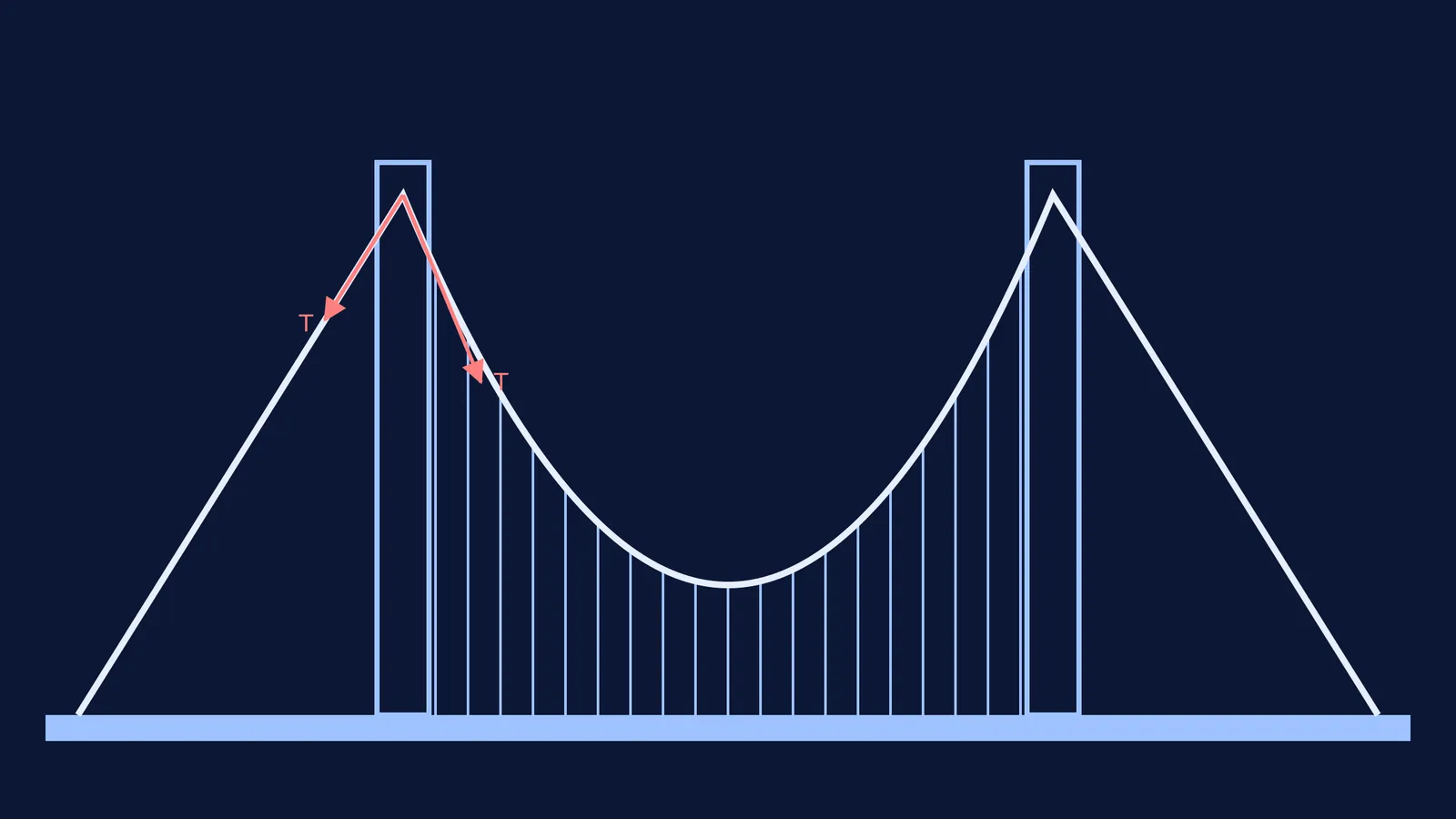
A suspension bridge carries its load by hanging a flexible cable between two compression towers. The road deck is held up by vertical suspender cables, which transfer the deck's weight into the main curve. The main cables then pull inwards and downwards on the towers, and the ends of the cables are firmly anchored into the ground.
If you are solving equilibrium problems for a bridge in physics, use this three-step framework:
Isolate the segment: Cut the cable mathematically at the lowest point (where tension is purely horizontal) and at the tower (where tension is angled).
Sum the vertical forces: The vertical component of tension at the tower must exactly equal the weight of the bridge deck segment it supports (Ty = mg).
Sum the horizontal forces: The horizontal component of tension is constant throughout the entire cable (Tx = T_bottom).
The curve of a loaded suspension bridge cable forms a parabola. To balance the forces, the tension must be calculated at every point. The tension is highest at the towers, where the cable must hold up the entire weight of the bridge span below it. If you struggle to picture how these forces resolve into horizontal and vertical components, the Fermi Simulation Lab provides interactive simulations for the ideas that are easier to see than to read, allowing you to drag vectors and watch the tension update as the bridge takes a load.
Roebling refined this architecture across several bridges before his final project. While Charles Wheatstone, the telegraph and the bridge named after him gave us a famous electrical circuit, Roebling gave us the modern structural bridge.
What happened to John Roebling in 1869?
Roebling's final project was the Brooklyn Bridge across the East River in New York. His design was officially accepted in 1867, calling for a main span of 486 metres (Britannica). It was to be the first suspension bridge to use steel for its cable wire, a material choice that provided a very high strength-to-weight ratio.
However, Roebling never saw it built. In 1869, while he was examining the site for the Brooklyn tower, a docking boat hit the ferry slip and crushed his toes (Britannica).
Although doctors amputated his crushed toes, he strongly rejected any further conventional medical treatment. He demanded that his foot be kept under a constant stream of cold water. Because of this treatment, or the initial dirty injury, he contracted tetanus (lockjaw). The infection led to severe muscle spasms, and Roebling died of the disease on 22 July 1869 at the age of 63 (Britannica).
His son, Washington Roebling, stepped in as chief engineer. Because of his father's meticulous planning, the Brooklyn Bridge was built exactly to his vision, cementing John Roebling's legacy as the pioneer of the wire rope suspension bridge.


