On this page
A cup anemometer tells you the average wind speed over a few seconds. To see the fast eddies in turbulent air, researchers use something much smaller: a tungsten wire about 5 µm thick, thinner than a hair, heated by an electric current and held at a fixed high temperature. Moving air cools it, and the electrical power needed to keep it hot tells you the air speed. The physics is Joule heating, the temperature coefficient of resistance and convection, all in one wire.
How does a hot-wire anemometer work?
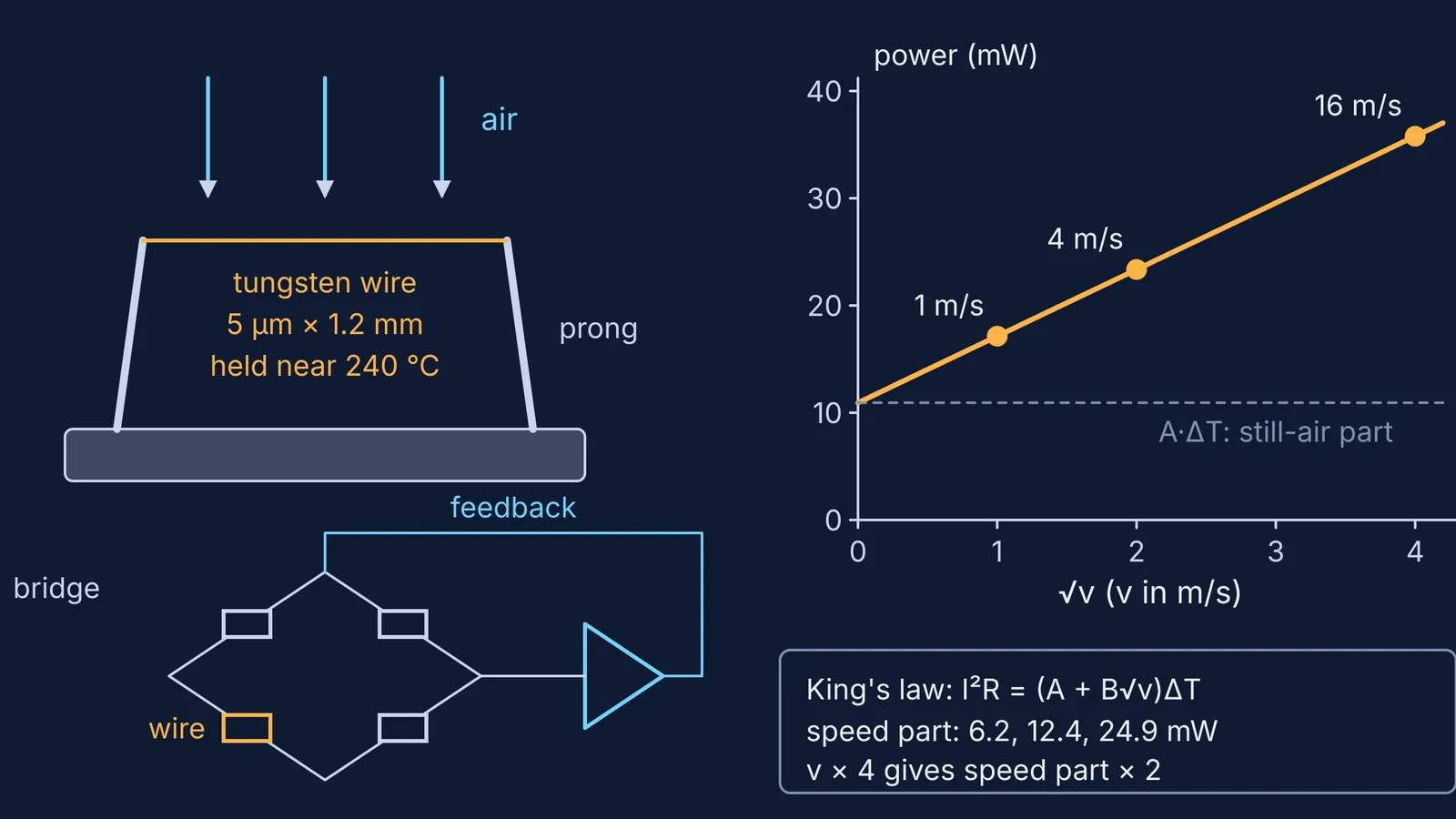
The wire is spot-welded between two needle-shaped prongs and forms one arm of a Wheatstone bridge. In the usual constant-temperature mode, an amplifier watches the bridge. If the air speeds up and cools the wire, its resistance drops, the bridge goes out of balance, and the amplifier pushes more current through the wire until it is back at its set temperature. So the wire's temperature and resistance stay fixed; what changes is the current, and the voltage needed to drive it.
The wire's resistance is its own thermometer: R = R₀(1 + αΔT), the relation covered in the temperature coefficient of resistance. Holding R fixed means holding ΔT fixed.
The figures below lean on Dantec Dynamics' practical guide to hot-wire anemometry (F. E. Jørgensen, 2002), which says wire sensors are normally 5 µm in diameter and about 1.2 mm long, that tungsten can be used up to about 300 °C, and recommends an overheat ratio of a = (R_hot − R_cold)/R_cold = 0.8 in air, an over-temperature of about 220 °C.
What is King's law?
In a steady state, electrical power in equals heat carried away:
I²R = (A + B vⁿ) ΔT
This is King's law. A is the heat lost even without a flow (conduction and natural convection), B vⁿ is the extra loss from forced convection, and n is close to 0.5. Since the anemometer's output voltage E satisfies E² = I²R × R, the same law is often written E² = A + B vⁿ with new constants. It is an empirical fit, not an exact result. The Dantec guide suggests starting a calibration fit with n = 0.45 and adjusting it until the fit is good, and notes that n itself varies slightly with speed.
Why roughly √v? Heat leaves the wire through a thin boundary layer of air. Faster air thins the layer, and for a thin cylinder the layer's thickness falls roughly as 1/√v, so the convective loss grows roughly as √v.
How much power does the wire need? A worked example
Take a tungsten wire 5 µm in diameter and 1.2 mm long in air at 20 °C, run at a = 0.8. Treat the material data as approximate: tungsten's resistivity about 5.6 × 10⁻⁸ Ω m at 20 °C, and air properties at the average film temperature of about 130 °C of k ≈ 0.034 W/m K, kinematic viscosity ν ≈ 2.6 × 10⁻⁵ m²/s and Prandtl number 0.69. For the heat loss we use Kramers' empirical correlation for thin heated cylinders, Nu = 0.42Pr^0.2 + 0.57Pr^0.33 Re^0.5, where Re = vd/ν. All of this makes the example illustrative rather than a specific probe's calibration.
Cold resistance. R₀ = ρL/A = 5.6 × 10⁻⁸ × 1.2 × 10⁻³ / [π × (2.5 × 10⁻⁶)²] = 3.42 Ω.
Hot resistance and temperature. With a = 0.8, R_hot = 1.8 × 3.42 = 6.16 Ω. Dantec pairs a = 0.8 with about 220 °C, which implies α ≈ 0.8/220 = 0.0036 per K for its wire. The wire sits near 240 °C.
Heat loss. P = Nu × k × π × L × ΔT. This gives about 17.1 mW at 1 m/s, 23.4 mW at 4 m/s and 35.8 mW at 16 m/s.
Split into the two parts. The constant part (the 0.42Pr^0.2 term) is 10.9 mW. The speed-dependent parts are 6.2, 12.4 and 24.9 mW. Each fourfold rise in speed doubles them, because √4 = 2.
Current and voltage. I = √(P/R_hot) gives 52.8, 61.6 and 76.2 mA; the voltage across the wire is 0.325, 0.379 and 0.469 V. Sixteen times the speed raises the voltage by only 44%.
Units check: Nu is dimensionless, k × L × ΔT has units (W/m K) × m × K = W. Because the output is so strongly non-linear, every real probe is calibrated in a known flow, and the result is a curve, not a single constant.
Why does the wire need to be so thin?
Two reasons: speed of response and how small a region it samples. The wire holds only about 0.45 µg of tungsten (density 19,300 kg/m³). Its heat capacity, divided by the convective conductance hπdL at 4 m/s, gives a thermal time constant of about 0.6 ms for the bare wire. That alone would only follow changes up to a few hundred hertz. The feedback amplifier does the rest: by driving the current as soon as the bridge unbalances, it extends the response far beyond the bare wire. Dantec quotes typical bandwidths of about 10 kHz for a simple constant-temperature unit and 100 to 250 kHz for research units.
A thicker wire would also lose a larger share of its heat by conduction into the prongs. How a thin wire's small radius shifts the balance of heat loss from its surface is worked in the critical radius of insulation for a thin wire.
What can't a hot wire tell you?
Direction. A single wire responds to the speed component across it and cannot tell which way the air is moving along that line. Two or three wires at angles are used to separate components.
Temperature changes in the air. The wire senses ΔT between itself and the air. If the air warms, the heat loss falls and the reading drops. The guide gives correction methods for this.
Dirty or fast-changing environments. A 5 µm wire breaks easily, and dust on it changes its heat loss.
For long-term average wind at a weather station, a common choice is still a rotating instrument such as Robinson's cup anemometer.
If you want to see how resistance, current and power trade off in circuits like this, the Simulation Lab has interactive simulations for ideas that are easier to see than read.
Quick checklist
The wire is held at a fixed temperature and resistance; current changes.
King's law: I²R = (A + B vⁿ)ΔT with n near 0.5; it is an empirical fit.
Four times the speed roughly doubles the speed-dependent cooling.
A 5 µm, 1.2 mm tungsten wire at a = 0.8 needs tens of milliwatts.
The bare wire's time constant is under a millisecond; feedback makes the system faster.
Real probes are calibrated, and read only the speed across the wire.