

On this page
When you look at a modern weather station, you will often see a spinning instrument with little cups catching the breeze. This simple, powerless device has been the international standard for measuring wind speed since the middle of the 19th century. Its reliable mechanical design allows meteorologists to record wind data consistently without relying on complex electronics.
Irish astronomer John Thomas Romney Robinson invented the four-cup anemometer in 1846. His invention solved a major practical problem for scientists of the time: how to mechanically record the continuous power of the wind over long periods.
Who was Thomas Romney Robinson?
Robinson was a dedicated scientist and the director of the Armagh Observatory in Northern Ireland for 59 years. During his long tenure, he focused on both astronomical observations and meteorological instruments. In January 1839, a catastrophic European windstorm known as the "Night of the Big Wind" struck the region, with gusts estimated to be over 185 km/h.
Extreme weather events like the 1839 storm demonstrated what turbulent forces instruments needed to withstand. By 1846, Robinson had developed his four-cup hemispherical design to measure wind speed. The simplicity of this anemometer made it incredibly robust, and it became a fundamental tool for gathering atmospheric data across the globe.
How does a cup anemometer measure wind speed?
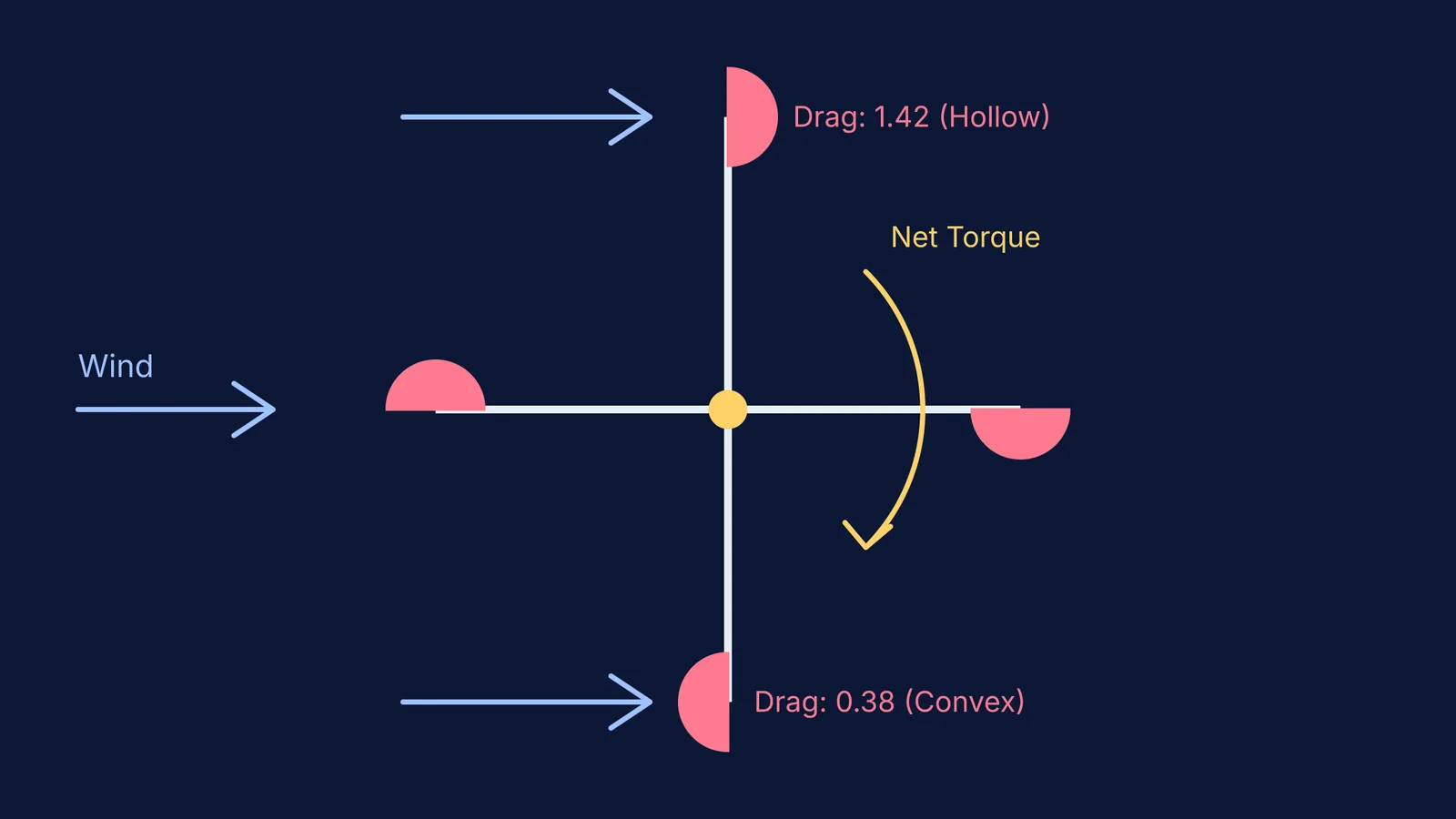
The secret to the cup anemometer is the physics of differential drag. Robinson's design featured four hemispherical cups mounted on horizontal arms around a vertical central shaft.
Because of their shape, the wind always pushes harder against the hollow (concave) side of one cup than it does against the back (convex) side of the opposite cup. In fluid dynamics, a hollow hemisphere has a drag coefficient of 1.42 on its hollow side and just 0.38 on its spherical side. This means the wind exerts more than three times the force on the open cup.
If you find torque and aerodynamic drag hard to picture, the Fermi Simulation Lab offers interactive simulations for the ideas that are easier to see than to read. You can see how unbalanced forces on opposite ends of a lever arm create rotation, which is exactly how Robinson's cups behave. For a closer look at the maths, you can explore Torque as r × F: finding torque about a point with vectors.
What was the "Robinson factor"?
When Robinson first described his invention to the scientific community, he claimed that the cups moved at exactly one-third of the wind speed (a factor of 3). He believed this ratio was a constant of nature, completely unaffected by how large the cups were or how long the arms were.
This assumption became widely accepted as the "Robinson factor." However, later physicists conducting independent tests discovered that this convenient one-third rule was incorrect. The actual ratio of wind speed to cup speed—the anemometer factor—typically ranges between two and a little over three, depending heavily on the specific dimensions, aerodynamics and friction of the device. Because of this early mathematical error, all previous experiments involving anemometers had to be repeated to correct the historical record.
Today, if you are setting up kinematics equations to link rotational velocity to wind speed, the Fermi Problem Library has worked problems with a step-by-step solver that explains the reasoning rather than printing an answer.
How do you calculate wind speed from cup rotation?
Understanding the anemometer gives you a highly practical framework for applying rotational kinematics to real-world physics. Here is how a modern meteorologist or physics student relates the spinning cups to the actual speed of the wind:
Find the circumference: Measure the radius r from the centre shaft to the centre of the cup. The path one cup travels in a full rotation is 2πr.
Count the RPM: Record the revolutions per minute (RPM) of the central shaft over a set time interval.
Calculate the cup speed: Multiply the circumference by the RPM, then convert it into metres per second to get the linear velocity of the rotating cup.
Apply the anemometer factor: Multiply the cup's linear velocity by the specific anemometer factor for your calibrated device (usually between 2 and a little over 3) to find the true wind speed.
Robinson's 1846 rotational design laid the groundwork for modern weather forecasting. His enduring legacy reminds us that even when the underlying physics is complex—like the turbulent airflow around moving hemispheres—the most elegant scientific solutions are often the simplest ones. (To read more about early pioneers in atmospheric science, see Vilhelm Bjerknes and the physics of weather forecasting.)


