On this page
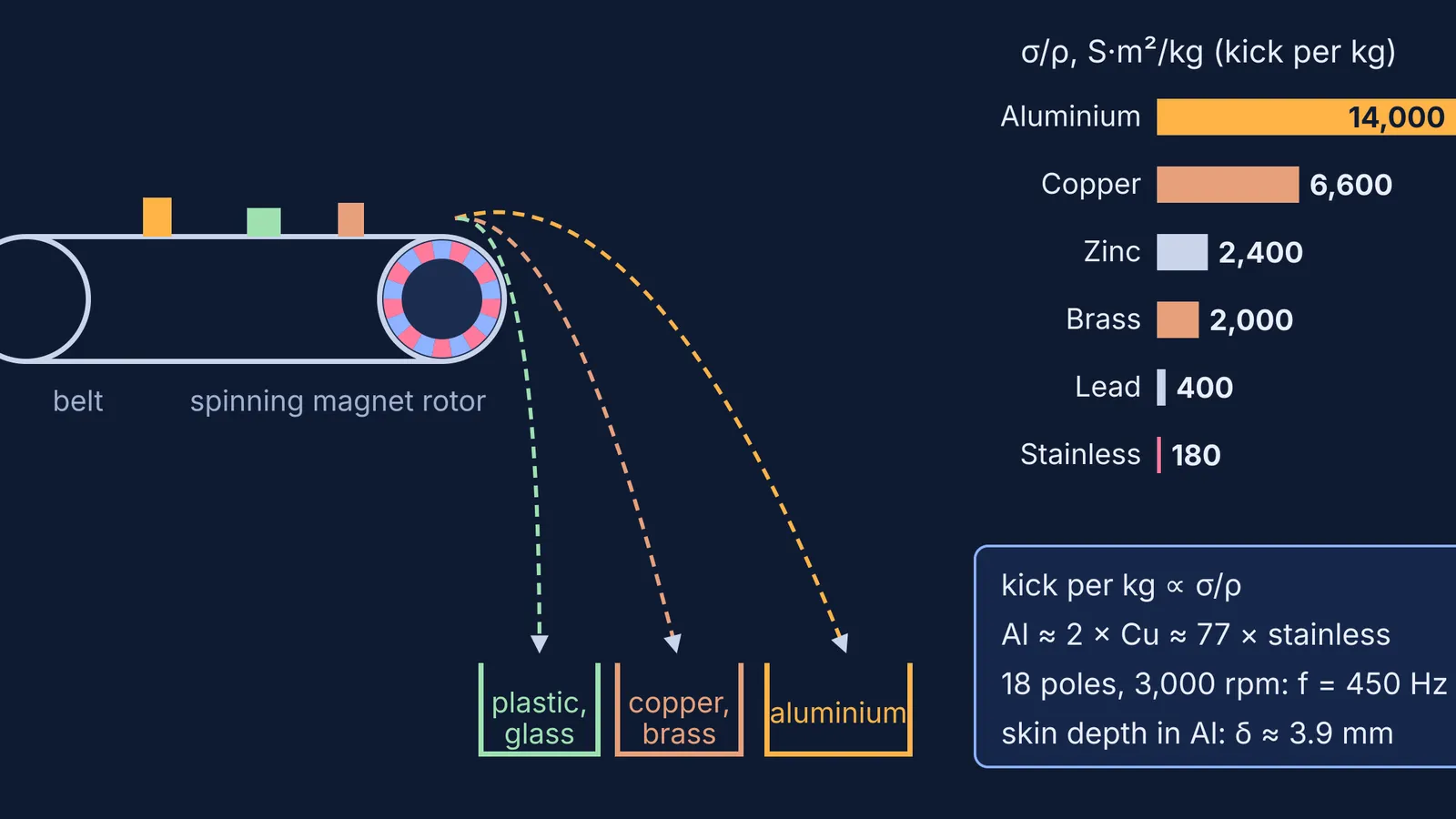
A recycling plant receives a mixed stream of shredded plastic, glass, aluminium cans and bits of copper wire. Near the end of the line, the belt runs over a drum that holds a ring of strong magnets spinning very fast. Aluminium jumps off the end of the belt and lands in a bin far away. Copper and brass land closer. Plastic and glass just drop off the end. Nothing touches the metal, and none of it is magnetic. The machine is an eddy-current separator, and it runs on Lenz's law.
How does an eddy-current separator work?
The drum at the end of the belt is a rotor with permanent magnets set around it with alternating poles: N, S, N, S. The rotor spins much faster than the belt moves. A piece of metal riding over it therefore sees a magnetic field that flips direction hundreds of times a second.
A changing field through a conductor induces an EMF in it, and because the metal is a conductor, current flows in closed loops inside it. These are eddy currents. By Lenz's law, they flow in the direction that opposes the change that produced them. In practice this means the piece is pushed along with the moving field, forwards and up, away from the rotor. It leaves the belt with extra speed and flies further than it would have on its own.
Plastic and glass carry no current, so the changing field does nothing to them. They fall off the end with only the belt's speed. A splitter plate placed between the landing zones divides the stream into bins.
This is the same push you see when a magnet falls slowly through a copper pipe, explained in why a magnet falls slowly through a copper tube. There the magnet moves and the copper is fixed; here the field moves and the metal is free, so the metal is the one that gets pushed. Braking, induction heating and damping are covered in eddy currents explained, so they are not repeated here.
Why is aluminium thrown further than copper?
Copper conducts better than aluminium, so it might seem that copper should fly furthest. It does not, and the reason is mass.
For a piece of a given size and shape in a given changing field, the induced EMF is the same whatever the metal. The current is then proportional to the conductivity σ, and so is the force on the piece. But the acceleration is force divided by mass, and mass is proportional to the density ρ. So the kick per kilogram goes as σ/ρ.
Aluminium conducts about 63% as well as copper but has only about 30% of its density. That puts it well ahead.
Worked example: σ/ρ for six metals
Approximate conductivities at 20 °C, from resistivity tables in the HyperPhysics resistivity table (aluminium, copper, lead) and the Wikipedia table of resistivity and conductivity (zinc, brass with 30% zinc, austenitic stainless steel), and typical densities:
Aluminium: σ = 3.77 × 10⁷ S/m, ρ = 2,700 kg/m³
Copper: σ = 5.95 × 10⁷ S/m, ρ = 8,960 kg/m³
Zinc: σ = 1.69 × 10⁷ S/m, ρ = 7,140 kg/m³
Brass (30% Zn): σ = 1.67 × 10⁷ S/m, ρ ≈ 8,530 kg/m³
Lead: σ = 4.55 × 10⁶ S/m, ρ = 11,340 kg/m³
Stainless steel: σ = 1.45 × 10⁶ S/m, ρ ≈ 8,000 kg/m³
Tables differ slightly between sources, and alloys vary, so treat these as approximate.
Divide σ by ρ for each. The unit is (S/m)/(kg/m³) = S·m²/kg.
Aluminium: 3.77 × 10⁷ ÷ 2,700 ≈ 14,000 S·m²/kg.
Copper: 5.95 × 10⁷ ÷ 8,960 ≈ 6,600.
Zinc: about 2,400. Brass: about 2,000. Lead: about 400. Stainless steel: about 180.
Compare. Aluminium ÷ copper = 13,976 ÷ 6,643 ≈ 2.1. Aluminium ÷ brass ≈ 7.1. Aluminium ÷ stainless steel ≈ 77.
Glass and plastic: σ is essentially zero, so σ/ρ is zero and they get no kick.
So, for pieces of the same size and shape, an aluminium piece is pushed about twice as hard per kilogram as copper and nearly 80 times as hard as stainless steel. That is why the aluminium bin is the far one.
What frequency does the rotor make, and does the current fill the metal?
Say the rotor has 18 magnet poles (9 N–S pairs) and spins at 3,000 rpm, which is 50 revolutions per second. A point on the belt sees one full cycle of the field each time a pole pair passes, so the frequency is 9 × 50 = 450 Hz. Real machines differ in pole count and speed; these numbers are illustrative.
Alternating current does not spread evenly through a thick conductor. It crowds into a surface layer of thickness δ = 1/√(πfμ₀σ), as worked out in the skin effect at 50 Hz. For aluminium at 450 Hz:
πfμ₀σ = 3.1416 × 450 × (4π × 10⁻⁷) × 3.77 × 10⁷ ≈ 6.7 × 10⁴ m⁻².
δ = 1/√(6.7 × 10⁴) ≈ 3.9 × 10⁻³ m = 3.9 mm.
A can's wall is a fraction of a millimetre thick, far thinner than 3.9 mm, so the current uses the whole wall. The σ/ρ argument assumes exactly this. For a thick lump much larger than δ, the gain from higher frequency levels off.
What can an eddy-current separator not sort?
Iron and ordinary steel. These are ferromagnetic, so the rotor attracts them instead of throwing them. They can stick to the belt over the rotor, heat up and damage it. Plants remove them first with an ordinary magnet.
Stainless steel. The common austenitic grades are barely magnetic and conduct poorly, with σ/ρ about 180. They get little kick and tend to fall with the glass.
Very small pieces. The kick per kilogram also grows with the size of the piece, because a bigger loop encloses more changing flux. Fragments a few millimetres across separate poorly.
Odd shapes. The σ/ρ rule compares pieces of similar size and shape. A flat sheet and a crumpled wad of the same metal fly differently.
If you want to practise Lenz's law direction questions like the ones behind this machine, the Fermi Problem Library has a step-by-step solver that explains the reasoning.
Quick checklist
A spinning rotor of alternating magnets makes a fast-changing field at the end of the belt.
Eddy currents in a conductor oppose the change (Lenz's law) and push it forwards and away.
Kick per kilogram goes as σ/ρ for pieces of similar size and shape: aluminium about 14,000, copper 6,600, stainless steel 180 S·m²/kg.
f = (number of poles ÷ 2) × revolutions per second; 18 poles at 3,000 rpm gives 450 Hz.
Skin depth in aluminium at 450 Hz is 3.9 mm, much thicker than a can's wall.
Remove iron first; stainless steel and tiny pieces separate poorly.