On this page
Engineers who look after dams, tunnels and bridges want to know how much the concrete squeezes or stretches over the years. One instrument they bury in it is a sonometer in miniature: a steel wire stretched between two anchors, plucked by a magnet and listened to. As the concrete strains, the wire's tension changes and so does its pitch. The reading that comes out of the dam is a frequency, and that is the whole trick.
How does a vibrating-wire strain gauge work?
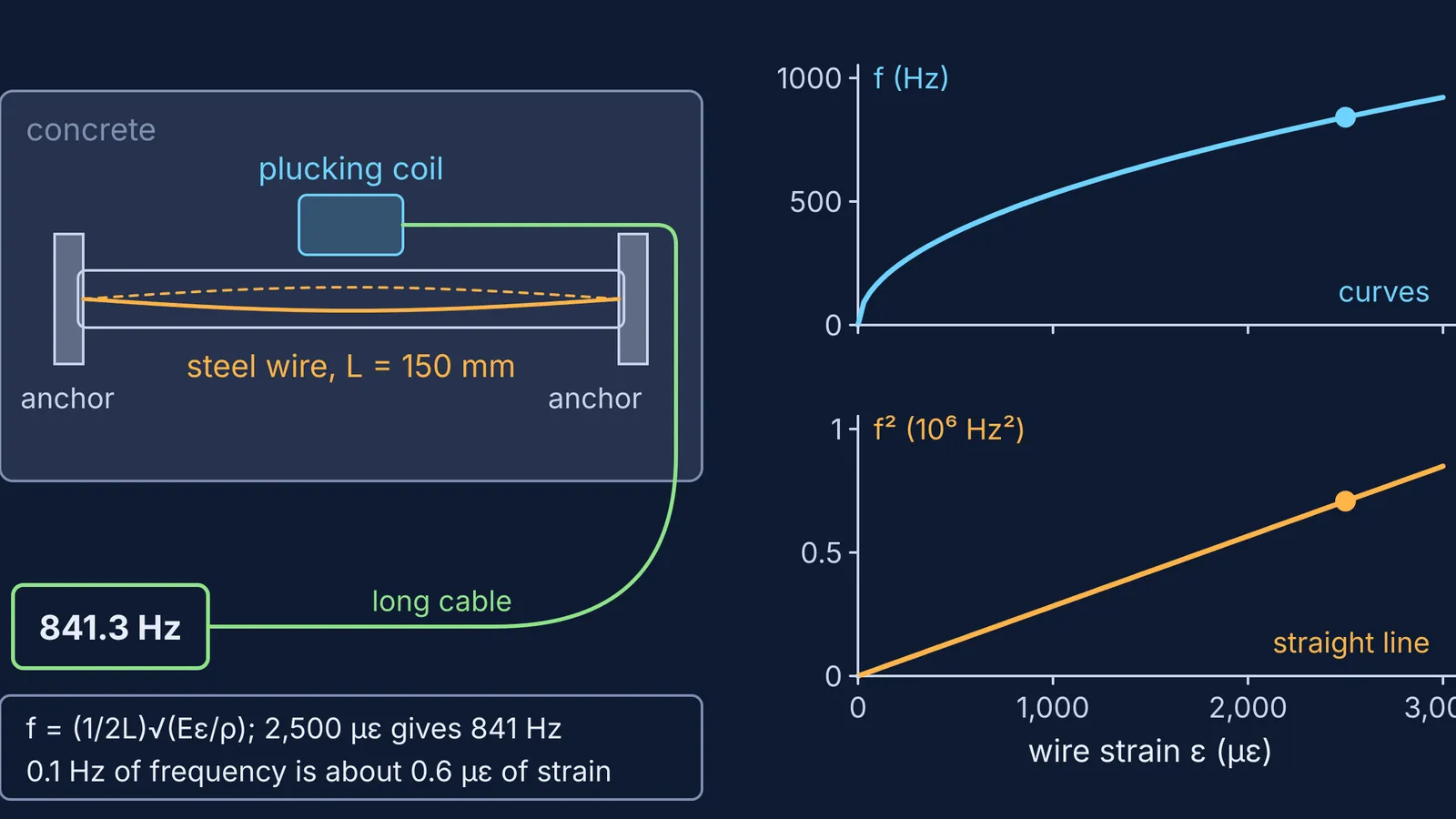
A thin steel wire is held under tension between two end blocks inside a sealed tube. The tube is cast into the concrete, so when the concrete between the two blocks shortens or lengthens, the wire's length changes with it. A small electromagnet near the middle of the wire gives it a pulse, the wire rings at its natural frequency, and the same coil picks up the vibration as an alternating voltage that travels down the cable to a readout.
The manufacturer Geokon describes its embedment gauges in exactly these terms in its Model 4200 series manual: the working principle is like a guitar string, and small changes in the distance between the end blocks cause a large change in the wire's resonant frequency.
Why is the frequency proportional to the square root of strain?
You know the sonometer result for the fundamental of a stretched string, f = (1/2L)√(T/μ), from the sonometer with a hanging load. For a wire, write the tension and the mass per unit length in terms of the material:
Tension T = stress × area = Eε × A, since stress = Young's modulus × strain (the relation measured in Searle's experiment).
Mass per unit length μ = ρA, where ρ is the density of steel.
The area cancels, so T/μ = Eε/ρ and
f = (1/2L)√(Eε/ρ)
Square both sides and rearrange:
ε = (4L²ρ/E) × f²
So the strain is proportional to f², not to f. The constant 4L²ρ/E is the gauge factor. Plot f against strain and you get a curve; plot f² against strain and you get a straight line. This is why readouts often display a quantity proportional to f². Geokon's readouts show "digits", defined as f²/1000, and its manual gives a theoretical gauge factor of 3.304 microstrain per digit for the Model 4200, which is 0.0033 µε per Hz².
What frequency does a typical gauge ring at?
Take an illustrative gauge: a steel wire 150 mm long, with E = 200 GPa and ρ = 7,850 kg/m³, pre-stretched to a strain of 2,500 µε (2.5 × 10⁻³) when it is installed.
Stress in the wire. σ = Eε = 200 × 10⁹ × 2.5 × 10⁻³ = 5.0 × 10⁸ Pa, or 500 MPa.
Wave speed on the wire. v = √(σ/ρ) = √(5.0 × 10⁸ / 7,850) = 252.4 m/s.
Fundamental frequency. f = v/2L = 252.4 / 0.300 = 841.3 Hz.
Gauge factor. 4L²ρ/E = 4 × 0.150² × 7,850 / (2.0 × 10¹¹) = 3.53 × 10⁻⁹ per Hz², or 0.00353 µε per Hz². Geokon's 3.304 µε per digit corresponds to a wire about 145 mm long, close to our illustrative 150 mm.
Units check: σ/ρ is (N/m²)/(kg/m³) = m²/s², so its square root is a speed; dividing by a length gives s⁻¹. The pre-strain lets the wire lose tension, and so report compression, when the concrete shortens.
The length and pre-strain are illustrative, not a particular model's, but 841 Hz sits inside the 450 to 1,200 Hz range Geokon lists for the Model 4200 in its specifications.
How small a strain can it resolve?
Suppose the concrete shortens by 100 µε. The wire relaxes to 2,400 µε and its frequency falls to 824.3 Hz. A stretch of 100 µε raises it to 857.9 Hz. So 100 µε moves the pitch by about 17 Hz.
For small changes, differentiate ε ∝ f²: Δε/ε = 2Δf/f. If the readout can resolve 0.1 Hz:
Δε = 2 × (0.1 / 841.3) × 2,500 µε = 0.59 µε
So the wire can, in principle, notice a change of about 0.6 millionths in the length of the concrete it spans. Real systems quote a little less: Geokon lists a resolution of 1.0 µε for the Model 4200 with its GK-404 readout, and notes that the resolution depends on the readout.
Why does a frequency survive a long cable when a resistance does not?
The common alternative is a bonded foil strain gauge, whose resistance changes with strain. A 120 Ω foil gauge with gauge factor 2 changes by 120 × 2 × 10⁻⁶ = 0.24 mΩ for 1 µε. Now put it at the end of a long cable. Geokon's manual gives its copper instrument leads as about 48.5 Ω per km at 20 °C, so a kilometre out and back is about 97 Ω. Copper's resistance rises by roughly 0.39% per kelvin, so that cable changes by about 0.38 Ω for a 1 K change in its temperature, which is as much as 1,600 µε of signal. Careful bridge wiring cancels much of this, but the signal stays tiny next to the cable.
A frequency is a count of cycles per second. A long cable weakens the signal and adds a little noise, but it cannot change how many cycles arrive each second. Geokon's manual says it plainly: because the output is a frequency rather than a current or voltage, cable splicing has no ill effects. This is the same reason a fibre Bragg grating sensor reports a wavelength rather than a light intensity.
How do engineers correct for temperature?
Steel and concrete expand by slightly different amounts. Geokon's data reduction section gives 12.2 µε per °C for the steel wire and about 10 µε per °C for concrete. When the dam warms, the wire tries to lengthen more than the concrete lets it, so it goes slacker and the gauge shows a false compression of about 2.2 µε for every degree.
Worked example. A gauge read 841.3 Hz at 15 °C when installed. A year later it reads 830.0 Hz at 25 °C. What strain did the load cause?
Apparent strain change. Δε = 0.00353 × (830.0² − 841.3²) = 0.00353 × (−18,886) = −66.7 µε.
Temperature correction. (25 − 15) × (12.2 − 10) = +22 µε, added back because warming made the wire slacker.
Strain caused by load. −66.7 + 22 = −44.7 µε. The minus sign means compression.
The gauge measures the change since installation, not the total stress in the concrete. The concrete's free thermal expansion over those 10 °C would have been about +100 µε, so its overall length still grew by about 55 µε; the load held back part of that growth. Real gauges also carry a batch calibration factor from the maker, which this example leaves out.
If you want to practise the sonometer and Young's modulus steps that go into this, the Fermi Problem Library has a step-by-step solver that explains the reasoning.
Quick checklist
f = (1/2L)√(Eε/ρ) comes from the sonometer formula with T = EεA and μ = ρA.
Strain is proportional to f², so Δε/ε = 2Δf/f.
2,500 µε on a 150 mm steel wire gives about 841 Hz; 0.1 Hz is about 0.6 µε.
A frequency is not changed by a long cable; a small resistance change is.
Correct for temperature using the difference between steel and concrete expansion.
The gauge reports change since installation, not absolute stress.