On this page
At an airport security check, an officer sometimes wipes your bag with a small cloth swab and puts it into a desktop machine. Many of these trace detectors are ion mobility spectrometers. NIST describes ion mobility spectrometry as a drift tube with an applied electric field that separates ionised molecules by their mobility, and notes its use at airports and border crossings. The physics inside is the same v = μE you meet for drift velocity, applied to ions in air instead of electrons in copper.
How does an ion mobility spectrometer work?
In general terms, the machine does four things.
Vaporise. The swab is heated, so traces of material on it turn into vapour.
Ionise. An ionisation source turns some of the vapour molecules into ions.
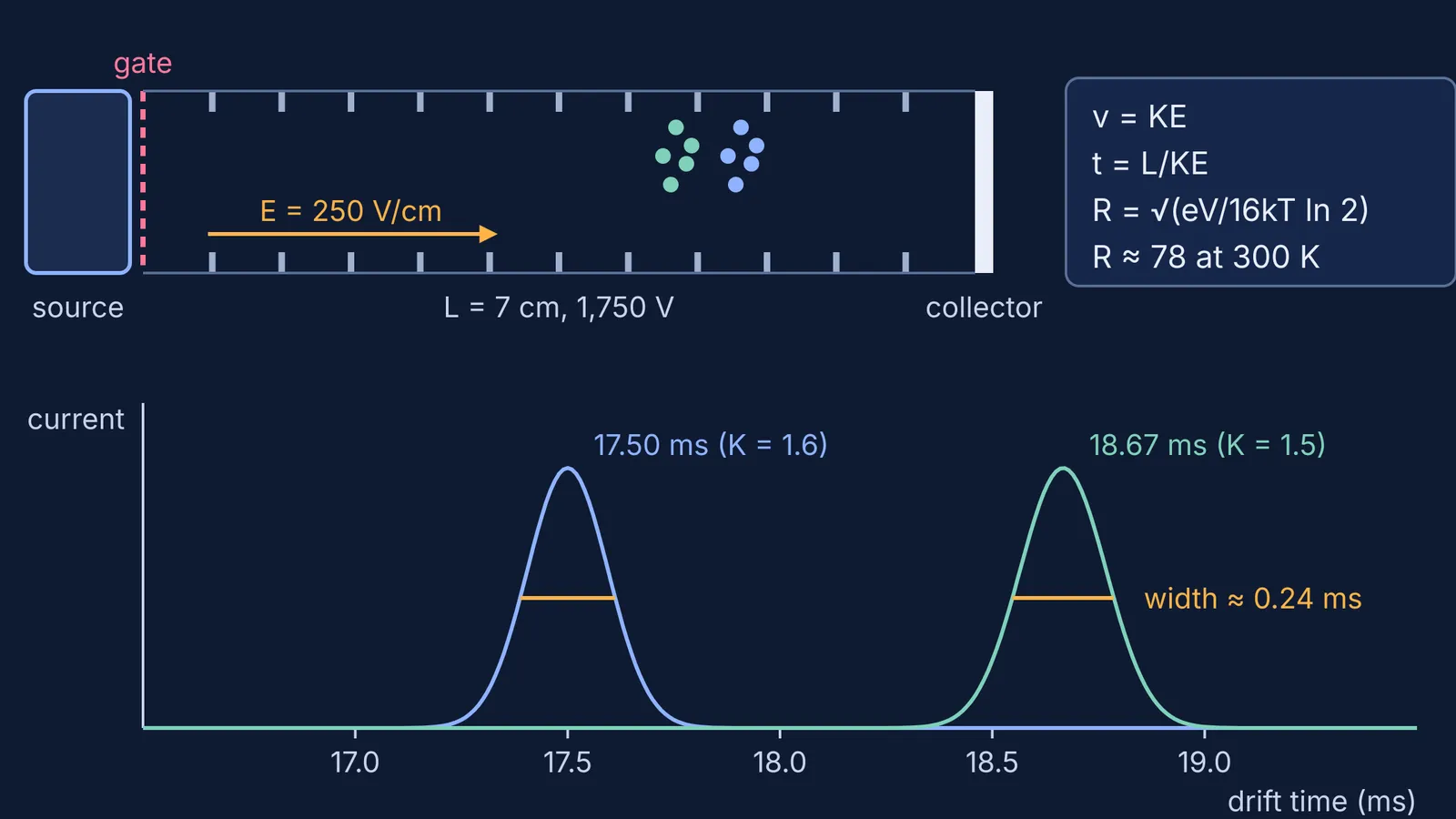
Gate. A wire grid called the gate opens for a fraction of a millisecond and lets a short pulse of ions into the drift tube.
Drift and collect. A stack of metal rings, each at a slightly lower voltage than the one before, makes a nearly uniform field E along the tube. The ions drift down the tube and land on a collector plate, where they make a tiny current.
The machine records that current against time. Different ions arrive at different times, and each arrival time is compared with a library of known values. The rest of this post is the physics of the drift.
Why do ions drift at a steady speed instead of accelerating?
In a vacuum, an ion in a field E would accelerate the whole way, with a = qE/m. The tube is full of air at atmospheric pressure, so the ion hits gas molecules all the time, and each collision takes away much of the speed it gained. The result is a steady average speed along the field, the drift velocity:
v = KE
K is the ion's mobility, usually quoted in cm²/V s. It depends on the ion's size, shape and charge, and on the gas it drifts through. A bulky ion collides more and has a smaller K.
This is the same idea as drift velocity of electrons in a metal, and the same physics as ions drifting through air under the fair-weather field. The difference is the speed. Electrons in a copper wire carrying 1 A per mm² drift at only about 0.073 mm/s, because there are so many of them. Ions in the tube move at metres per second.
How long does an ion take to cross the drift tube?
Take a tube 7 cm long with a field of 250 V/cm. Mobilities of real ions in air are of order 1 to 2 cm²/V s. A peer-reviewed study of chemical standards in ion mobility spectrometry (Fernández-Maestre and co-workers, Analyst, 2010) reports that published reduced mobilities for the tetrabutylammonium ion, a common calibration ion, range from 1.19 to 1.40 cm²/V s. The two values below are illustrative, chosen in that range.
Worked example. Ion A has K = 1.5 cm²/V s and ion B has K = 1.6 cm²/V s, measured under the tube's conditions.
Voltage across the tube. V = EL = 250 V/cm × 7 cm = 1,750 V.
Convert units. E = 250 V/cm = 2.5 × 10⁴ V/m. K_A = 1.5 cm²/V s = 1.5 × 10⁻⁴ m²/V s.
Drift speed of A. v = KE = 1.5 × 10⁻⁴ × 2.5 × 10⁴ = 3.75 m/s.
Drift time of A. t = L/v = 0.07/3.75 = 0.01867 s = 18.67 ms.
Ion B. v = 1.6 × 10⁻⁴ × 2.5 × 10⁴ = 4.00 m/s, so t = 0.07/4.00 = 17.50 ms.
Gap. B arrives 1.17 ms before A.
Units: (m²/V s) × (V/m) = m/s. An ion about 7 % more mobile arrives about 7 % sooner in drift time, since t = L/KE.
Why does diffusion limit the resolving power?
The gate releases a thin pulse, but while it drifts the ions also diffuse, spreading out along the tube. For ions drifting in a gas, the diffusion coefficient is linked to mobility by the Einstein relation, D = KkT/e. At 300 K, kT/e = 0.0259 V, so for ion A:
Diffusion coefficient. D = 1.5 × 10⁻⁴ × 0.0259 = 3.9 × 10⁻⁶ m²/s.
Spread after 18.67 ms. σ = √(2Dt) = √(2 × 3.9 × 10⁻⁶ × 0.01867) = 3.8 × 10⁻⁴ m = 0.38 mm.
Spread in time. σ_t = σ/v = 0.38 mm ÷ 3.75 m/s = 0.10 ms.
Peak width. A Gaussian's full width at half maximum is 2.355σ_t = 0.24 ms.
Resolving power. R = t/Δt = 18.67/0.239 = 78.
Now do it with symbols. Put t = L²/KV and D = KkT/e into σ = √(2Dt), divide by L, and K and L both cancel:
R = √(eV/16kT ln 2)
With V = 1,750 V and T = 300 K this gives 78 again. Two consequences follow. The limit does not depend on which ion you look at, and it grows only as √V: doubling the voltage to 3,500 V raises it to about 110, not 156. R = 78 means mobilities that differ by more than about 1/78, or 1.3 %, can be told apart. Ions A and B differ by about 7 %, so their peaks, 1.17 ms apart and each about 0.24 ms wide, are cleanly separated.
This is the diffusion limit. Real instruments do worse, because the gate pulse has its own width and the ions repel each other (space charge), which spreads the pulse further.
Why are mobilities corrected to 273 K and 760 torr?
Mobility depends on how often an ion hits gas molecules. Hotter or thinner air means fewer collisions per metre and a larger K. So published values are quoted as the reduced mobility K₀, corrected to 273 K and 760 torr, as the same Analyst study defines it:
K₀ = K × (273/T) × (P/760)
Turn it round to find K on the day. An ion with K₀ = 1.50 cm²/V s, in a tube at 40 °C (313 K) and 684 torr, has K = 1.50 × (313/273) × (760/684) = 1.91 cm²/V s. Its drift time in our tube would drop from 18.67 ms to about 14.7 ms. An uncorrected instrument would misread the ion completely.
If you want to practise v = KE, Einstein's relation and unit conversions on more problems, the Fermi Problem Library has a step-by-step solver that explains the reasoning.
How is this different from an airport X-ray scanner?
The X-ray scanner looks through your bag, as explained in how airport baggage scanners show orange, green and blue. The ion mobility spectrometer never looks at the bag. It works on molecules picked up by the swab and sorts them by drift speed.
Quick checklist
Ions in a gas reach a steady drift speed v = KE because of constant collisions.
Drift time t = L/KE; convert cm²/V s to m²/V s with 10⁻⁴.
Worked example: 1,750 V over 7 cm, K = 1.5 cm²/V s gives 3.75 m/s and 18.67 ms.
Diffusion: D = KkT/e and σ = √(2Dt) set the peak width.
Diffusion-limited resolving power R = √(eV/16kT ln 2) ≈ 78 here; it grows only as √V.
Tables quote K₀ at 273 K and 760 torr; correct for temperature and pressure before comparing.