

On this page
Switch on a torch and the bulb glows before you can blink. Yet the electrons carrying that current drift at around a millimetre per second. Both statements are true, and the NCERT Class 12 chapter on current electricity poses this very puzzle. Watch electrons in a simulation, but only after writing down what you expect to see.
What is drift velocity in a wire?
Inside a copper wire, free electrons already rush about at high speed in random directions, so on average they go nowhere. Switch on a field and each electron is pushed a little against the field between collisions with the metal ions. The small average velocity this adds is the drift velocity, as the NCERT Class 12 Physics chapter on current electricity explains.
The same chapter derives the key relation: current I = neAv, so drift speed v = I/(neA), where n is the number of free electrons per cubic metre, e is the electron's charge and A is the wire's cross-section (NCERT, Eq. 3.18). It also gives v = eEτ/m, where E is the field and τ the average time between collisions.
For copper, n is about 8.5 × 10^28 free electrons per cubic metre, assuming one free electron per atom (NCERT Example 3.1).
How fast do electrons drift in a copper wire?
NCERT Example 3.1 takes a copper wire of cross-section 1.0 × 10^-7 m² carrying 1.5 A and finds a drift speed of about 1.1 mm/s (NCERT).
At 1.1 mm/s, an electron needs about 900 seconds, roughly 15 minutes, to drift one metre.
How does drift speed change with current and wire thickness?
Open any simulation that shows electrons drifting in a wire and work through these. The Fermi Simulation Lab has interactive simulations for ideas that are easier to see than to read. Each answer uses the numbers from NCERT Example 3.1 (n = 8.5 × 10^28 m^-3, e = 1.6 × 10^-19 C, A = 1.0 × 10^-7 m²), so neA = 1360 C/m and v = I/1360.
Double the current to 3 A. Prediction: drift doubles, because v is proportional to I. Check: 3/1360 is about 2.2 mm/s.
Same 1.5 A, wire twice the area. Prediction: drift halves. Check: about 0.55 mm/s.
Same 1.5 A, wire twice the diameter. Many students say "half". Area goes as diameter squared, so area is four times larger and drift falls to a quarter, about 0.28 mm/s.
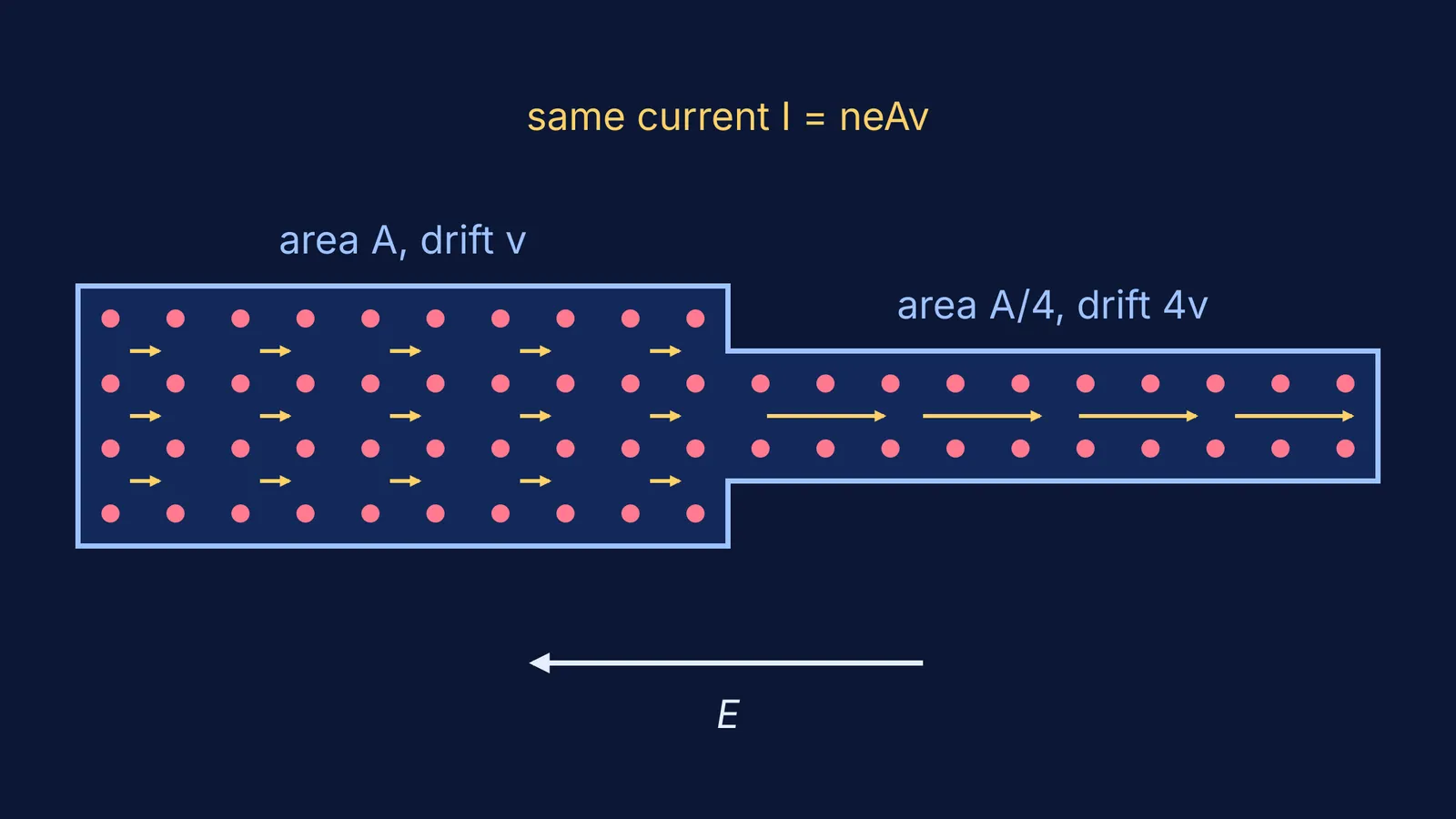
A thick wire joined to a thin one, in series. The current is the same in both, and so is n (both are copper). The thin section must have the faster drift. The diagram at the top of this post shows it: a quarter of the area, four times the drift.
Same battery, wire twice as long. Use v = eEτ/m, ignoring the battery's internal resistance. The field E = V/L halves, so drift halves. In I = neAv terms, the current halves too, which is what Ohm's law predicts for double the resistance.
If you got 3 or 4 wrong, the slip is usually the same one: mixing up current, which is fixed by the circuit, with drift speed, which adjusts to the wire. Our worked post on drift velocity, current density and resistivity takes the algebra further.
Why does a bulb light instantly if electrons drift so slowly?
NCERT answers this directly in Example 3.2: the electric field is set up throughout the circuit almost instantly, travelling at about the speed of light, and that field causes a local electron drift at every point (NCERT).
Put numbers on it. NCERT puts the field's speed at 3.0 × 10^8 m/s, about 10^11 times the drift speed in Example 3.1 (NCERT). Across one metre of wire, the field arrives in a few billionths of a second, while a single electron would need about 15 minutes. HyperPhysics draws the same contrast: drift of millimetres per second for ordinary currents, against a signal speed on the order of the speed of light.
The electrons that heat the filament were already in the filament. The wire is like a pipe that is already full of water: push at one end and water comes out of the other end at once.
A 10-minute plan for your next study session
Two minutes: write v = I/(neA) and v = eEτ/m from memory.
Three minutes: write your predictions for the five cases above.
Three minutes: test each one in a simulation and mark any surprise.
Two minutes: explain the instant bulb out loud, as if to a younger sibling.
For more prediction-first practice, try our guide to learning DC circuits with a simulation, or read what PhET research says interactive simulations are good for.


