On this page
A pendulum clock loses time in summer because its rod gets longer. You might expect a mechanical watch to have the same problem, only smaller. It does not. A watch with a plain steel hairspring loses about twenty times more than that per degree, and the main cause is not expansion at all. The steel spring simply gets softer when it is warm. Here is how big the effect is and how one alloy removed it.
What keeps time in a mechanical watch?
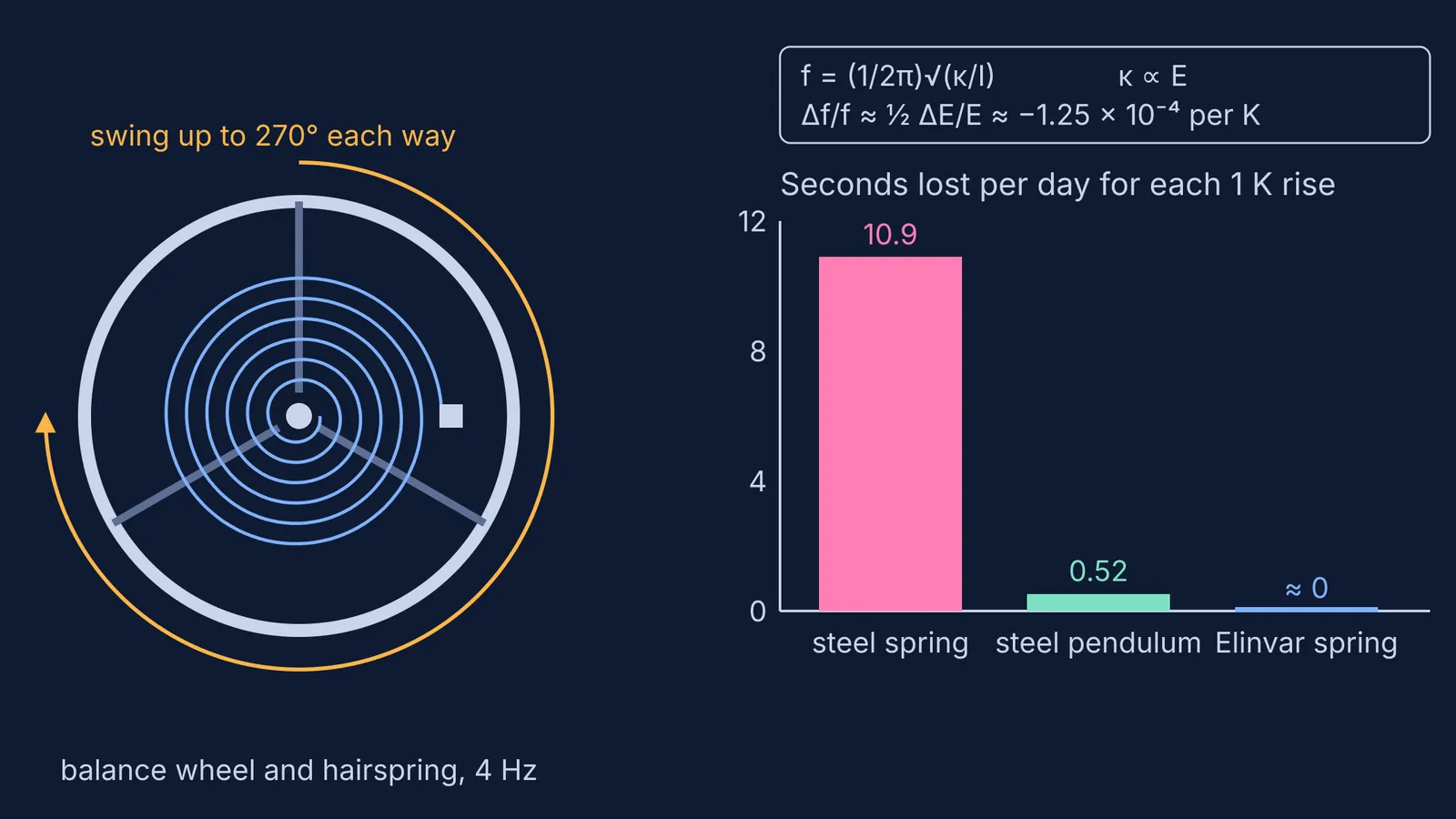
A watch has no pendulum. Its regulator is a balance wheel, a small ring that turns back and forth on an axle, and a hairspring, a flat spiral of thin metal strip. One end of the spring is fixed to the wheel's axle and the other to the frame. Turn the wheel and the spiral winds or unwinds, giving a restoring torque proportional to the angle turned: τ = −κθ.
That is angular simple harmonic motion, the same as a torsional pendulum, whose period is T = 2π√(I/C). For the balance:
f = (1/2π)√(κ/I)
where κ is the hairspring's torsion constant and I is the wheel's moment of inertia. Gravity does not appear, which is why a watch still keeps time where a pendulum clock stops, in an orbiting satellite.
What does "28,800 beats per hour" mean?
Watchmakers count beats, and a beat is one tick. The balance ticks twice in each full oscillation, once on each swing. So:
28,800 beats per hour ÷ 3,600 s = 8 beats per second;
8 beats per second ÷ 2 = 4 oscillations per second, f = 4 Hz.
Take a balance with I = 1.0 × 10⁻⁹ kg m² (a round illustrative value of the right size for a wristwatch). The spring needs:
κ = I(2πf)² = 1.0 × 10⁻⁹ × (2π × 4)² = 6.3 × 10⁻⁷ N m/rad
At a swing of 270° (4.71 rad) that is a torque of only 3.0 × 10⁻⁶ N m, about 3 micronewton-metres. A tiny change in κ changes the rate.
Why does a warm steel hairspring slow the watch down?
A hairspring is a long strip that bends as it winds. Its torsion constant is
κ = E w t³/(12 L)
where E is Young's modulus, w the strip's width, t its thickness and L its length. Warming changes three things:
Young's modulus. For ordinary steel, E falls as temperature rises. A softer spring means smaller κ and lower f.
The spring's size. Width and thickness grow, w t³ goes up by 4α per kelvin, and L goes up by α. Net: κ rises by 3α. On its own this would make the watch fast.
The balance's size. A larger wheel has a larger I = mr², up by 2α per kelvin. This makes the watch slow.
Putting these together for small changes:
Δf/f = ½(ΔE/E + 3α_spring − 2α_balance)
Charles-Édouard Guillaume, who measured this for chronometers, made exactly this point in his 1920 Nobel lecture, "Invar and Elinvar". He noted that, contrary to a widespread idea, expansion of the spring alone would make the chronometer fast. With a steel spring and a brass balance, the two expansion effects largely cancel. Yet such a chronometer loses 11 seconds a day for each degree rise, and he wrote that this loss is due almost entirely to the change in the modulus.
Worked example: how much does a watch lose per degree?
Use Young's modulus falling by 2.5 × 10⁻⁴ per kelvin for steel (the value that matches Guillaume's 11 s a day), α = 1.2 × 10⁻⁵ /K for the steel spring and about 1.9 × 10⁻⁵ /K for a brass balance (typical textbook values).
Expansion terms. 3α_spring − 2α_balance = 3.6 × 10⁻⁵ − 3.8 × 10⁻⁵ = −2 × 10⁻⁶ per K. Almost zero, as Guillaume said.
Fractional change in frequency. Δf/f = ½(−2.5 × 10⁻⁴ − 2 × 10⁻⁶) = −1.26 × 10⁻⁴ per K.
Seconds per day. A day is 86,400 s. Loss = 1.26 × 10⁻⁴ × 86,400 = 10.9 s per day per kelvin.
A real temperature swing. From a 15 °C night table to a 35 °C wrist is 20 K: 20 × 10.9 = 218 s, about 3.6 minutes a day.
Check the dimensions: Δf/f is a pure ratio per kelvin, and multiplying by seconds in a day gives seconds per day per kelvin. The result, 10.9 s, matches the measured 11 s.
Why is this twenty times worse than a pendulum?
A pendulum's period is T = 2π√(L/g), so only expansion of the rod matters:
ΔT/T = ½αΔT
For a steel rod, α = 1.2 × 10⁻⁵ /K. The clock loses ½ × 1.2 × 10⁻⁵ × 86,400 = 0.52 s a day per kelvin.
Compare: 10.9 s ÷ 0.52 s ≈ 21. The hairspring watch is about twenty times more sensitive, because the modulus of steel changes about twenty times faster with temperature than its length does (2.5 × 10⁻⁴ against 1.2 × 10⁻⁵ per kelvin). For watches, the problem is stiffness, not length.
How did Elinvar fix the hairspring?
Guillaume had already made Invar, a nickel steel that hardly expands, which solved the pendulum's problem; that story is in Charles-Édouard Guillaume, Invar and thermal expansion. But a watch needed something different: a spring whose stiffness stays the same when warmed.
In the same Nobel lecture he explains that in iron–nickel alloys the thermoelastic coefficient (the fractional change of Young's modulus per degree) climbs from the normal negative value, crosses zero and becomes positive as the nickel content rises. An alloy at the zero crossing would have an invariable modulus, so he named the target alloy elinvar ("elasticity invariable") before he had made it. Pure iron–nickel mixtures were hard to use because the coefficient crossed zero so steeply that small errors in composition spoiled it. Adding chromium flattened the curve, and Pierre Chevenard found true elinvar with about 12% chromium.
With ΔE/E close to zero, the frequency equation leaves only the small expansion terms, and the watch's temperature error drops to a small fraction of steel's. Guillaume received the 1920 Nobel Prize in Physics "in recognition of the service he has rendered to precision measurements in Physics by his discovery of anomalies in nickel steel alloys".
If you want to revise angular SHM and torsion constants, try the Concept Library.
Quick checklist
Balance wheel: f = (1/2π)√(κ/I); gravity plays no part.
28,800 beats per hour = 8 ticks per second = 4 Hz.
Hairspring stiffness κ = E w t³/(12 L), so κ ∝ E.
Δf/f = ½(ΔE/E + 3α_spring − 2α_balance); the modulus term dominates for steel.
Steel hairspring: about 11 s a day lost per kelvin. Steel pendulum: about 0.52 s.
Invar fixes expansion; Elinvar fixes stiffness.