

On this page
Before the 20th century, physics laboratories and mapmakers faced an invisible enemy: temperature. Heat makes metals expand, meaning a steel measuring tape on a hot summer day is slightly longer than it was in winter. In precision timekeeping, a longer pendulum swings slower, causing the world's best clocks to drift. That changed when Charles-Édouard Guillaume discovered the Invar alloy, solving the thermal expansion problem for good.
Why do pendulum clocks lose time in summer?
Nearly all metals expand when heated. As the temperature rises, atoms vibrate more vigorously, pushing further apart. The amount a material stretches per degree of temperature change is its coefficient of thermal expansion (often denoted by the Greek letter α).
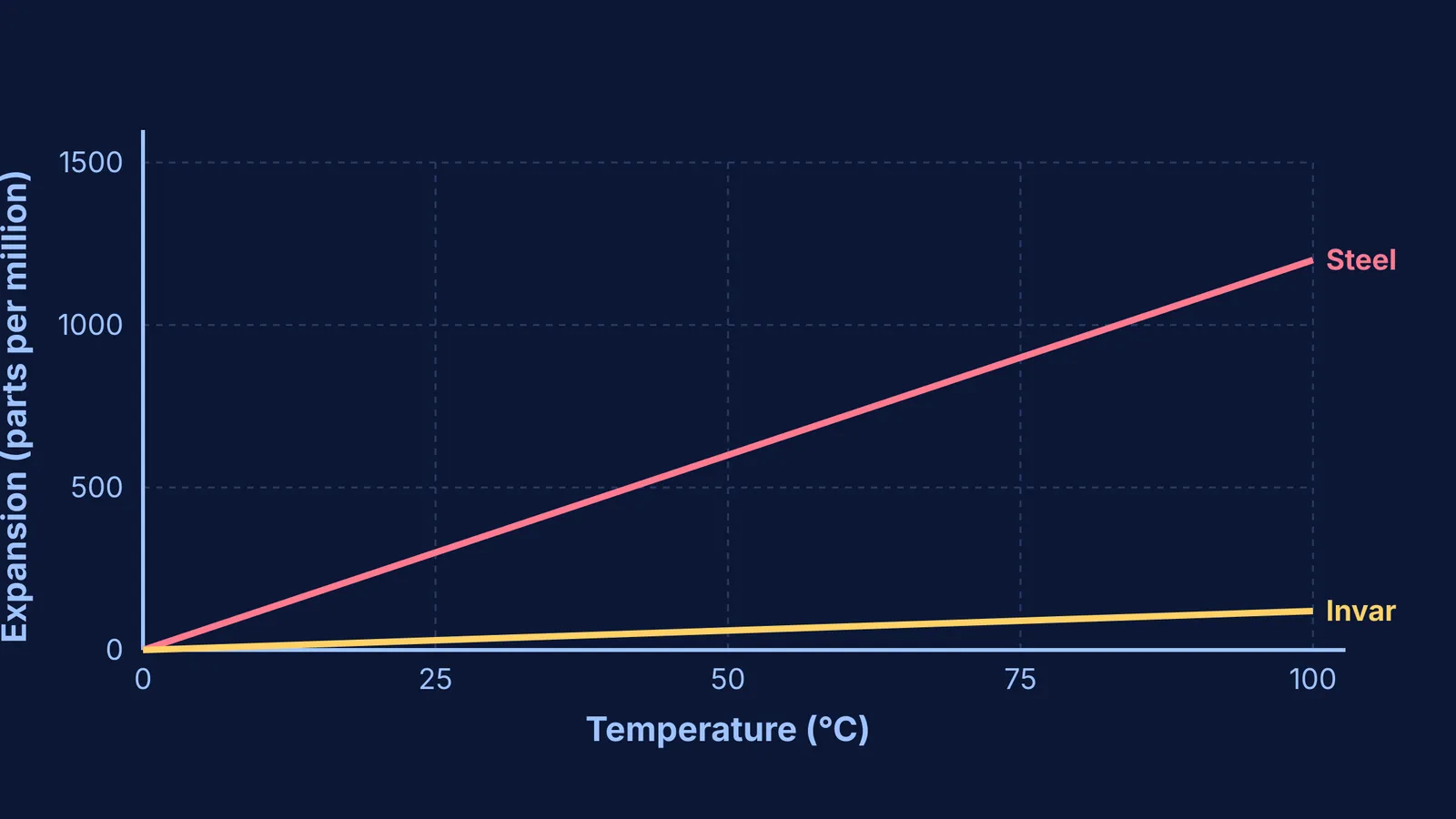
For ordinary steel, this coefficient is approximately 11 to 15 × 10⁻⁶ K⁻¹ (or 11–15 parts per million per degree Celsius). If you have a one-metre steel pendulum rod, heating it by 10 °C increases its length by about 0.12 millimetres.
That tiny stretch might seem harmless, but the period of a pendulum depends directly on its length. As the rod elongates in the summer heat, the pendulum takes longer to complete a swing. The clock ticks slower, steadily losing seconds every day. For navigation and astronomy, these errors were disastrous. (To understand how the period relates to length, see Seconds pendulum: how its period changes with length and g.)
What is the Invar alloy and who discovered it?
Working at the International Bureau of Weights and Measures (BIPM) near Paris, Swiss physicist Charles-Édouard Guillaume sought a cheaper alternative to platinum-iridium for making standard metre bars. In 1895, he struck upon a precise mixture: an alloy of 36% nickel and 64% iron.
Guillaume named this alloy Invar—short for "invariable"—because its dimensions barely changed with temperature. Standard Invar has a coefficient of thermal expansion of just 1.2 × 10⁻⁶ K⁻¹ at room temperature. This means it expands about 10 times less than ordinary steel. Some highly purified grades of Invar can reach coefficients as low as 0.62 × 10⁻⁶ K⁻¹.
In 1920, Guillaume was awarded the Nobel Prize in Physics "in recognition of the service he has rendered to precision measurements in Physics by his discovery of anomalies in nickel steel alloys."
Before Invar, measuring vast distances for mapmaking (geodesy) was incredibly tedious. Surveyors had to measure the temperature of their steel tapes at every single step to mathematically correct for expansion. With the invention of Invar, a surveyor could drag a baseline tape across a field without worrying about the midday sun skewing the measurements. This single application saved countless hours of calculation and drastically improved the precision of global mapping.
How much time does an Invar clock save?
To see why Invar mattered so much to clockmakers, we can work through a real calculation. Imagine a pendulum clock with a 1-metre rod, undergoing a 10 °C temperature increase. The formula for the period of a pendulum is T = 2π√(L/g). When the length L changes by a tiny amount ΔL, the fractional change in the period (ΔT/T) is mathematically equal to half the fractional change in length (ΔL/2L).
For a steel rod (α ≈ 12 × 10⁻⁶ K⁻¹):
The fractional change in length (ΔL/L) is 12 × 10⁻⁶ × 10 = 1.2 × 10⁻⁴. The fractional change in period (ΔT/T) is half of that, or 0.6 × 10⁻⁴. In one day (86,400 seconds), the clock loses: 86,400 × 0.6 × 10⁻⁴ ≈ 5.2 seconds. Over a month, that is more than two and a half minutes of error.
For an Invar rod (α ≈ 1.2 × 10⁻⁶ K⁻¹):
The expansion is exactly 10 times smaller. ΔL/L = 1.2 × 10⁻⁵. ΔT/T ≈ 0.6 × 10⁻⁵. In one day, the Invar clock loses just 0.52 seconds.
By simply swapping the material of the pendulum rod, a clock becomes ten times more reliable. (If you are curious about other ways materials deform, explore A rod stretching under its own weight: the WL/2AY result.)
When studying physics for exams like JEE, thermal expansion questions often mix formulas from mechanics and heat. If you need help bridging these concepts, the Fermi Problem Library has worked problems with a step-by-step solver that explains the reasoning rather than printing an answer. Or, if you bring a problem set to Fermi's AI tutor, it works out what you already know, builds a plan for the session, and teaches through it — writing on a board, drawing the figure, and checking understanding as it goes.


