

On this page
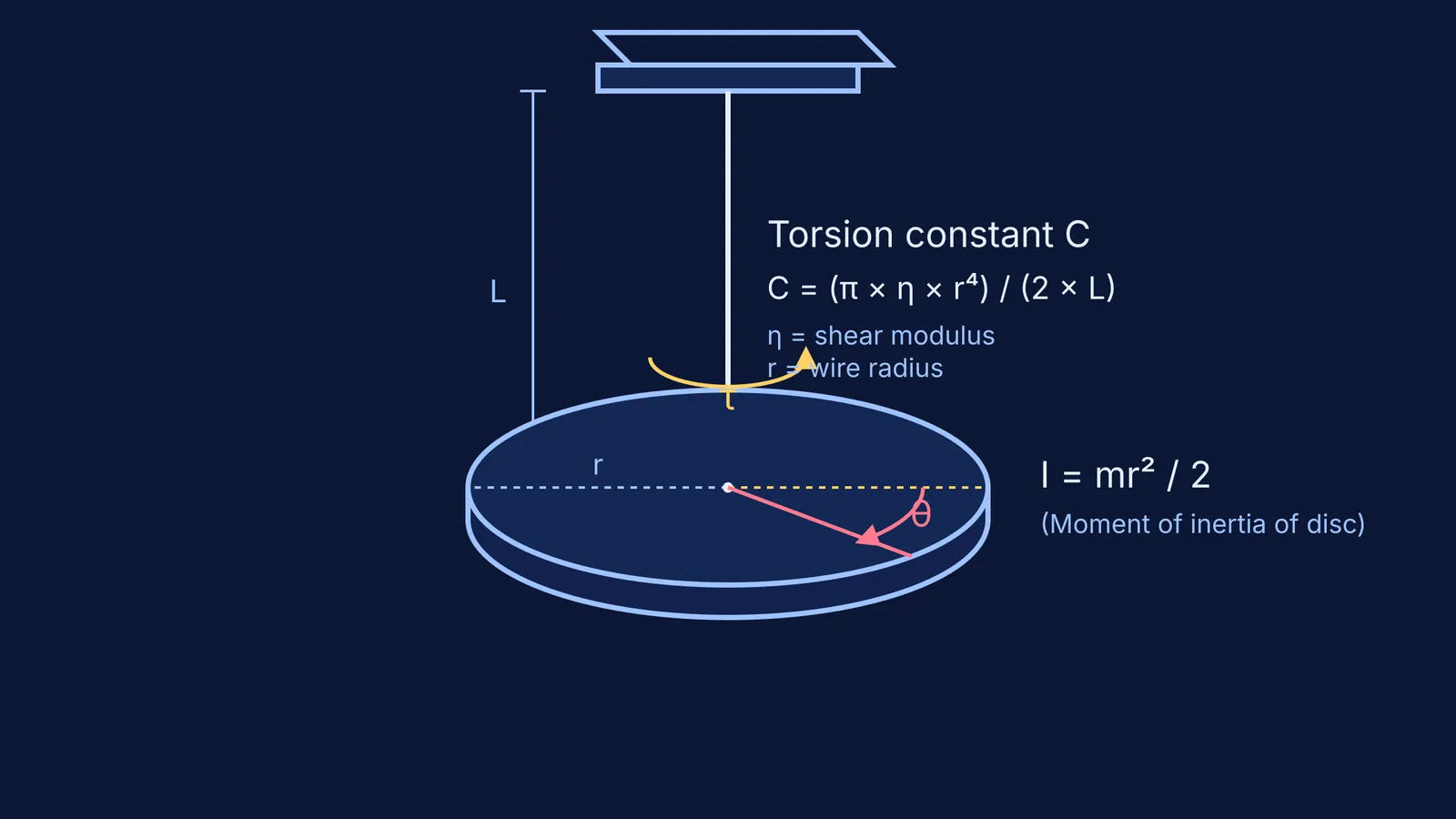
When a heavy disc hangs from a thin wire and you give it a slight twist, it oscillates back and forth. This setup is a torsional pendulum. Instead of swinging under gravity like a grandfather clock, it twists under the restoring torque of the wire.
You will see this system in physics lab experiments and exam questions, usually to measure a material's rigidity or an object's rotational inertia. Because the oscillation depends on the twist rather than a swing, the mathematics closely mirrors the mass-on-a-spring system you learn in linear mechanics.
What is the formula for the time period of a torsional pendulum?
The time period of a torsional pendulum is the time it takes to complete one full back-and-forth twist. It is given by the formula:
T = 2π√(I/C)
In this equation:
T is the time period of oscillation.
I is the moment of inertia of the suspended rigid body about the axis of the wire.
C is the torsion constant of the wire, which measures how much torque is needed to twist the wire by one radian.
Unlike a simple pendulum where gravity pulls the bob back to the centre, the restoring force here comes entirely from the wire resisting the twist. This means the pendulum's period is independent of gravity. You could take a torsional pendulum to the International Space Station, and as long as the wire remains taut, it would oscillate with the exact same time period.
How does the torsion constant depend on the wire?
The torsion constant C dictates the stiffness of the setup. It depends on the material of the wire and its dimensions:
C = (π × η × r⁴) / (2 × L)
η (eta) is the rigidity modulus (or shear modulus) of the wire's material.
r is the radius of the wire.
L is the length of the wire.
The most sensitive part of this formula is the radius. Because the torsion constant is proportional to the fourth power of the radius (r⁴), even a small change in wire thickness has a massive effect. If you use a wire that is twice as thick, the torsion constant becomes 16 times larger (HyperPhysics). Since the time period is inversely proportional to the square root of C, the period will be reduced to a quarter of its original value.
Similarly, increasing the length of the wire makes it easier to twist. A longer wire reduces the torsion constant, resulting in a slower oscillation and a longer time period. When working on these SHM problems, checking the power dependencies is a quick way to catch algebraic mistakes.
How do you find an unknown moment of inertia?
A standard physics laboratory trick uses the torsional pendulum to find the moment of inertia of irregularly shaped objects. In many experiments, you start with an empty cradle or a simple disc whose moment of inertia you already know.
If you measure the time period of an empty pendulum cradle (T₁), you establish a baseline. Then, you measure the period again with identical known masses added at a specific distance from the centre (T₂). The new moment of inertia is the original inertia plus the inertia of the added masses. By rearranging the time period formula and setting up a ratio of the squares of the periods, you can isolate the unknown variable without ever needing to know the wire's exact torsion constant.
This technique is frequently tested in competitive exams, as it requires you to synthesize rotational kinematics and simple harmonic motion. Common student mistakes include forgetting to square the distance when calculating the new inertia, or using the diameter of the wire instead of the radius when finding the torsion constant.
What happens if the amplitude of the twist is large?
In a simple pendulum, the formula T = 2π√(L/g) is only an approximation that works for small angles of swing. If you swing a simple pendulum too high, the restoring force is no longer directly proportional to the displacement, and the period begins to lengthen.
A torsional pendulum does not have this small-angle restriction in the same way. As long as the twisting angle stays within the elastic limit of the wire material, Hooke's Law for torsion holds true. This means the restoring torque remains perfectly proportional to the angular displacement. Consequently, the torsional pendulum will maintain the same time period whether you twist it by a small or a large angle.
If you are preparing for questions that test these conceptual boundaries, checking your understanding through active practice is essential. The Problem Library has worked problems with a step-by-step solver that explains the reasoning rather than printing an answer, helping you isolate exactly where your algebraic setups go wrong.
Understanding how to link linear concepts (like force and mass) to their rotational equivalents (like torque and moment of inertia) makes derived formulas like the torsional time period much easier to remember.


