On this page
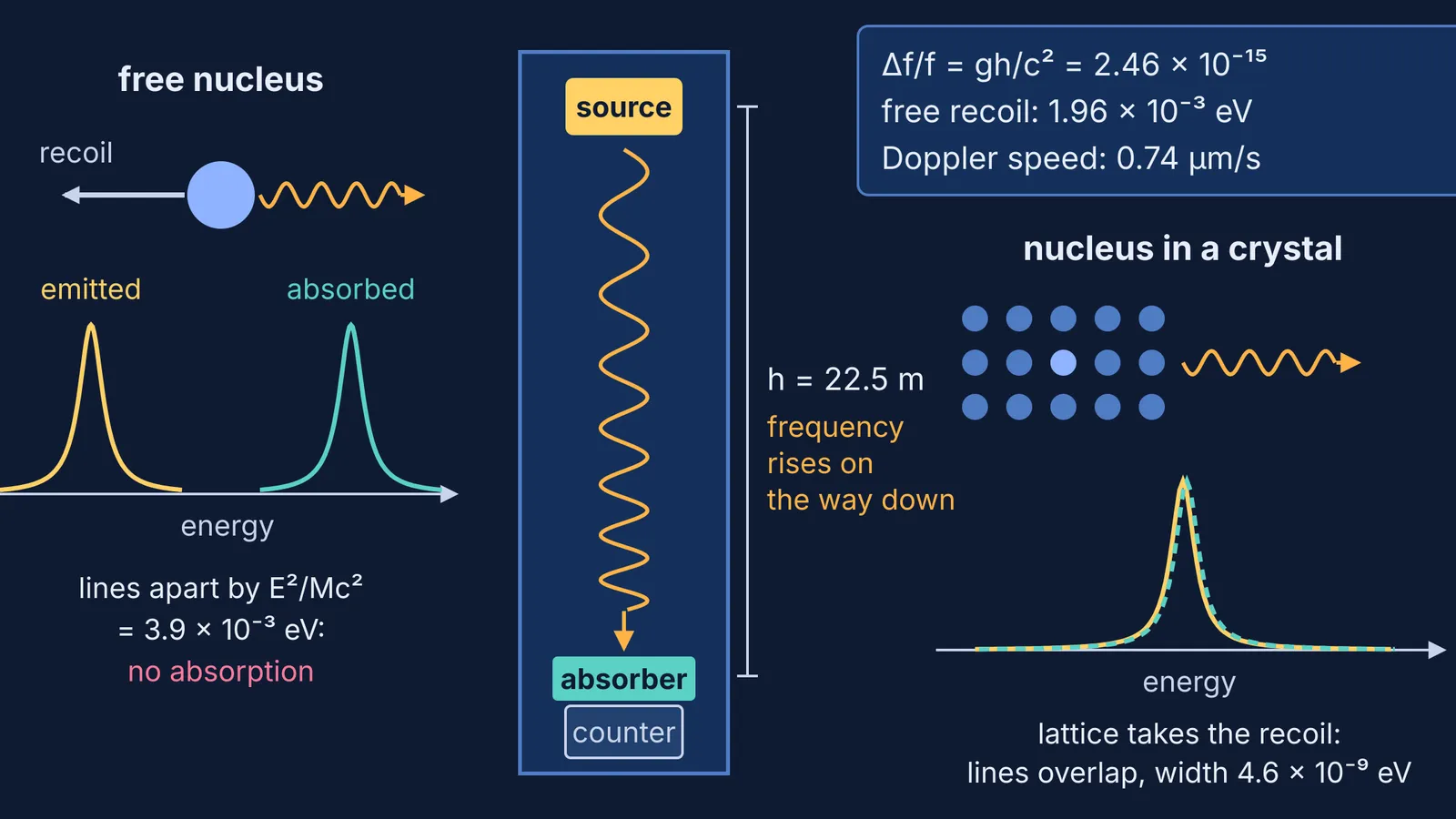
Drop a stone and it gains kinetic energy as it falls. Einstein argued that light does something similar: a photon falling towards Earth arrives with slightly more energy, so a slightly higher frequency, than it left with. For a 22.5 m drop the change is 2.5 parts in 10¹⁵. In 1960 Robert Pound and Glen Rebka measured it in a tower at Harvard. The size is a one-line calculation; seeing it needed the Mössbauer effect.
Why does light falling to Earth gain frequency?
Here is Einstein's energy argument. An atom at the top of a tower of height h emits a photon of energy E downwards. An atom at the bottom absorbs it. Now imagine turning that absorbed energy back into mass, E/c², and lifting it back to the top. Lifting it costs (E/c²)gh. If the photon arrived with only E, running this cycle the other way would create energy from nothing. Energy conservation needs the photon to arrive with
E′ = E(1 + gh/c²), so Δf/f = gh/c²
The argument does not say a photon has rest mass. It only uses E = mc² for the absorber and the fact that energy is conserved. The equivalence principle gives the same answer: a frame falling freely sees no shift, and translating back to the ground frame adds the Doppler shift gh/c².
Light falling down is shifted to higher frequency, a blueshift. Light climbing up is shifted to lower frequency, the gravitational redshift. The same physics, on a far larger scale, is seen in starlight close to the black hole at the centre of our galaxy, described in Andrea Ghez and the black hole at the centre of our galaxy.
How big is the shift over 22.5 m?
Pound and Rebka's tower had a working height of 74 feet, which is 22.6 m; the usual textbook figure is 22.5 m. They used the 14.4 keV gamma ray of iron-57.
Fractional shift. Δf/f = gh/c² = 9.81 × 22.5 ÷ (3.00 × 10⁸)² = 2.46 × 10⁻¹⁵. Check the units: (m s⁻²)(m) ÷ (m s⁻¹)² has no units, as a fraction should.
Energy shift. ΔE = 2.46 × 10⁻¹⁵ × 14,400 eV = 3.5 × 10⁻¹¹ eV.
No ordinary spectrometer resolves a change of a few parts in 10¹⁵. What is needed is an emission line so sharp that a tiny shift moves it noticeably off a matching absorption line.
Why does recoil stop a free nucleus from absorbing its own gamma ray?
When a free nucleus emits a photon, it recoils to conserve momentum, and the recoil takes energy E²/2Mc². You can see the same calculation for an atom emitting visible light in recoil of a hydrogen atom when it emits a photon. For a gamma ray the photon energy is thousands of times bigger, and the recoil energy grows as E².
Recoil energy for iron-57. Mc² for iron-57 is about 5.30 × 10¹⁰ eV, so E²/2Mc² = (14,400)² ÷ (2 × 5.30 × 10¹⁰) = 1.96 × 10⁻³ eV.
Compare with the effect. 1.96 × 10⁻³ ÷ 3.5 × 10⁻¹¹ = 5.5 × 10⁷. The recoil is 55 million times bigger than the gravitational shift.
It is worse than that. The emitted photon is short of the transition energy by the recoil energy, and an absorbing nucleus needs the transition energy plus the recoil energy, because it too must recoil. The emission and absorption lines are 3.9 × 10⁻³ eV apart, and they are far narrower than that gap. A free iron-57 nucleus cannot absorb a gamma ray from another free one.
How does the Mössbauer effect remove the recoil?
In 1958 Rudolf Mössbauer found that a nucleus held in a crystal can emit or absorb a gamma ray with no recoil energy lost, for a sizeable fraction of events. The recoil momentum is still there, but it is taken by the whole crystal. Even a microgram of iron holds about 10¹⁶ atoms, so with M that large the recoil energy p²/2M becomes negligible. The momentum is not reduced; the energy is, because M is enormous.
How sharp is the line now? The only width left is the natural width from the excited level's lifetime. The 14.4 keV level has a half-life of 98.3 ns (NNDC NuDat), so a mean life τ = 98.3 ÷ 0.693 = 141.8 ns. Then Γ = ħ/τ = 6.58 × 10⁻¹⁶ eV s ÷ 1.418 × 10⁻⁷ s = 4.6 × 10⁻⁹ eV.
Shift compared with the width. 3.5 × 10⁻¹¹ ÷ 4.6 × 10⁻⁹ = 0.0076. The gravitational shift is 0.76% of the line width, about one part in 130.
The Doppler check. A source moving at speed v shifts the frequency by v/c. To make a shift of 2.46 × 10⁻¹⁵, v = 2.46 × 10⁻¹⁵ × 3.00 × 10⁸ m/s = 7.4 × 10⁻⁷ m/s, or 0.74 µm/s. Moving the source slowly away from the absorber would cancel the blueshift exactly.
Pound and Rebka did not watch a line move. They moved the source back and forth at known speeds, counted gamma rays reaching the absorber at each, and measured the slight lopsidedness of the absorption, then calibrated it against a known Doppler shift.
How did they make sure it was gravity?
A shift of one part in 10¹⁵ is easily faked by other effects. Pound and Rebka found that two source–absorber pairs could differ in frequency by more than the gravitational shift, and that a temperature difference of 1 °C between source and absorber produced a shift as large as the one they wanted, through thermal motion of the atoms. So they monitored the temperatures and corrected for them, and they ran the experiment both ways: source at the top, then source at the bottom. Gravity reverses sign when you swap them; a built-in frequency difference does not. The difference between the two runs is twice the one-way shift, 4.92 × 10⁻¹⁵ for their 74 ft.
Their result, in Physical Review Letters 4, 337 (1960), was a measured shift equal to 1.05 ± 0.10 times the prediction, so agreement within 10%. In 1965 Pound and Joseph Snider improved this to 0.9990 ± 0.0076, close to 1% (Physical Review 140, B788).
Where does this matter today?
Clocks are oscillators, so the same Δf/f = Δ(gravitational potential)/c² applies to them. A clock higher up runs faster than one lower down. For a GPS satellite at 20,180 km altitude, the gravitational part alone makes its clock gain about 45.7 µs a day relative to the ground; its orbital speed takes back about 7 µs. See how GPS on a phone finds your location.
If you want to practise photon energy, recoil and Doppler problems like these, the Fermi Problem Library has a step-by-step solver that explains the reasoning.
Quick checklist
Falling light gains frequency: Δf/f = gh/c², a blueshift. Rising light is redshifted.
For h = 22.5 m: Δf/f = 2.46 × 10⁻¹⁵, ΔE = 3.5 × 10⁻¹¹ eV for a 14.4 keV photon.
A free nucleus recoils with E²/2Mc² = 1.96 × 10⁻³ eV, 55 million times larger.
In a crystal the whole lattice takes the momentum, so the recoil energy is negligible.
Natural width Γ = ħ/τ = 4.6 × 10⁻⁹ eV; the shift is 0.76% of it.
Result: 1.05 ± 0.10 of prediction in 1960; 0.9990 ± 0.0076 in 1965.