On this page
A small satellite thrown out of its launcher usually tumbles. Before it can point its antenna or camera, it has to stop spinning, and it has no fuel to spare. Many CubeSats do this with a few coils of copper wire. Pass a current through a coil and it becomes a magnetic dipole; Earth's magnetic field then twists it, exactly as it twists a compass needle. The device is called a magnetorquer, and the physics is the τ = NIAB sin θ you learn for a current loop.
What is a magnetorquer?
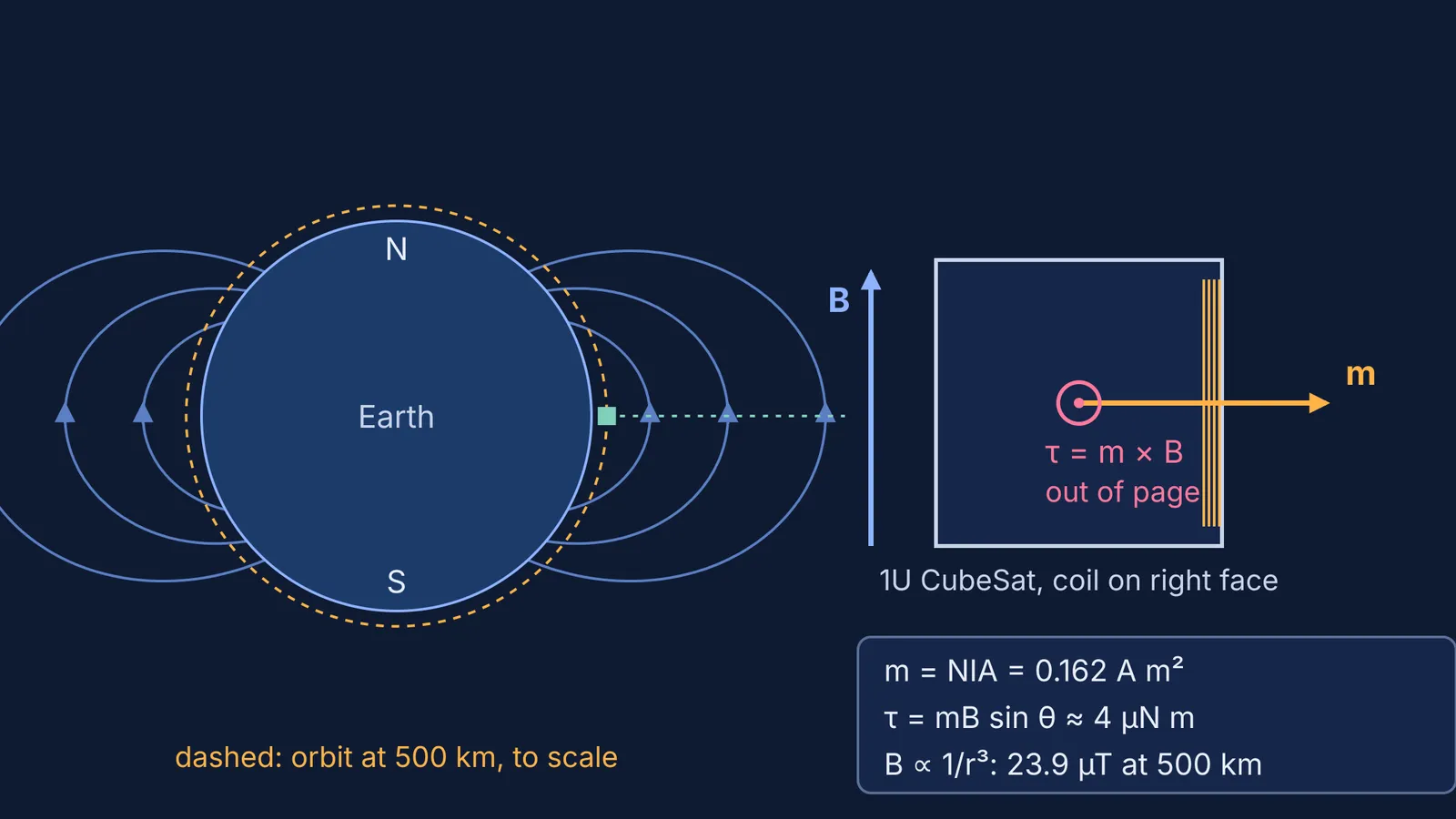
A magnetorquer is a coil, either an air-core loop wound around a satellite panel or a coil on a soft-iron rod (a torque rod), whose current the satellite's computer controls. Its magnetic moment is
m = NIA
and in a field B it feels a torque τ = m × B, of size mB sin θ. NASA's state-of-the-art report on small spacecraft guidance, navigation and control puts it plainly: magnetic torquers provide control torques perpendicular to the local external magnetic field. The same report's product table lists CubeSat torque rods with peak dipole moments from 0.2 to 2 A m², masses of tens of grams and power below 1 W each.
The derivation of the torque on a rectangular coil is in torque on a rectangular coil, side by side, so here we only use the result. The same torque turns the coil of a meter, where a spring balances it; see why a radial field is used in a galvanometer.
How strong is Earth's magnetic field in low orbit?
At the ground, NOAA's geomagnetism FAQ gives the field's strength as roughly 25,000 to 65,000 nT, that is 25 to 65 µT. It is weakest near the equator and strongest near the magnetic poles. To first approximation the field is a dipole, and a dipole's field falls as 1/r³.
Take a round illustrative value of 30 µT for the field at the equator on the ground, with Earth's radius 6,371 km.
Distance factor at 500 km. (6,371/6,871)³ = 0.797.
Over the equator at 500 km. 30 µT × 0.797 = 23.9 µT.
Over the poles. A dipole's field on its axis is twice the equatorial value at the same distance, so about 47.8 µT.
So in a 500 km orbit the field is about 20 % weaker than on the ground. Real values differ by place, because the field is not a perfect dipole; mission designers use a field model.
How much torque does a CubeSat coil make?
Worked example. The numbers are illustrative, not a product specification: a 1U CubeSat, a 10 cm cube taken as 1.33 kg, with a 200-turn coil of 9 cm × 9 cm on one face, carrying 0.1 A, in a 500 km orbit over the equator.
Area. A = 0.09 × 0.09 = 0.0081 m².
Magnetic moment. m = NIA = 200 × 0.1 × 0.0081 = 0.162 A m². This is in the range NASA lists for CubeSat torquers.
Maximum torque. With m perpendicular to B, τ = mB = 0.162 × 23.9 × 10⁻⁶ = 3.9 × 10⁻⁶ N m, about 4 µN m.
Over the poles. With B twice as large, up to 7.7 µN m.
The coil itself. Each turn is 4 × 9 cm = 36 cm, so 200 turns use 72 m of wire. Copper wire 0.2 mm across has a cross-section of 3.14 × 10⁻⁸ m², so R = ρL/A = 1.68 × 10⁻⁸ × 72 / 3.14 × 10⁻⁸ = 38.5 Ω. At 0.1 A it needs 3.9 V and takes P = I²R = 0.39 W. The copper has a mass of about 20 g.
Units check: A m² × T = A m² × N/(A m) = N m.
How long does it take to stop a tumbling CubeSat?
Suppose the satellite tumbles at 10° per second about an axis through its centre.
Moment of inertia. For a uniform cube of mass M and side s about an axis through the centre, I = Ms²/6 = 1.33 × 0.1² / 6 = 2.2 × 10⁻³ kg m².
Angular speed. ω = 10° per second = 0.175 rad/s.
Angular momentum. L = Iω = 2.2 × 10⁻³ × 0.175 = 3.9 × 10⁻⁴ N m s.
Time at full torque. t = L/τ = 3.9 × 10⁻⁴ / 3.9 × 10⁻⁶ ≈ 100 s.
Realistic time. The coil is not always at 90° to the field, so the average torque is smaller. At half the torque on average, it takes about 200 s, a little over 3 minutes.
That is short compared with one orbit at 500 km, which takes about 94 minutes. Real detumbling takes longer, because the satellite tumbles about all three axes, the field keeps changing direction, and the computer uses only part of its power for the coils. Manufacturers advertise exactly this use: AAC Clyde Space's MTQ800 datasheet, for a larger torquer meant for 50–200 kg satellites, describes de-tumbling and de-saturating reaction wheels.
Why can't a magnetorquer turn the satellite about the field direction?
The torque m × B is always perpendicular to B. Whatever current you choose, you cannot make a torque along the field line the satellite is in at that instant. One axis is always out of reach.
The way round it is time. As the satellite moves round its orbit, the direction of Earth's field changes relative to the satellite, so the axis that cannot be controlled keeps moving. Averaged over an orbit, the controller can reach all three axes. This is also why NASA's report says magnetic torquers alone cannot typically give three-axis stabilisation, and why their use beyond low Earth orbit needs careful study: further out, B falls as 1/r³ and the torque falls with it.
If you want more torque and rotation problems with full reasoning, the Fermi Problem Library has a step-by-step solver that explains each step.
Why are magnetorquers paired with reaction wheels?
Micronewton-metres are far too small for quick pointing. For fast, accurate turns, satellites use reaction wheels, as worked out in how satellite reaction wheels turn a spacecraft. But a wheel that keeps absorbing small disturbing torques spins faster and faster until it reaches its limit. A magnetorquer can then push against Earth's field and take that extra angular momentum out of the satellite, so the wheel can slow down. The wheels give speed and precision; the coils give a slow, fuel-free way to dump momentum and to stop the first tumble.
Quick checklist
Magnetic moment m = NIA; torque τ = mB sin θ, perpendicular to both m and B.
Earth's field is about 25–65 µT at the ground and falls as 1/r³; about 24 µT over the equator at 500 km with a 30 µT surface value.
Worked example: 0.162 A m² gives about 4 µN m.
A 10° per second tumble of a 1.33 kg cube stops in about 100 s at full torque.
No torque is possible along B at any instant; the changing field direction around the orbit fixes this.
Magnetorquers detumble satellites and dump reaction-wheel momentum; they do not make fast turns.