On this page
A Galileo thermometer is a tall glass tube of clear liquid with a cluster of coloured glass bulbs inside, each carrying a small metal tag such as "22 °C". Some bulbs float at the top, some rest at the bottom, and the temperature is read from the gap between the two groups. It looks like decoration, but it is a neat piece of physics: Archimedes' principle plus the thermal expansion of a liquid. Working out the numbers also shows why the liquid inside is not plain water.
Did Galileo invent the Galileo thermometer?
No. Galileo built a thermoscope, an air-filled bulb whose trapped air pushed a column of water up and down; that device is covered in how Galileo's thermoscope worked. The floating-bulb instrument is credited to the Accademia del Cimento, a Florentine scientific society, as Peter Loyson explains in "Galilean thermometer not so Galilean" in the Journal of Chemical Education (2012). The name "Galileo thermometer" is a modern label.
How does a Galileo thermometer work?
Each bulb is a sealed glass sphere containing some coloured liquid, with a metal tag hung from it. Its volume V is fixed (apart from a tiny glass expansion), and its total mass m includes the glass, the coloured liquid inside it and the tag. Its average density is m/V.
The clear liquid around the bulbs is the one whose density matters. A bulb floats if its average density is less than the clear liquid's and sinks if it is more. This is the same rule that sets how deep a hydrometer floats, explained in why a hydrometer's scale is upside down.
When the room warms, the clear liquid expands, so its density falls:
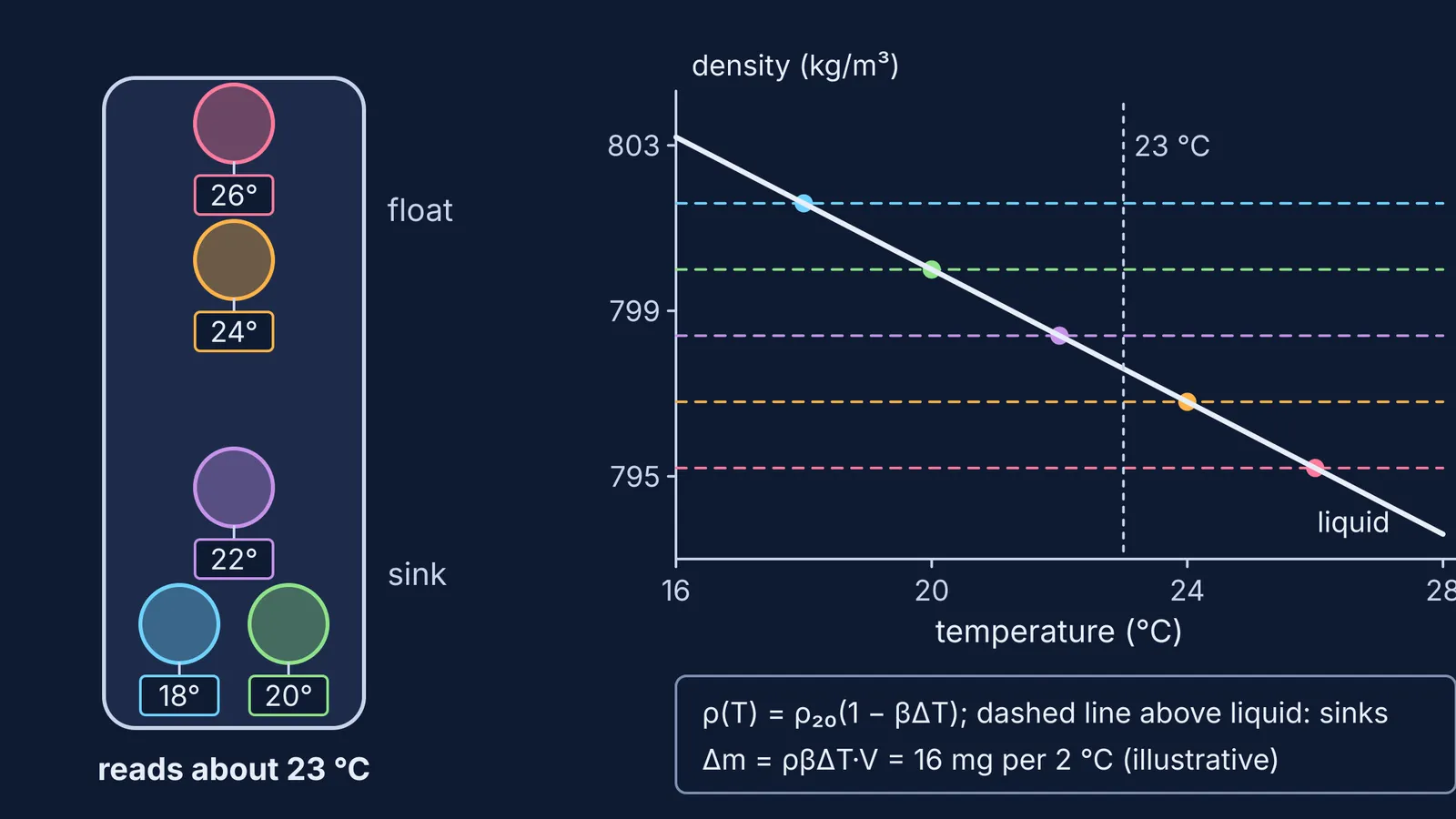
ρ(T) = ρ₂₀[1 − β(T − 20)]
where ρ₂₀ is the density at 20 °C and β is the coefficient of volume expansion. The maker trims each bulb so that its average density equals ρ(T) at the temperature printed on its tag. A bulb tagged 24 °C is a little lighter than one tagged 18 °C.
Why do the bulbs sink when it gets warmer?
Because warming makes the clear liquid less dense, so it gives less upthrust. A bulb that was just floating at 20 °C becomes slightly heavier than the liquid it displaces at 22 °C and drifts down. Rising temperature means more bulbs at the bottom, not more at the top. Many people guess the opposite, because a liquid thermometer's column rises when it is warm.
How much do neighbouring bulbs differ in mass?
Take an illustrative clear liquid with round values ρ₂₀ = 800 kg/m³ and β = 1.0 × 10⁻³ /K, and bulbs of volume 10 cm³ (1.0 × 10⁻⁵ m³). These are labelled illustrative values chosen to show the size of the effect, not the properties of any particular maker's liquid.
Density at each tag. ρ(T) = 800 × [1 − 0.001 × (T − 20)]. At 18, 20, 22, 24 and 26 °C this gives 801.6, 800.0, 798.4, 796.8 and 795.2 kg/m³.
Mass of each bulb. m = ρ(T) × V. The five bulbs must have masses 8.016, 8.000, 7.984, 7.968 and 7.952 g.
Step between neighbours. Δm = ρ₂₀βΔT × V = 800 × 0.001 × 2 × 1.0 × 10⁻⁵ kg = 1.6 × 10⁻⁵ kg, or 16 mg for bulbs 2 °C apart.
Reading at 23 °C. The liquid's density is 797.6 kg/m³. The 18, 20 and 22 °C bulbs are denser than this, so they sink. The 24 and 26 °C bulbs are less dense, so they float. The temperature lies between the highest tag that sank (22 °C) and the lowest tag that floats (24 °C).
Units check: (kg/m³) × (1/K) × K × m³ = kg. Each tag is a fixed mass difference of a few tens of milligrams, which is why the tags are small metal discs that can be trimmed.
Why are the bulbs so slow to move?
Look at the force on a bulb 1 K away from its balance temperature. The density difference is ρ₂₀β × 1 K = 0.8 kg/m³, so the net force is 0.8 × 1.0 × 10⁻⁵ × 9.8 = 7.8 × 10⁻⁵ N, or 0.078 mN. The bulb's weight is 8.0 × 10⁻³ × 9.8 = 78 mN. The net force is one-thousandth of the weight, and the bulb is moving through a viscous liquid, so it drifts slowly. The liquid itself also takes time to reach room temperature. The instrument reads in steps of one tag and lags behind quick changes.
Does the glass expanding spoil it?
Only slightly. The glass bulb also expands as it warms, so its average density falls too. For glass with a linear expansion coefficient of about 9 × 10⁻⁶ /K, the volume coefficient is about 3 × 9 × 10⁻⁶ = 2.7 × 10⁻⁵ /K, which is 2.7% of the liquid's β. So the liquid's density falls away from the bulb's a little more slowly, and the step between neighbours becomes 800 × (1.0 × 10⁻³ − 2.7 × 10⁻⁵) × 2 × 1.0 × 10⁻⁵ kg = 15.6 mg instead of 16 mg. This is the same idea as apparent expansion in a glass vessel, worked in real and apparent expansion of liquids.
Why would water be a poor liquid for it?
Three reasons, all from water's expansion data. From the density table in the NIST Chemistry WebBook, water at 1 atm is 998.406 kg/m³ at 19 °C and 997.993 kg/m³ at 21 °C, so β ≈ 2.07 × 10⁻⁴ /K at 20 °C.
Small steps. With water, bulbs 2 °C apart would differ by 998.2 × 2.07 × 10⁻⁴ × 2 × 1.0 × 10⁻⁵ kg = 4.1 mg instead of 16 mg. A trimming error of 1 mg would then be a temperature error of about 0.5 °C, against about 0.13 °C for the illustrative liquid.
Uneven steps. Water's β changes noticeably over the room-temperature range. The same NIST table gives about 2.5 × 10⁻⁴ /K near 24 °C, so the mass steps would not be equal.
The 4 °C anomaly. Water is densest near 4 °C. Below that, cooling makes it less dense, so the bulbs would behave the wrong way round.
If buoyancy and expansion questions still trip you up, the Concept Library explains Archimedes' principle and volume expansion one idea at a time.
Quick checklist
A bulb floats if its average density is below the clear liquid's.
Warming lowers the liquid's density, so bulbs sink as temperature rises.
Each bulb is trimmed to match ρ(T) at its tag: Δm = ρ₀βΔT × V.
Illustrative liquid (800 kg/m³, β = 10⁻³ /K, 10 cm³ bulbs): 16 mg per 2 °C.
Read between the highest sunk tag and the lowest floating tag.
Glass expansion is a small correction of a few percent.
Water's small, uneven β and its 4 °C anomaly make it a poor choice.