

On this page
In a letter dated 20 September 1638, Benedetto Castelli described an experiment Galileo had shown him more than 35 years earlier. It used "a glass flask the size of a small hen's egg with a neck around two palms in length and as thin as a barley-stalk" (Museo Galileo, Castelli's letter). Museo Galileo dates the instrument to 1597, following Galileo's early biographer Vincenzo Viviani, and notes that Santorio built a similar one in Venice in 1612 (Museo Galileo, Thermoscope). It also had a flaw: it responded to the weather as well as to warmth.
How did Galileo's thermoscope work?
The thermoscope was a bulb of air on a thin glass tube about 50 cm long, its open end standing in water (Marta Stefani, Museo Galileo). To set it up:
Warm the bulb in your hands, so the air inside expands.
Turn it upside down and dip the open end of the tube into the water.
Let go. As the air cools it contracts, and water climbs up the tube.
After that, warmer air expanded and pushed the water down; cooler air shrank and water rose (Stefani, Museo Galileo). Notice the direction: higher water meant colder.
It was a thermo-scope ("seeing heat"), not a thermo-meter: the same guide notes it showed changes but measured nothing.
Why did changing air pressure fool the thermoscope?
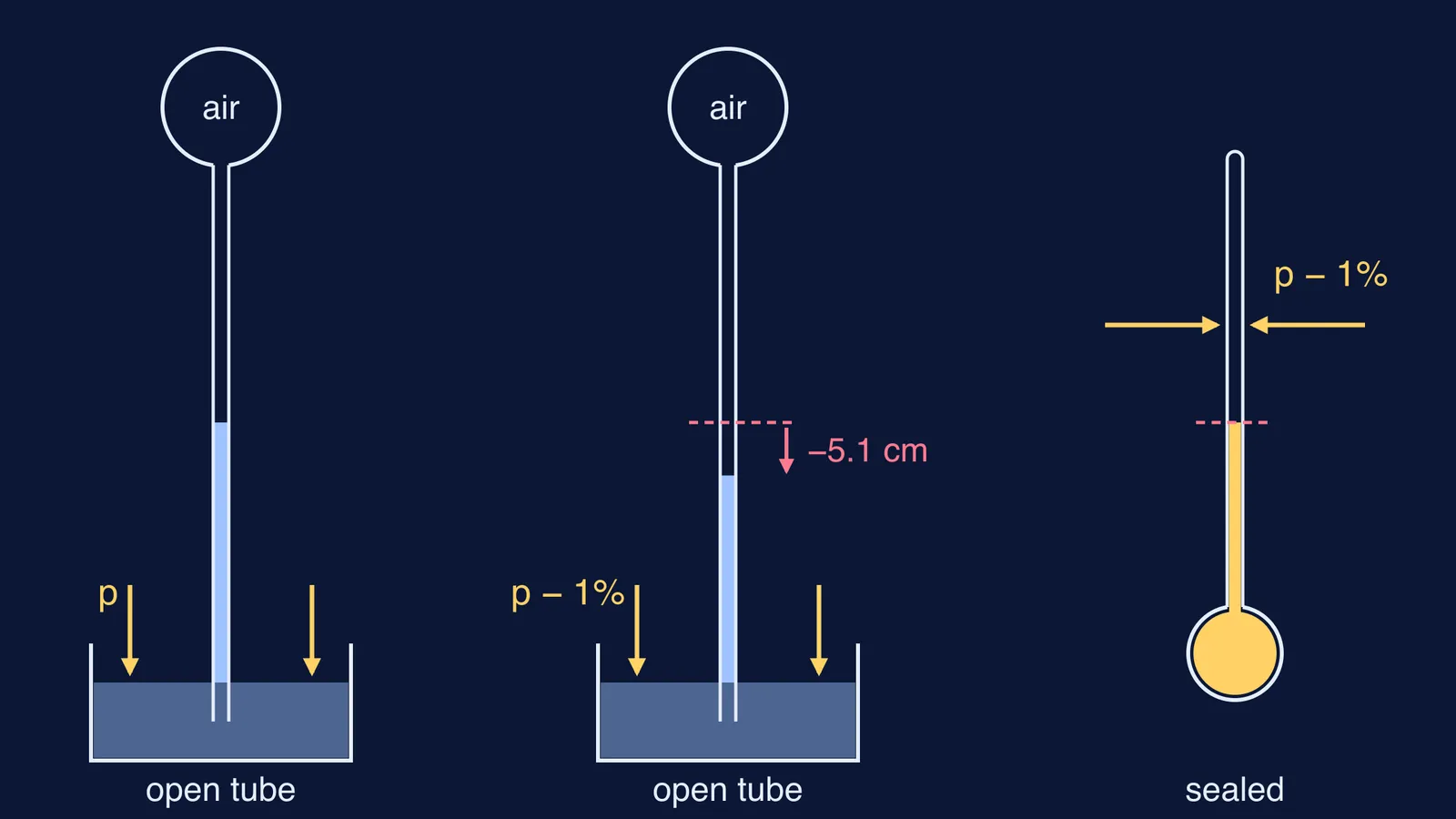
The trapped air pushes down on the column from above, while the atmosphere pushes on the open bowl. If either side changes, the water moves.
Early air thermometers "suffered from the disadvantage that they were also barometers, i.e. sensitive to air pressure" (Wikipedia, Thermometer). Torricelli's barometer experiments of 1644 showed that the weight of the air holds up a liquid column, and Museo Galileo says they opened new horizons to thermometry (Museo Galileo, Accademia del Cimento thermometers). For that story, read how Evangelista Torricelli built the first barometer.
Worked example: how big was the error?
The gas equation pV = nRT uses absolute temperature, counted from absolute zero in kelvin (NASA Glenn Research Center). So for trapped air, a 1% fall in outside pressure acts roughly like a 1% rise in absolute temperature.
A room at 20 °C is at about 293 K.
A low-pressure system arrives and pressure falls by 1%, about 10 mb from an average of roughly 1013 mb (Penn State METEO 101).
The trapped air expands as if it had warmed by 1% of 293 K, which is about 3 K.
The thermoscope says the room is 3 °C warmer, though nothing has changed.
Most sea-level pressures lie between 980 and 1040 mb (Penn State METEO 101). That 60 mb spread is about 6% of the average. On our estimate, the weather alone could move an open air thermoscope by roughly 17 °C.
How did sealed liquid thermometers fix the problem?
In about 1654, Ferdinando II de' Medici, Grand Duke of Tuscany, produced "the first modern-style thermometer, dependent on the expansion of a liquid and independent of air pressure" (Wikipedia, Thermometer). Museo Galileo credits him with inventing the fifty-degree thermometers in its collection, filled with acquarzente (Museo Galileo, Fifty-degree thermometers), the Accademia del Cimento's term for wine spirit, or alcohol (Museo Galileo, Acquarzente).
The Accademia del Cimento was active in Florence from 1657 to 1667 under Ferdinando and his brother Prince Leopoldo (Stefani, Museo Galileo), and published its experiments in a 1667 book, the Saggi di naturali esperienze. A University of Oklahoma Libraries exhibit says the Academy turned the thermoscope into a thermometer "by adding a graduated scale" and "by sealing the tube to make it independent of air pressure" (University of Oklahoma Libraries).
Sealing works because inside a closed tube the atmosphere has no liquid surface to push on; the rigid glass takes the load, so the level depends only on how much the liquid expands with heat. The glass itself matters too; see why a thermometer bulb has thin glass. Museo Galileo says their readings "were comparable with one another", and the academicians used them chiefly for weather observations (Museo Galileo, Fifty-degree thermometers).
What can you learn from the thermoscope's flaw?
The thermoscope obeyed physics perfectly; it just answered two questions at once. Before you trust a reading in a practical, ask:
What does the instrument actually respond to? (For the thermoscope: the volume of trapped air.)
What else changes that same thing? (Outside air pressure.)
Can you block the second cause, or measure and correct for it? (Seal the tube, or read a barometer.)
Try them on a Boyle's law air column: if the lab warms mid-experiment, the column grows for a reason other than the pressure you applied. For the pressure-temperature link that tripped up the thermoscope, see how Guillaume Amontons found pressure rises with temperature.
If the gas law still feels shaky, the Fermi Concept Library gives every physics and chemistry concept its own lesson. For ideas easier to see than to read, the Fermi Simulation Lab has interactive simulations.
Next time you read a thermometer, thank the seal at the top.


